

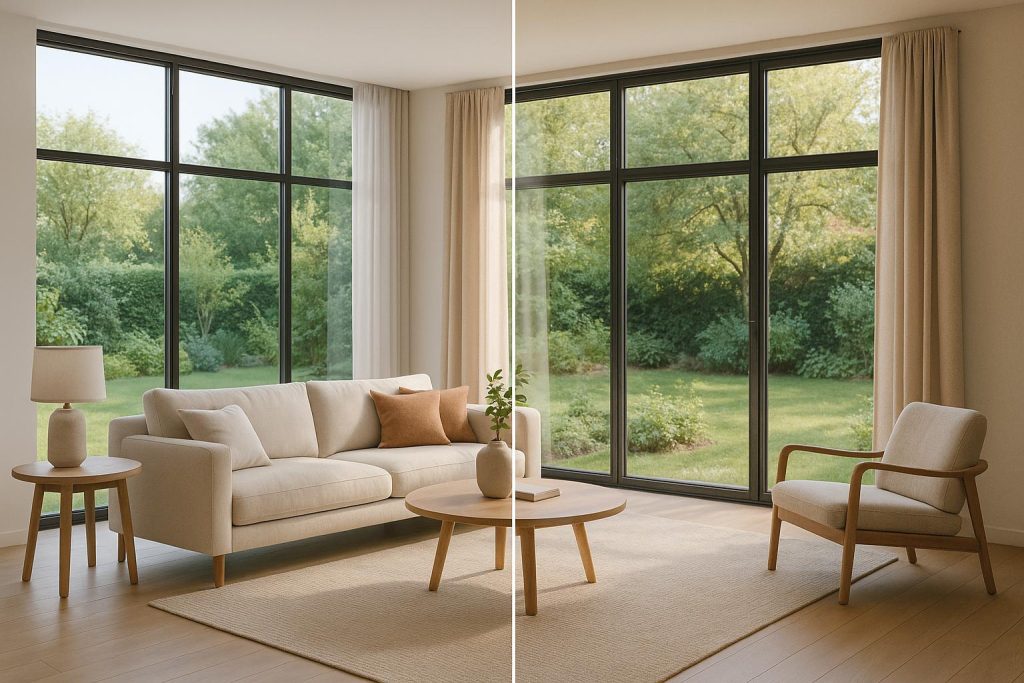
In real estate, visuals are everything. Buyers spend 60% of their time on listing photos and make decisions within 20 seconds of viewing a property online. Both 3D renders and photography play key roles, but each serves different purposes:
- 3D Renders: Ideal for showcasing unbuilt properties, renovations, or multiple design options. They offer full control over visuals, cost less over time, and attract remote buyers.
- Photography: Best for existing homes, providing a sense of reality and trust. It excels in highlighting actual textures, lighting, and staged interiors.
Quick Takeaway: Use 3D renders for pre-construction or renovation projects and photography for move-in-ready homes. Combining both creates a balanced strategy that appeals to a wide audience.
Quick Comparison
| Feature | 3D Renders | Photography |
|---|---|---|
| Initial Cost | Higher (software, training) | Lower (basic equipment) |
| Ongoing Costs | Lower (revisions, updates) | Higher (reshoots, logistics) |
| Customization | Unlimited design options | Requires physical changes |
| Best For | Pre-construction, renovations | Completed properties |
| Weather Impact | None | Weather-dependent |
Bottom Line: The most successful agents use both tools – renders to showcase potential and photos to build trust. Listings with high-quality visuals sell 30% faster and for 5-20% higher prices.
Render Like a Photographer
What Are 3D Renders: Features and Benefits
3D rendering is a digital technique that creates photorealistic images using computer software, allowing visuals to be generated from any angle and within any setting. In real estate, these lifelike images are especially powerful for showcasing properties under construction or not yet built. They let buyers visualize spaces as they would appear in real life, making them an impactful marketing tool. This approach offers a clear edge in real estate marketing by presenting properties in their best light.
Unlike traditional photography, which captures what already exists, 3D rendering highlights a property’s potential – making it invaluable for pre-sales. It creates realistic models of buildings, interiors, and landscapes, offering a chance to make virtual adjustments before any physical work begins. This can help avoid expensive mistakes and refine designs.
Benefits of 3D Renders
The capabilities of 3D rendering provide several advantages for marketing properties.
- Full Control Over Visuals: 3D rendering allows precise adjustments to every detail, from angles to lighting and backgrounds. Properties can be displayed in perfect lighting conditions, no matter the time of day or season.
- Cost Savings and Scalability: Once a 3D model is created, it can produce endless variations at a fraction of the cost of repeated photoshoots. This also enables quick edits and ensures consistent branding across multiple listings.
- Quick Turnaround: With 3D rendering, images can be created or modified almost instantly, cutting down on production times.
- Eco-Friendly Alternative: By removing the need for physical samples and resource-heavy photoshoots, 3D rendering reduces waste and environmental impact.
- Adaptable Designs: Agents can tailor visualizations to suit different buyer preferences. The same property can be shown with varying furniture styles, color schemes, or layouts to appeal to a broader audience.
- Boosted Perceived Value: A well-designed 3D visualization can increase a property’s perceived value by as much as 30%. Buyers can better imagine the space’s potential rather than relying on empty rooms or blueprints.
How 3D Renders Affect Buyer Engagement
3D renderings provide an immersive experience, offering virtual walkthroughs and tours that let buyers explore properties at their own pace, from anywhere in the world. This is especially valuable for remote or international buyers.
High-quality visuals create a strong emotional connection with potential buyers. Studies suggest that visual advertising can increase sales by up to 23%. Since people process images 60,000 times faster than text, 3D renders can instantly communicate a property’s appeal.
- Building Buyer Confidence: Detailed, high-quality renders reduce uncertainty by clearly showing a property’s potential, making buyers feel more secure in their decisions.
- Reaching Remote Buyers: For those unable to visit in person, 3D renders offer comprehensive visual details, expanding the buyer pool.
- Highlighting Renovation Opportunities: Properties needing updates can be marketed more effectively with 3D renders that illustrate what they could look like post-renovation. This shifts focus from current flaws to future possibilities.
Incorporating 3D renderings into marketing strategies helps properties stand out, generates more buyer interest, and can accelerate sales. These visuals not only make a property more appealing but also elevate the overall marketing campaign.
Photography: Strengths and Drawbacks
When discussing visual real estate marketing, it’s impossible to ignore the role of traditional photography. While 3D renders allow for visualizing unbuilt properties, photography captures the essence of existing spaces – their features, layout, and ambiance – helping buyers imagine themselves in real, visitable homes.
Photography continues to be a cornerstone of real estate marketing. In fact, 87% of homebuyers rely on listing images when browsing properties online. This visual connection is often the first step in grabbing a buyer’s attention in a crowded market.
Strengths of Photography
Photography has several undeniable advantages when it comes to showcasing existing properties. Professional photos not only boost online engagement but also contribute to quicker sales. The authentic representation of textures, natural lighting, and real-world details helps build trust and creates an emotional connection with potential buyers.
Another benefit? Photography highlights the effectiveness of professional staging. It brings together furniture, décor, and lighting to create inviting, aspirational spaces. On a practical level, photography is relatively quick to set up, allowing agents to list properties soon after staging is complete.
Limitations of Photography
Despite its strengths, photography has its share of challenges. Its biggest limitation is its reliance on physical reality. Unlike 3D renders, it can’t showcase unbuilt properties, demonstrate renovation potential, or market developments still under construction. Additionally, weather and lighting conditions can delay shoots or result in images that fail to capture a property’s appeal.
Changes to staging, color schemes, or layouts often require entirely new photoshoots, which can quickly become costly and time-consuming. Post-production editing is another hurdle – while some touch-ups are necessary, over-editing can lead to misrepresentation, raising ethical concerns.
Photography also struggles to convey the flow and spatial connections within a property. Its static nature means it can’t fully communicate how rooms interact or how a space feels in motion. Coordinating multiple shoots and managing logistics for physical staging adds another layer of complexity. Surprisingly, only about 15% of listings feature high-quality photography, leaving many agents facing practical hurdles to implementation.
These challenges highlight why many real estate professionals are turning to 3D renders as a complementary or alternative solution, which we’ll explore in the next section.
sbb-itb-e3e39b4
3D Renders vs Photography: Direct Comparison
This section breaks down the key differences between 3D renders and photography in real estate marketing. The choice between the two depends on your project’s specific needs. Below, we’ve outlined a table and some insights to help clarify these differences.
Comparison Table: 3D Renders vs Photography
Here’s a side-by-side look at how these two methods stack up across important factors:
| Feature | 3D Renders | Traditional Photography |
|---|---|---|
| Initial Cost | Higher (software, hardware, training) | Lower (camera, basic equipment) |
| Ongoing Costs | Lower (software updates, minor revisions) | Higher (studio rental, photographer fees, reshoots) |
| Visual Control | Full control over lighting, angles, staging | Limited by physical conditions and setup |
| Customization | Unlimited design options and finishes | Requires physical changes and reshoots |
| Property Stage | Ideal for pre-construction or renovations | Best for completed, existing properties |
| Time Efficiency | Faster modifications after setup | Time-consuming for each variation |
| Scalability | High – multiple images from one model | Low – new photoshoot needed for variations |
| Authenticity | Photorealistic but digitally created | Captures genuine textures and details |
| Weather Dependency | No weather constraints | Dependent on natural lighting and weather |
Key Insights
Research shows that 3D renders often drive more engagement and inquiries compared to traditional photography, especially among younger audiences. Younger buyers tend to respond well to 3D and augmented reality visualizations, while older generations lean toward the clarity and realism of traditional photos.
In terms of cost efficiency, 3D rendering can be a game-changer. Over three years, companies using 3D report a 30% higher ROI on visual content compared to photography. For example, a Dubai developer managed to sell 70% of units off-plan using hyper-realistic 3D tours, reducing marketing costs by 60% compared to maintaining physical showrooms.
"3D rendering flips this model on its head. After the initial modeling investment, generating new images is virtually free. No reshoots for minor tweaks, no travel expenses, and no waiting for perfect weather conditions." – 7CGl
3D renders shine when it comes to customization. They allow for highly realistic textures, lighting, and decor while offering the flexibility to present multiple design options and finishes. This makes them particularly useful for properties still under construction or undergoing renovation.
On the other hand, photography excels in capturing the real-world details and textures that build trust with potential buyers. Its authenticity provides a tangible connection to the property, which can be crucial for buyers who value seeing the actual space.
When to Use Each Method
The choice between 3D renders and photography depends on your project’s stage, audience, and goals.
- Go with 3D renders if you’re marketing pre-construction properties, showcasing multiple design options, or emphasizing renovation potential. They’re also ideal for luxury developments where aspirational, polished visuals are a priority. Additionally, 3D renders can include surrounding environments like landscapes or neighboring properties, offering a complete view of the property’s context.
- Stick with traditional photography for existing homes, especially when authenticity and trust are critical. Photography is particularly effective for resale properties, where buyers want to see the actual condition and feel of the space. This is especially true for audiences that prefer tangible, real-world visuals.
- Factor in your timeline and budget. For quick turnarounds with completed properties, photography might be the better choice. But for long-term campaigns or scenarios requiring multiple variations, 3D rendering offers unmatched scalability and cost-effectiveness.
Many top real estate professionals blend both methods. 3D renders allow for tailored, engaging visualizations that can attract specific audiences, while traditional photography provides the credibility needed to close the deal. Combining these approaches ensures your marketing strategy is versatile and effective.
"Real photos capture what exists. But what about the projects still in the making – the homes not yet built, the spaces still on the drawing board? That’s where 3D rendering changes the game. It lets you sell the dream before it’s real, craft the perfect presentation, and win clients with visuals that leave no room for doubt." – Houston3DRenderings.com
Practical Tips for Real Estate Professionals
Using 3D renders and photography effectively can set you apart in the competitive real estate world. Each has its strengths, and combining them strategically can create a lasting impression on potential buyers.
Combining 3D Renders and Photography
Pairing 3D renders with traditional photography allows you to craft a compelling "before and after" story. While photography captures the current state of a property – its layout, features, and condition – 3D renders highlight its potential. For example, one real estate agent successfully marketed a 1970s home by showcasing photos of its existing structure alongside 3D renders of a modernized kitchen and updated exterior. This approach not only drew attention but also resulted in multiple offers.
For pre-construction projects, this method is equally impactful. A developer pre-selling condos used detailed 3D interior renderings based on architectural plans, paired with drone footage of the construction site. This combination gave buyers a clear vision of the future development, leading to early interest and pre-sales.
To make this approach effective, consistency is key. Ensure photo-matching by aligning lighting, angles, and color tones across all visuals. Here’s how you can apply this:
- Use photography to highlight a property’s current charm and 3D renders to showcase renovation possibilities. Tailor these visuals to suit your audience’s preferences.
- Clearly label virtual elements to manage expectations and build trust with buyers.
These strategies not only enhance your marketing efforts but also make your listings stand out in a crowded market.
Improving Visual Appeal with Property Render
A mix of high-quality photos and polished 3D renders can elevate your property’s presentation while building credibility with potential buyers.
Property Render, a service catering to developers and marketers in over 15 countries, specializes in creating visual stories for undeveloped spaces. Their offerings include everything from conceptual designs to detailed marketing visuals for apartments, townhouses, and commercial properties. These tools help bring properties to life and leave a lasting impression.
Realism is crucial when creating 3D renders. High-quality textures, precise lighting, and attention to detail make all the difference. The right composition and framing can guide the viewer’s eye and increase engagement. For lighting, photometric techniques provide accurate, natural illumination, while color choices – such as warm tones for family homes or cool palettes for city condos – can evoke the right emotional response.
Details matter, too. Texture mapping, including subtle elements like reflectivity and imperfections, adds authenticity. Avoid overused effects like heavy filters or lens flares, as they can detract from a natural look. Every render should tell a story that resonates with your audience, whether it’s showcasing a home’s connection to nature through large windows or emphasizing spaces for socializing and entertaining.
Consistency is another critical factor. A cohesive style and branding across all visuals not only enhances recognition but also builds trust. Property Render offers two main options: Standard Renders for essential visuals and Premium Renders for high-end, photorealistic imagery. Investing in quality 3D renders is a smart move that can significantly boost your marketing success.
"Real estate 3D rendering gives homebuyers the convenience of viewing properties remotely. For realtors, it provides a powerful marketing asset to promote listings to more buyers."
– dignuzdesign.com
Regularly test your renders and seek feedback to refine your visual strategy and ensure it resonates with your target audience.
Conclusion: Choosing the Right Visual Tools for Real Estate Success
The data speaks for itself: combining 3D rendering with traditional photography creates a winning formula in real estate. Properties featuring 3D visuals see 40% more engagement, sell 30% faster, and 3D-staged homes command 5-20% higher prices compared to unstaged ones.
The best results come from using both tools. While 3D renders showcase a property’s potential, photography captures its authentic charm. Together, they create a balanced approach – one that highlights possibilities while building trust with buyers. As buyer preferences continue to evolve, understanding how to use these tools effectively is key.
The shift in the real estate market is undeniable. In urban areas, 79% of listings now feature virtual tours or 3D elements. For international buyers, these tools are even more critical, with 52% relying solely on virtual tours for cross-border purchases. These technologies have moved from being optional to being expected.
To sum it up: Luxury properties and new developments gain the most from 3D renders, while move-in-ready homes thrive with high-quality photography. The most successful agents combine both, using photography to document reality and 3D renders to present possibilities.
Investing in top-notch visuals isn’t just a nice-to-have – it’s essential. With 87% of buyers considering visuals a crucial part of their decision-making process, a strong visual strategy can mean the difference between a quick, full-price sale and a property that sits unsold. By pairing the real with the potential, you can meet the needs of a diverse and increasingly tech-savvy audience.
FAQs
How can real estate agents use both 3D renders and traditional photography to enhance their marketing strategies?
Real estate agents can effectively combine 3D renders with traditional photography to create a dynamic marketing strategy that resonates with buyers at various stages of their journey.
3D renders are especially useful for properties still in development or at the planning stage. These visuals allow agents to showcase detailed and tailored designs, helping potential buyers envision the possibilities and future potential of the space. Meanwhile, traditional photography excels in highlighting the authentic character and real-world appeal of completed properties, giving buyers a clear and tangible sense of the environment.
By pairing 3D renders to illustrate a property’s vision with traditional photography to display the finished result, agents can craft a compelling narrative that captures attention and builds interest. This balanced approach effectively combines imagination with reality, broadening the appeal and reaching a wider audience.
How do 3D renders benefit international or remote real estate buyers?
3D renders provide a game-changing solution for international or remote buyers, letting them explore properties virtually from anywhere. This means no more pricey, time-consuming travel – just a more convenient and straightforward buying experience.
Thanks to their detailed and immersive visuals, 3D renders give buyers a crystal-clear view of a property’s layout, design, and features. This helps them make quicker, well-informed decisions. Plus, showcasing properties through 3D renders opens the door to a global audience, boosting the chances of connecting with the perfect buyer, no matter where they are.
When is traditional photography better than 3D renders for real estate marketing?
Traditional photography often shines when it’s crucial to present the real, unaltered look of a property. For instance, when marketing fully constructed homes or capturing the genuine atmosphere of a space, photographs offer a sense of authenticity that tends to resonate with buyers.
This approach is especially effective for showcasing unique architectural features or intricate textures that might be difficult to replicate with 3D renders. Plus, if time is of the essence, photography can be a faster option since it typically requires less preparation than producing high-quality 3D visuals. By emphasizing the property’s natural charm, traditional photography helps foster trust and create a more personal connection with potential buyers.


