


3D rendering is now a game-changer for real estate developers in 2025. Here’s why:
- Buyers demand immersive visuals: Static photos and floor plans no longer meet expectations. 96% of buyers start their search online, preferring 3D tours, virtual walkthroughs, and interactive tools.
- Faster sales: Properties with 3D renders sell 20% faster, with 87% more views and 40% more inquiries.
- Cost savings: Virtual staging and design testing reduce the need for physical models and expensive adjustments.
- Pre-construction sales: Developers can sell units before breaking ground by showcasing photorealistic renders.
- Global reach: 3D tours attract out-of-state and international buyers, erasing geographic barriers.
Developers who integrate 3D rendering into their marketing strategies can meet buyer expectations, reduce costs, and accelerate sales.
3D Marketing Video Rendering for Real Estate Development Portwood
How 3D Renders Increase Buyer Interest and Speed Up Sales
3D rendering creates immersive experiences that can significantly influence buyer interest and decision-making. By helping potential buyers visualize themselves in a space, this technology removes traditional barriers, leading to faster sales cycles and stronger engagement between developers and buyers.
Using Virtual Walkthroughs to Connect with Buyers
Virtual walkthroughs have transformed the way buyers explore properties. Instead of relying on static images and their own imagination, buyers can now "walk" through rooms, examine every detail, and grasp the property’s scale and layout firsthand. This immersive experience fosters a deeper emotional connection, making it easier for buyers to envision themselves in the space.
The numbers back this up: 54% of buyers now skip in-person tours until they’ve viewed a 3D virtual tour. This shows how essential these tools have become in the decision-making process.
Virtual staging adds another layer to the experience. Empty spaces are brought to life, showing buyers how a bare living room can become a welcoming family area or how an empty bedroom can transform into a serene retreat. These visualizations turn casual interest into serious intent, helping buyers see the property’s potential clearly.
Beyond the emotional connection, virtual walkthroughs also provide practical benefits. Buyers can explore details like sightlines and room flow, giving them the confidence they need to move forward. This approach doesn’t just engage local buyers – it opens the door to a much larger audience.
Marketing to Out-of-State and International Buyers
3D tours have also erased the limitations of geography, making it easier than ever to market properties to remote buyers. Listings with 3D tours attract 87% more views and generate 49% more qualified leads. For developers, this means they can reach a broader audience without the logistical challenges of hosting multiple in-person showings.
Take a developer in Miami, for instance. They can now market properties to buyers in New York, California, or even overseas with ease. This is especially impactful for pre-construction projects, where photorealistic 3D renderings allow buyers to assess properties confidently, even before they’re built.
Helping Buyers Make Decisions Faster
Speed is critical in real estate, and 3D-rendered previews are a game-changer when it comes to accelerating decision-making. By providing an accurate representation of the final product, these visuals reduce uncertainty and help buyers feel more confident in their choices.
With fewer doubts about room sizes, natural lighting, or layout, buyers can focus on whether the property meets their personal and lifestyle needs. This clarity has a direct impact on sales: homes with virtual tours sell 10% faster. Faster sales cycles mean lower carrying costs for developers and quicker capital turnover, allowing them to move on to new projects sooner.
3D rendering also addresses common buyer questions before they arise, streamlining the entire process. The result? Shorter sales cycles, higher conversion rates, and a smoother experience for everyone involved. In fact, the virtual tour real estate market, valued at $340 million in 2022, is projected to exceed $1.2 billion by 2032. This growth highlights a major shift in how properties are marketed and sold, driven by the power of immersive, digital experiences.
Main Benefits of 3D Rendering for Real Estate Developers
3D rendering offers real estate developers more than just eye-catching visuals – it delivers practical solutions to common challenges and creates opportunities to boost growth and profitability.
Selling Properties Before They Are Built
One of the most impactful uses of 3D rendering is in pre-construction sales. Developers can present projects that haven’t broken ground yet, giving potential buyers the confidence to commit early. With photorealistic 3D renders, developers can showcase a property’s potential, easing buyer concerns and building excitement.
Take, for instance, the 16-story building designed by Katerra Inc. in Bellevue, Washington. By leveraging 3D visualization, the project team was able to secure commitments and funding before construction began. Buyers could even customize layouts and interiors virtually, adding a personal touch to their future homes.
3D renderings also play a critical role in securing financing. Lenders and investors gain a clear understanding of the project, including how it will integrate into its surroundings. This early confidence doesn’t just streamline funding; it also leads to cost savings, as detailed below.
Saving Money with Virtual Design Testing
The ability to test designs virtually can lead to massive financial savings. With 3D rendering, developers can explore multiple design options before construction begins, avoiding costly changes later. For example, reconfiguring a kitchen layout after framing could cost tens of thousands of dollars, but these adjustments can be made virtually for a fraction of the price.
The cost of 3D interior renderings starts at around $500, with more elaborate designs reaching $5,000 or more. These high-quality visuals help developers spot and correct potential issues early, reducing expensive mistakes during the build phase. In fact, 83% of businesses report a positive ROI from 3D rendering videos, thanks to both cost savings and improved sales effectiveness.
By addressing design concerns before construction, developers not only save money but also build buyer confidence, ensuring smoother project execution.
Creating Targeted Marketing for Different Buyer Types
3D rendering isn’t just about faster sales or cost savings – it’s also a powerful tool for crafting tailored marketing strategies. Developers can use it to create visuals that resonate with specific buyer groups.
"Effective marketing knows its audience, and 3D architectural visualisation is no different." – RealRender3D
For instance, luxury developments can be rendered with features like marble countertops, custom millwork, and high-end appliances under perfect lighting to appeal to premium buyers. Meanwhile, family-focused properties can highlight practical elements like open floor plans, playrooms, and safe outdoor spaces. These customized visuals help potential buyers picture themselves living in the space, turning abstract concepts into emotional connections.
3D rendering also helps developers reframe potential drawbacks as unique selling points, demonstrating how every inch of space can be utilized effectively. Across various marketing platforms, ads with emotional appeal have been shown to increase sales by 23% compared to standard ads. This ability to connect with buyers on a personal level adds another layer of value to the core benefits of 3D rendering, enhancing both sales and cost efficiency for real estate developers.
3D Rendering Tools and Services for Developers
As we look ahead to 2025, the demand for top-notch 3D visualization in real estate marketing is stronger than ever. Developers need more than just visual content – they need partners who understand how to present properties in a way that resonates with buyers. That’s where Property Render shines, offering tailored services and local expertise that elevate project presentations and help speed up sales. Let’s dive into what makes their services stand out.
Property Render‘s Services and Features
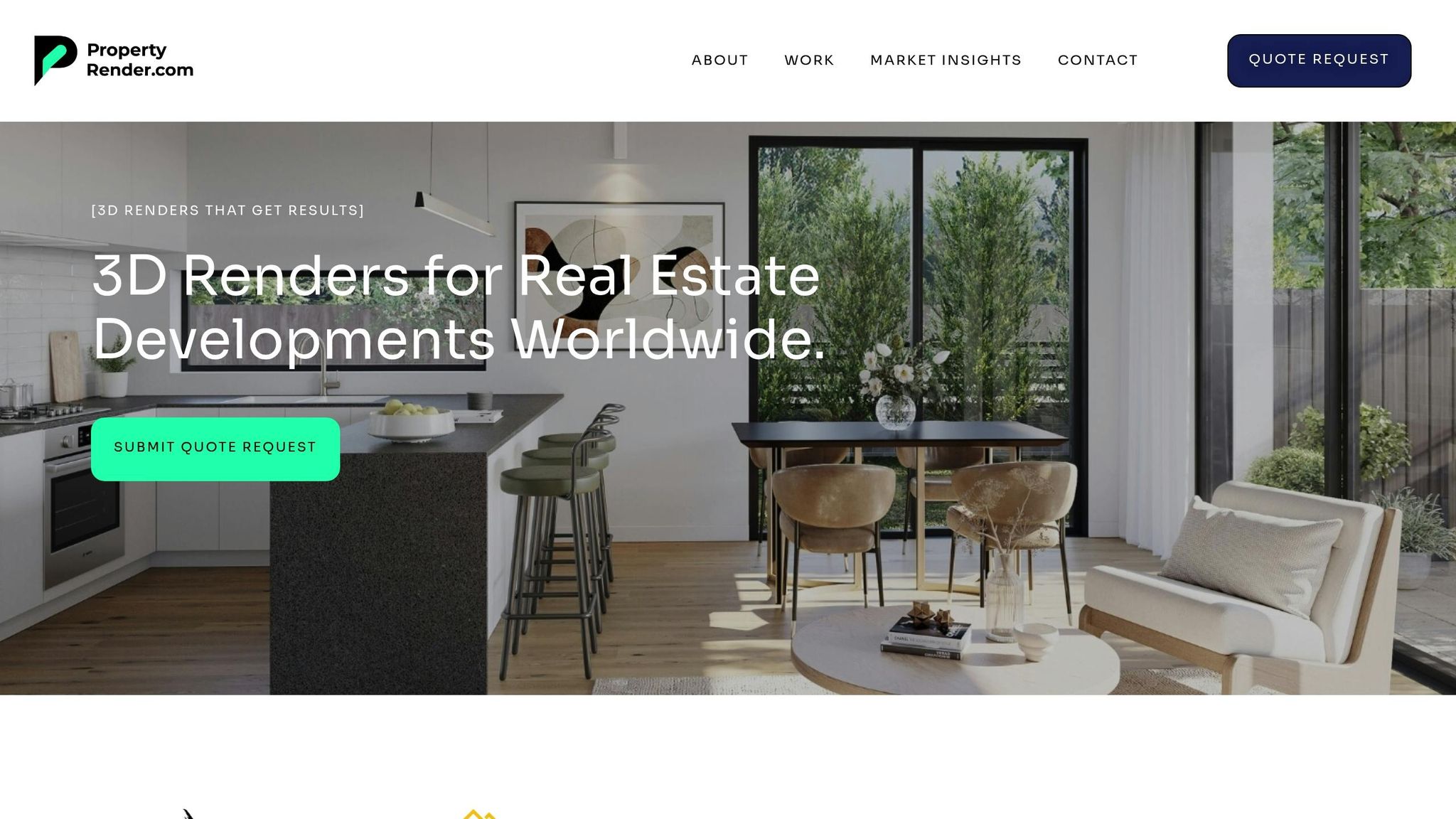
Property Render specializes in 3D architectural visualization, designed with real estate professionals in mind. Their portfolio includes lifelike interior and exterior renders, enabling developers to showcase projects long before construction begins. These visuals not only bring designs to life but also help potential buyers feel more confident about their investments.
Their offerings go beyond standard renders. Aerial views and streetscapes provide context by showing how a property fits into its surroundings. For developers focused on layouts, they create detailed site plans and floor plan renders that clearly communicate the flow of a space. Want to immerse buyers further? Their virtual walkthroughs and CORE Virtual Realty Tours let potential clients explore properties remotely, offering a realistic, interactive experience.
Property Render also offers integrated marketing packages, combining various visualization types into cohesive campaigns across digital and print platforms. For commercial developers, their photomontages and commercial renders are ideal for showcasing office buildings, retail spaces, and mixed-use developments. Altogether, their services cover nearly every aspect of real estate visualization.
How Property Render Serves U.S. Developers
What sets Property Render apart is how well they cater to the U.S. market. They use imperial measurements, ensuring room dimensions and property specs align with American standards, which reduces misunderstandings during the sales process.
Their visualizations are also tailored to match regional design preferences. Whether it’s a sleek, modern home on the West Coast or a classic New England-style property, they incorporate realistic lighting and environmental effects to reflect the property’s true setting. This attention to detail helps buyers visualize how the property will look and feel in real life.
To make collaboration even easier, Property Render uses cloud-powered platforms for real-time rendering, allowing teams to work together seamlessly – even from different locations.
From concept development to final marketing materials, Property Render acts as a full-service visualization partner. Their deep understanding of U.S. real estate markets, combined with cutting-edge 3D rendering expertise, makes them an invaluable ally for developers aiming to stand out in 2025’s competitive real estate scene.
sbb-itb-e3e39b4
2025 Trends and Strategies in Real Estate Visualization
The real estate visualization world is evolving at a fast pace, and developers who want to stay ahead must understand the forces shaping this change. New technologies are redefining how properties are marketed, setting fresh standards for effectiveness. Let’s dive into the trends and strategies making waves in 2025.
Advances in 3D Visualization Technology
Real-time rendering has completely changed the game. Unlike traditional rendering, which could take hours, real-time systems generate images instantly. This means developers can make adjustments during client meetings – like tweaking lighting, materials, or layouts – without delays. Since 2023, the adoption of real-time rendering has grown by 10%.
Artificial intelligence (AI) is now a key player in creating 3D visuals. Nearly half (46%) of architecture firms already incorporate AI into their workflows. AI handles tedious tasks like material selection and lighting, allowing designers to focus on creativity. Projects using generative AI for early visualization have seen a 37% drop in design revision cycles and a 28% boost in client satisfaction. Looking ahead, 74% of professionals plan to increase their use of AI in the next year, with 86% believing it will shape the future of architecture.
Virtual and augmented reality (VR/AR) have moved beyond experimentation. Digital twins paired with AR headsets now allow real-time collaboration in mixed-reality environments.
Cloud collaboration is another game-changer. Teams, including architects, engineers, visualizers, and clients, can now work on the same model simultaneously, no matter where they are. This shift has made project coordination smoother and more efficient.
Sustainability visualization is gaining traction as environmental concerns grow. Visualization tools now incorporate features to analyze CO₂ emissions, solar radiation, and energy efficiency, helping teams design with sustainability in mind.
These advancements are setting the stage for more effective multi-channel marketing strategies in real estate.
3D Renders Across Marketing Channels
Developers are using 3D renders across various marketing platforms to maximize their reach. Social media is a prime example, with visuals tailored for Instagram and TikTok to grab attention in crowded feeds.
Websites remain a cornerstone of real estate marketing. Listings with 3D tours see 87% more views and 95% more inquiries than those without. Properties featuring AR or VR content can see user interactions increase by up to 300%. Developers are also embedding 3D models directly into websites using tools like WebGL or Three.js, creating seamless browsing experiences.
Virtual staging and tours have proven highly effective. Virtually staged properties sell up to 73% faster than empty ones. Virtual tours function like 24/7 open houses, attracting up to 50% more inquiries.
Video marketing takes 3D renders to the next level. Listings with video content receive four times as many inquiries as those without. Developers are using 3D-rendered animations in videos to highlight architectural details and showcase properties from multiple perspectives.
International reach is another advantage. Virtual open houses eliminate geographic barriers, making it easier for international buyers to explore properties. Nearly 90% of marketers report increased sales when using location-based strategies.
These digital strategies consistently outperform traditional marketing methods in every measurable way.
Comparing Traditional Marketing to 3D Render Marketing
| Aspect | Traditional Marketing | 3D Render Marketing |
|---|---|---|
| Buyer Engagement | Passive photo and brochure viewing | Interactive VR tours increase engagement time by up to 40% |
| Property Access | Requires in-person visits | 24/7 virtual access from anywhere in the world |
| Staging Costs | Physical staging for every property | Virtual staging at a lower cost |
| Sales Timeline | Standard market pace | Properties sell 20% faster with virtual tours |
| Customization | Fixed presentations | Buyers can modify furniture, colors, and layouts in real time |
| Pre-construction Sales | Limited to static floor plans and renderings | Immersive experiences of unbuilt properties |
The contrast is clear. Traditional marketing relies on static, passive methods, while 3D render marketing offers dynamic, interactive experiences. Virtual reality, in particular, allows buyers to "step inside" properties, creating a deeper connection.
"Virtual reality offers the possibility to virtually visit a lot more homes in a lot less time. This will naturally increase sales efficiency, as well as allow the ability to see more potential buyers." – Abbasi, Forbes
Cost efficiency is another big win for 3D render marketing. Traditional methods require ongoing expenses for physical staging, photography, and printed materials. In contrast, 3D renders can be created once and reused across multiple platforms, saving time and money while driving better results.
Time savings benefit everyone involved. Virtual tours help pre-qualify buyers, reducing the need for in-person visits. Buyers can explore multiple properties online before choosing which ones to see in person, streamlining the entire process.
This shift is reshaping real estate marketing. Developers who embrace 3D render strategies are positioning themselves to attract more buyers, drive higher engagement, and close deals faster in 2025’s competitive market.
Why Developers Must Use 3D Renders in 2025
In 2025, 3D rendering has become an essential tool for real estate developers. The industry has evolved, and those who don’t incorporate this technology risk being left behind. What was once a luxury is now a necessity for staying relevant and competitive in today’s fast-paced market.
The Impact of 3D Rendering
The numbers don’t lie – 3D rendering is transforming how properties are sold. Properties that feature virtual tours or 3D renderings sell 20% faster than those using traditional methods, according to a survey by the National Association of Realtors. Faster sales cycles mean developers can improve cash flow and reduce the costs associated with holding unsold properties.
But it’s not just about speed. Listings with 3D renderings or virtual tours generate up to 40% more inquiries and receive 87% more views compared to conventional listings. Even more compelling, developers report a 30% increase in conversion rates when using 3D renders versus static images. These statistics highlight a major shift in how buyers interact with and ultimately choose properties.
Beyond buyer engagement, 3D rendering offers cost savings. Traditional staging and photography require repeated investments, but 3D renders are created once and can be used across multiple platforms. This approach not only reduces costs but also allows for a broader reach and more dynamic marketing materials.
Another game-changer is the ability to sell properties before construction even begins. With 3D rendering, developers can showcase digital representations of properties, giving buyers the confidence to commit to purchases even before a project is completed. This opens up new revenue opportunities and reduces the financial risks tied to pre-construction sales.
And let’s not overlook the emotional connection. As Architectural Rendering Services puts it:
"3D house rendering isn’t just a design tool – it’s a powerful storytelling device that helps buyers feel, explore, and connect with properties on a deeper level".
This deeper connection often leads to quicker decisions and higher sales volumes, making 3D rendering a critical tool for success.
How Developers Can Get Started
The advantages of 3D rendering demand immediate attention. Start by evaluating your properties to determine which features would benefit most from this technology. Highlight unique design elements and showcase them with high-quality renderings.
Focus on high-impact areas by integrating 3D renders early in your marketing strategy. Use them to attract pre-sale buyers and emphasize key features like materials, finishes, and layout. Combine interior and exterior views for a comprehensive presentation, and share these visuals widely on social media to maximize reach and engagement.
Track your results to measure the effectiveness of your efforts. Monitor metrics like inquiry rates, conversion percentages, and sales timelines. This data will help you refine your strategy and ensure you’re getting the most out of your investment.
If creating professional-quality renders feels overwhelming, consider partnering with experts. Companies like Property Render specialize in 3D architectural visualization, offering services that range from detailed renders to virtual walkthroughs and full marketing packages. By outsourcing this work, developers can focus on their projects while ensuring top-tier visuals that drive results.
The real estate market is undergoing a visual revolution. Developers who embrace 3D rendering will not only stay competitive but also gain a clear edge in engaging buyers, speeding up sales, and enhancing marketing efforts in 2025. The time to act is now.
FAQs
How can 3D rendering help real estate developers sell properties before they are built?
The Power of 3D Rendering in Real Estate
3D rendering gives real estate developers a powerful tool to showcase properties with lifelike detail – even before construction begins. Buyers can explore the design, layout, and features of a property visually, helping them grasp the space and imagine what it would be like to live there. This kind of immersive experience not only fosters trust but also creates an emotional connection, making buyers more inclined to commit early.
Beyond just visual appeal, 3D renders emphasize important property details, such as materials, finishes, and even the surrounding environment. These realistic previews can play a big role in boosting pre-sales by providing potential buyers with a clear picture of the final product. For developers, this means attracting serious buyers and locking in commitments long before the project is completed.
How does the cost of 3D renders compare to traditional staging and marketing methods?
3D renders offer a much more budget-friendly alternative compared to traditional staging methods. For instance, while traditional staging packages can run anywhere from $400 to $600, virtual staging using 3D renders typically costs just $20 to $100 per image – a fraction of the price.
On top of that, 3D renders cut out the need for physical furniture, transportation, and labor, slashing additional expenses. This means real estate developers can save money while still presenting properties in a visually appealing and engaging way to attract potential buyers.
How can real estate developers use 3D renders to attract international buyers and close deals faster?
Real estate developers can use 3D renders to showcase properties in a way that grabs the attention of international buyers. These photorealistic visuals offer a clear and detailed view of properties, breaking through language and cultural differences. Buyers can explore homes remotely, getting a feel for the space without ever setting foot on-site. This immersive experience helps build trust and confidence in their investment.
Adding tools like virtual reality (VR) and augmented reality (AR) takes things to the next level. These technologies allow developers to offer interactive walkthroughs and dynamic perspectives, making it easier for buyers to picture themselves in the property. Plus, high-quality 3D visuals emphasize important architectural elements and design features, helping properties stand out in an increasingly crowded global market.
By using these approaches, developers can engage buyers more effectively, ease their concerns, and speed up the decision-making process – leading to quicker and smoother sales.


