


High-quality 3D renderings can help properties sell 20–25% faster, with luxury listings generating 45% more inquiries. From photorealistic visuals that immerse buyers in unbuilt spaces to minimalist designs that highlight architectural form, each style serves a specific purpose. Whether you’re marketing luxury homes, off-plan developments, or commercial projects, choosing the right rendering style can boost engagement, reduce time on the market, and even increase perceived property value by 12–18%.
Key CGI Rendering Styles:
- Photorealistic: Highly detailed, lifelike visuals for luxury homes and off-plan sales.
- Minimalist: Clean, simplified designs for modern spaces and early-stage concepts.
- Luxury: Emotionally driven visuals showcasing premium finishes and aspirational lifestyles.
- Conceptual: Abstract visuals for early design approval and planning.
- Stylized: Artistic renderings that evoke mood and creativity.
- Real-Time: Interactive walkthroughs powered by advanced game engines.
- Cinematic: Dramatic lighting and storytelling for hero shots.
- Interior-Focused: Detailed room layouts with lived-in touches.
- Exterior: Curb appeal and landscaping visuals.
- Aerial: Bird’s-eye views of large developments and surroundings.
- Streetscape: Street-level views showcasing neighborhood integration.
- Site Plan: Overhead layouts for planning and marketing.
- Virtual Walkthroughs: Immersive, interactive tours for remote buyers.
- Photomontage: Blending real photography with CGI for realistic integration.
- Nighttime: Atmospheric visuals highlighting lighting design.
- Seasonal: Scenes that showcase properties in different weather conditions.
- Lifestyle: Emotional storytelling through lived-in details.
- Commercial: Functional visuals for offices, retail, and mixed-use spaces.
- Floor Plan: 3D layouts for clear spatial understanding.
- BIM-Integrated: Data-driven renderings for precision and sustainability.
Quick Comparison Table
| Style | Best For | Key Benefit | Turnaround Time |
|---|---|---|---|
| Photorealistic | Luxury, off-plan | Realistic visuals boosting engagement | 7–14 days |
| Minimalist | Modern, early-stage concepts | Highlights form and structure | 7–14 days |
| Luxury | High-end, aspirational properties | Emotional connection | 7–14 days |
| Real-Time | Interactive walkthroughs | Instant feedback for buyers | 2–4 weeks |
| Cinematic | Hero shots, storytelling | Dramatic lighting for emotional impact | 3–4 weeks |
CGI renderings are not just visuals – they’re a tool to drive faster sales, stronger engagement, and higher property value. Let’s dive into the top styles and how they can transform your marketing strategy.
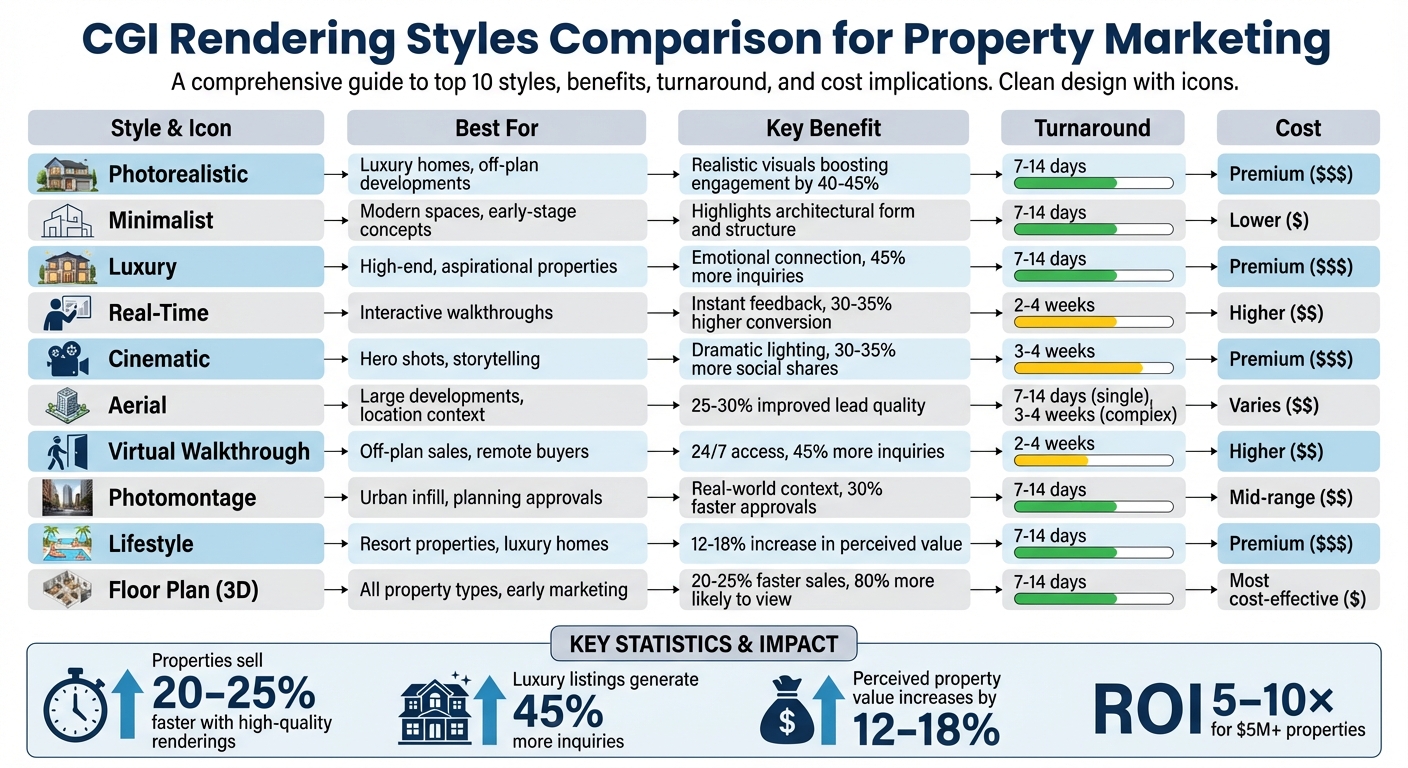
CGI Rendering Styles Comparison: Best Use Cases, Benefits & Turnaround Times
1 Project and 6 Different Visualization Styles in Architecture
1. Photorealistic Rendering
Photorealistic rendering brings unbuilt properties to life by replicating real-world materials, lighting, and environments with incredible precision. Using advanced techniques like ray tracing and physically based shading, it simulates how light interacts with surfaces. This creates soft shadows, accurate reflections, and textures that make images look more like photographs than digital graphics. This approach is highly effective for showcasing properties and is worth diving into for its visual and marketing advantages.
Visual Impact and Realism
What sets photorealistic rendering apart is its attention to subtle details. By including imperfections – like puddles, scattered leaves, light fog, or even rain – it avoids the overly polished look of typical digital renders. Adding to the realism, human-eye-level camera angles, especially from building corners, help viewers feel immersed in the scene. This sense of presence can increase website visit durations by 40–45%, which is a clear win for engagement.
Suitability for Specific Property Types
This rendering style isn’t just visually impressive – it’s versatile. Luxury residential properties, for example, benefit greatly from photorealistic renders because high-end buyers are drawn to the emotional appeal these visuals create. For off-plan developments, photorealistic imagery transforms abstract blueprints into vivid, engaging visuals. It’s also a go-to choice for commercial projects, like skyscrapers or shopping centers, where it helps illustrate how large structures fit into their urban surroundings.
Marketing Effectiveness for Target Demographics
Photorealistic visuals don’t just look good – they perform exceptionally well in marketing. Properties that use these premium visuals receive more inquiries and sell faster compared to those relying on basic imagery. Adding lifestyle elements, like showing spaces being lived in, can boost perceived value by 12–18%. In the hospitality sector, these dynamic visuals generate buzz for hotels and restaurants even before they open, driving social media engagement and early bookings. The key is balance: atmospheric, dramatic renders work best for signature "hero" spaces, while material-focused visuals highlight custom high-end details for maximum impact.
Cost-Effectiveness and Production Time
While photorealistic rendering costs 30–40% more than standard 3D imagery, the investment pays off. For a $5 million property, these premium visuals can deliver returns 5–10 times their cost by reducing carrying expenses and increasing final sale prices. Production timelines vary – standard interior or exterior views typically take 7–14 days, while larger multi-unit projects may require 3–4 weeks. By testing layouts and materials digitally before construction, developers can avoid costly revisions down the line. Providing a well-prepared brief, including CAD files, material samples, and mood boards, further streamlines the process. These efficiencies not only save time but also give properties a competitive edge in the market.
2. Minimalist Rendering
Minimalist rendering strips away excess detail to emphasize the architecture itself. By simplifying textures, materials, and lighting, this approach brings attention to a building’s structure and form. Often presented as a "White Model" or a monochromatic base with selective color accents, it creates a clean, polished look that highlights key features. Unlike photorealistic visuals, which aim to replicate real-world complexity, minimalism focuses on showcasing the purity of architectural design.
Visual Impact and Realism
Photorealistic rendering strives to mimic reality, but minimalist rendering takes a different path. It prioritizes clarity and simplicity, using even tones and clean lines to reveal spatial relationships without unnecessary distractions. This approach keeps the focus on the essential elements of the design. Alexander Grabalyuk from Cylind explains it well:
"Soft and minimal rendering doesn’t distract with unnecessary detail or give a false impression of completion. It keeps the viewer’s attention on the core – the architectural idea."
Best Fit for Certain Properties
Minimalist rendering works particularly well with modern designs that emphasize bold lines and the interplay of light and shadow. It’s especially effective for showcasing smaller spaces, where its clean aesthetic can highlight subtle details without overwhelming the viewer. During the early stages of design, this style is ideal for communicating spatial relationships and volumes before finalizing material choices. A popular trend involves presenting exterior spaces in grayscale, focusing on form and lighting rather than vibrant colors.
Marketing Appeal and Efficiency
This style resonates with a niche audience of sophisticated buyers, including art collectors and design enthusiasts, who appreciate architectural purity. Judy Abello from Panoram CGI notes:
"This style speaks to sophisticated buyers who appreciate architectural integrity and design clarity. For clients who are art collectors or design aficionados, these renderings signal that the architecture itself is the primary artwork."
Minimalist rendering also offers practical benefits. It’s faster and less expensive to produce compared to high-fidelity photorealistic renders, which can significantly reduce project timelines and costs. By focusing on geometry and massing without committing to specific materials, this method minimizes costly revisions and streamlines the design process. It’s a smart choice for early-stage concepts, balancing visual clarity with efficient production to keep projects moving forward.
3. Luxury Rendering
Luxury rendering goes beyond simply replicating reality or embracing minimalist aesthetics. Instead, it transforms spaces into aspirational experiences that resonate emotionally. By using cinematic lighting and creating a distinctive atmosphere, it shifts the focus from how a space looks to how it feels to live there. As Judy Abello from Panoram CGI explains:
"Luxury home buyers typically buy based on emotion first, then justify with logic."
This approach builds on the precision of photorealistic rendering and the clarity of minimalist designs, adding aspirational elements that elevate the story a property tells.
Visual Impact and Realism
Luxury rendering thrives on attention to detail and material quality. It highlights premium finishes with dramatic lighting and incorporates high-end furnishings, curated art, and even luxury vehicles to paint a complete lifestyle picture. Features like day-to-night transitions take this a step further, showcasing how a property evolves under different lighting conditions – offering two distinct experiences in one visualization.
Perfect Match for High-End Properties
This emotionally charged style is particularly suited for signature architectural properties, resort-like developments with lavish amenities (think pools and wine cellars), and custom homes featuring rare materials. For properties nestled in natural settings, luxury rendering can seamlessly integrate the environment to highlight architectural harmony. High-rise condos, for instance, benefit from aerial perspectives and evening ambiance, emphasizing location, breathtaking views, and lifestyle appeal. Such thoughtful environmental integration has been shown to boost property values by 15–25%.
Impact on Marketing and Affluent Buyers
The numbers reveal the effectiveness of premium visualizations. Luxury properties with these renderings see 45% more initial inquiries and sell 20–25% faster compared to those with basic imagery. Contextual lifestyle visuals can enhance perceived property value by 12–18%, while premium renderings often lead to a 4–7% bump in final sale prices. For a $5 million property, this translates to a 5–10× return on investment, making it a powerful tool for appealing to high-net-worth buyers.
Efficiency and Results
Luxury rendering doesn’t just create emotional appeal – it delivers measurable results. Properties with these atmospheric visuals enjoy 40–45% longer website engagement and see sales cycles reduced by 20–25%. These benefits underscore the value of investing in this style for marketing high-end real estate.
4. Conceptual Rendering
Conceptual rendering leans on abstraction to convey the core ideas behind an architectural design. Think of it as a visual sketchpad – using clay-like models, sketch-style imagery, or simple monochromatic visuals to focus on form, light, and spatial relationships, rather than diving into material specifics. It serves as a bridge between early design ideas and the detailed visualizations that come later in a project.
Visual Impact and Realism
Instead of prioritizing intricate textures or advanced lighting, this style highlights the essentials: volume, structure, and spatial logic. Techniques like white model renders, watercolor-inspired effects, and sketch-style illustrations showcase a design’s evolution while keeping the focus on its broader vision.
Ideal Applications for Specific Properties
This style shines when used for properties with bold architectural elements, renovations where layouts are still being refined, or modern and contemporary designs where the structure itself takes center stage. It’s also a go-to choice for planning submissions, as it illustrates how a building’s massing blends into its surroundings without locking in final material decisions. For projects where the form is the star, muted and monochromatic visuals communicate design intent effectively without overloading on details. Like other rendering methods, conceptual rendering plays a strategic role, offering a clear picture of a property’s essence before moving on to more polished presentations.
Appeal to Target Audiences
With its minimalist and abstract presentation, conceptual rendering appeals to visionary buyers and investors who are more interested in the big picture than the finer details. Its simplicity facilitates early decision-making and fosters collaboration. As Zach Jaffe from Landtech Consultants Inc. explains:
"Digitalization can reduce project cost and duration by 30–50%, and double returns".
This approach not only helps clarify design intent but also reduces the need for revisions, making it particularly effective for community engagement and early stakeholder discussions. Its abstract nature encourages input and collaboration, making it a powerful tool during the initial phases of a project.
Efficiency and Affordability
One of the biggest advantages of conceptual rendering is its speed and affordability. By skipping detailed textures and complex lighting setups, this style is quicker and less expensive to produce compared to photorealistic renderings. This makes it a perfect fit for projects with tight timelines or those requiring frequent design iterations. It’s an efficient way to explore ideas early on without committing significant resources, offering flexibility and adaptability during the creative process.
5. Stylized Rendering
Stylized rendering focuses on capturing mood and emotion rather than sticking to strict technical accuracy. This method employs artistic techniques – like watercolor effects, pencil textures, sketch lines, or collage elements – to craft a narrative about a space. Instead of meticulously documenting every detail, it invites viewers to imagine life within the space. It’s less about the materials and finishes and more about the feeling. Stylized rendering, much like other approaches we’ve discussed, turns architectural visuals into storytelling tools. Its artistic flair pairs well with the technical precision of other rendering styles.
Visual Impact and Realism
Using techniques such as watercolor washes, marker-style illustrations, or "Oil on Canvas" effects, stylized rendering adds a human touch and warmth that pure realism often lacks. For modern high-end properties, a “White Model” approach with selective pops of color highlights architectural form and conveys sophistication – perfect for buyers who see the building as a piece of art. Unlike minimalist rendering, which removes distractions, stylized rendering introduces intentional textures to create a specific atmosphere. Whether it’s the hand-crafted feel of a historical renovation or the dynamic energy of a contemporary design, this style brings a unique emotional layer to architectural visuals.
Perfect Fit for Certain Property Types
Stylized rendering shines when the narrative is as important as the structure itself. Early-stage developments often benefit from this approach, as it communicates vision and emotional resonance rather than just technical plans. It’s ideal for projects like historical restorations, cultural spaces, and luxury properties with standout architectural details. For modern designs that showcase bold structural elements, monochromatic or clay-style renders work well to keep the focus on form and spatial flow.
Resonating with Target Audiences
This rendering style is especially effective for engaging communities because its approachable, unfinished look invites collaboration and feedback. For art collectors or design-savvy buyers, it signals that they’re seeing something special – something far from ordinary. Stylized visuals help clients who lack architectural expertise grasp the bigger picture more easily than technical drawings ever could. With the rise of AI tools, creating multiple versions of these visuals is now faster than ever. Designers can switch from photorealistic to watercolor styles in seconds to cater to different audience preferences.
Balancing Costs and Time
By skipping intricate textures and complex lighting setups, stylized rendering offers quicker turnaround times and reduced costs. This makes it a practical choice for design competitions, initial client presentations, or projects requiring frequent revisions. AI-powered tools further simplify the process, eliminating the need for manual adjustments with every new version. This approach delivers professional-quality results while keeping both deadlines and budgets in check. For projects with tight timelines or limited resources, stylized rendering offers a creative and efficient solution.
6. Real-Time Rendering
Real-time rendering leverages advanced game-engine technology, such as Unreal Engine, Enscape, or Twinmotion, to create interactive 3D environments that clients can explore as if they were physically present in a virtual building. Unlike traditional static images, this approach allows users to move freely through spaces, instantly tweak materials, and see design changes happen in real time during live presentations. The technology delivers lifelike lighting, shadows, and reflections, making these virtual environments feel strikingly realistic. When paired with VR headsets, it takes things a step further by transforming architectural visualization into a fully immersive experience, where stakeholders can interact with designs using avatars and simulation data. This level of interactivity opens the door to dynamic client presentations, which can be further explored in marketing applications.
Visual Impact and Realism
Real-time rendering engines provide a level of visual quality that rivals traditional photorealistic methods. The key difference lies in how they work: real-time engines rapidly convert geometry into pixels, offering immediate feedback during design reviews, while traditional rendering relies on ray tracing for ultra-detailed light calculations. While real-time rendering prioritizes speed and flexibility over absolute precision, this trade-off makes it perfect for client meetings and design discussions where instant feedback is more valuable than flawless detail. VR-powered presentations using real-time rendering can shorten the design feedback cycle by as much as 40%, and adopting these tools can reduce project costs and timelines by 30–50%.
Ideal Applications for Different Properties
Real-time rendering shines when applied to large-scale or mixed-use developments, where it helps stakeholders grasp complex site layouts, circulation patterns, and the relationships between structures without relying on technical drawings. High-rise towers benefit from immersive flythroughs that highlight panoramic views and nearby infrastructure. For properties offering customizable interiors, real-time tools allow clients to personalize finishes, rearrange furniture, and experiment with lighting during sales presentations. The global 3D rendering market, valued at $4.21 billion in 2024, is expected to grow to $19.82 billion by 2033, with a projected annual growth rate of 19.2%. These capabilities not only clarify design concepts but also significantly boost a property’s appeal to a wide range of buyers.
Marketing Advantages for Specific Audiences
For remote buyers, interactive 360° tours provide a deeper sense of connection than static visuals ever could. Marketing teams report that immersive visualizations can increase client conversion rates by 30–35%. Daniel Sundlin, Partner at BIG, highlights the future potential:
"Soon, we’ll move toward a much more seamless process – where you don’t just walk through models, but interact with them through avatars, using simulation data to test ideas in real time".
This collaborative, interactive approach helps non-design stakeholders, like investors and community boards, make faster and more informed decisions.
Economic Benefits and Faster Turnaround
In addition to improving design workflows, real-time rendering offers clear financial advantages. Tools like Enscape and Twinmotion are ideal for quick architectural iterations, while Unreal Engine excels at producing high-end, interactive marketing experiences. The integration of AI and machine learning is cutting rendering times by up to 50%, enabling faster exploration of design variations. Interactive walkthroughs in sales centers help off-plan buyers visualize their future homes more effectively, speeding up decision-making and improving conversion rates.
7. Cinematic Rendering
Cinematic rendering takes property marketing to the next level by creating an emotional connection with potential buyers. By incorporating cinematic lighting techniques like the golden hour or blue hour, it evokes feelings that resonate deeply. This method uses volumetric light, atmospheric effects like mist or haze, and intentional focus to highlight key architectural elements, drawing viewers’ attention exactly where it’s needed. It blends technical precision with the art of storytelling.
As Judy Abello from Panoram CGI explains:
"When potential buyers can feel the warmth of sunset coming through floor-to-ceiling windows or the peaceful feeling of a misty morning on a waterfront property, they’re already mentally moving in".
Visual Impact and Realism
Cinematic rendering doesn’t just showcase a property – it tells a story about the lifestyle it offers. By emphasizing emotional cues, this approach enriches the viewer’s experience through meticulous visual details. For example, advanced texturing ensures materials like Italian marble or custom bronze interact naturally with dramatic, mood-enhancing lighting. Techniques such as staged lighting and post-production color grading add depth and drama to the visuals. This emotional storytelling is particularly effective for luxury buyers, who often rely on feelings rather than logic when making decisions.
Ideal Applications for Cinematic Rendering
Cinematic techniques shine when used to depict properties that inspire awe. They are particularly suited for:
- Signature architectural designs with unique, eye-catching forms.
- High-end luxury homes designed with specific lighting conditions in mind.
- Properties set in breathtaking natural environments, such as oceanfront estates or mountain retreats.
By showcasing properties in their best light, cinematic visuals can significantly boost perceived value. Properties that harmonize with their surroundings often see price increases of 15–25% when marketed with these visuals.
Reaching the Right Audience
Luxury properties presented with cinematic rendering enjoy tangible marketing benefits. Listings featuring these visuals attract 45% more initial inquiries and sell 20–25% faster than those using standard imagery. Visitors spend 40–45% more time on websites with atmospheric renders, and these “hero” images perform exceptionally well on platforms like social media, where they generate 30–35% higher sharing rates.
Costs and Production Timelines
The sophistication of cinematic rendering comes with higher costs – about 30–40% more than standard high-quality renders. While standard renders take around 7–14 days to produce, more complex cinematic scenes for large-scale developments may require 3–4 weeks. Despite the upfront investment, this style pays off in the luxury market by reducing time on the market and boosting perceived property value by 12–18%.
8. Interior-Focused Rendering
Building on the idea of emotional and contextual marketing discussed earlier, interior-focused rendering transforms empty spaces into inviting, ready-to-live-in homes. By showcasing detailed layouts, carefully chosen furnishings, and realistic lighting, this approach gives buyers a chance to truly feel what it would be like to live in the space.
Visual Impact and Realism
The real power of interior rendering lies in its ability to evoke emotions through meticulous attention to detail. Techniques borrowed from cinematography – like golden hour lighting, soft light diffusion, and well-placed shadows – create a sense of atmosphere that resonates with viewers. For ultra-luxury properties, hyperrealistic rendering takes things even further by highlighting microscopic details, enhancing the realism of materials like wood grains or fabric textures.
What sets truly effective interior renders apart from basic visualizations are the small, lived-in details – things like a casually draped blanket or a steaming cup of coffee on the counter. These elements add a sense of presence and warmth. Virtual staging takes this concept to the next level by digitally furnishing empty rooms, offering a cost-effective alternative to traditional staging while still making the property feel stylish and functional.
Suitability for Specific Property Types
Interior rendering isn’t one-size-fits-all; its effectiveness depends on the type of property being marketed.
- Luxury and high-end homes use dramatic lighting and material-focused techniques to highlight premium finishes like Italian marble or custom bronze fixtures, reinforcing their high price tags through an emotional connection.
- Off-plan residential developments rely heavily on these renderings to bring blueprints to life, helping buyers imagine their future homes before construction even begins.
- Small apartments benefit from minimalist styles, where clean lines and simple shapes make compact spaces feel larger and more open.
- Resort properties or amenity-rich homes shine with lifestyle-focused renderings, showcasing spaces like entertainment areas or home theaters that help buyers picture their ideal lifestyle.
Marketing Effectiveness for Target Demographics
The stats back up the power of interior-focused renderings. Properties with premium interior visualizations see 45% more inquiries compared to those using basic imagery. High-quality renderings can also speed up sales by 20–25%, while visualizations that show a space in use can increase perceived value by 12–18%. One particularly effective technique is day-to-night transition renders, which highlight how a space transforms from bright and airy during the day to cozy and inviting at night. This approach has been shown to improve client conversion rates by 30–35%.
For high-end homes priced at $5 million or more, investing in premium interior renderings often pays off significantly – yielding returns 5–10 times higher than the initial cost through reduced carrying expenses and higher sale prices. However, understanding your target audience is key. For example, Millennials may prefer modern, minimalist aesthetics, while Baby Boomers might gravitate toward more traditional styles.
Cost-Effectiveness and Production Time
Interior rendering offers a budget-friendly alternative to physical staging or building model homes, while also allowing developers to refine designs early in the process. On average, creating a professional interior 3D rendering takes 7–14 days, with larger projects like multi-unit developments requiring 3–4 weeks. Pricing starts at about $200 per image, with premium renderings costing 30–40% more.
Modern tools like Enscape, Lumion, and Twinmotion streamline the process by enabling instant visualization of changes to lighting or materials, speeding up both design and feedback. Additionally, AI-powered software can quickly generate multiple stylistic variations, cutting down on time spent reworking scenes manually. To keep costs under control and avoid unnecessary revisions, it’s crucial to provide complete CAD files, material details, and specific view angles at the start of the project. This streamlined approach ensures a smooth transition into exterior rendering techniques.
9. Exterior Rendering
Interior renderings help buyers envision life inside a home, but exterior rendering takes it a step further by bringing the outside to life. It showcases a property’s curb appeal, how it fits into the neighborhood, and even its overall street presence. By turning blueprints into vivid visuals, exterior renderings highlight facade details, landscaping, and lighting, creating a complete visual story that pairs perfectly with interior renderings.
Visual Impact and Realism
A well-executed exterior rendering focuses on creating a sense of realism and atmosphere. Using cinematic lighting and lifelike textures, it replicates natural conditions like the golden hour or twilight. Materials such as brick, timber, and cladding are rendered with precision, while landscaping is brought to life with fine details like mist or soft light diffusion. These elements work together to evoke emotion and set the tone, much like in interior or cinematic renderings.
"Good CGI for property developers brings a space to life before there’s even a shovel in the ground. You can feel it, imagine yourself in it, and, if you’re selling, it starts to look like real money on the table." – Valerie Adams, ArchiCGI
The production approach varies depending on the scale of the building. For low-rise homes, the focus is on blending the property with its surroundings. Mid-rise buildings emphasize streetscape and shared spaces, while high-rises highlight urban integration and sweeping views.
Tailored for Different Property Types
Exterior renderings cater to various property types, offering unique benefits for each:
- Luxury homes: By adding elements like luxury cars or outdoor entertaining spaces, these renderings can increase perceived value by 12–18%.
- Off-plan developments: Transforming blueprints into realistic visuals helps speed up buyer decisions, even before construction begins.
- Commercial and industrial projects: Renderings demonstrate large-scale structures’ integration into urban areas, aiding investor pitches and planning approvals.
- Multi-unit communities: Aerial and streetscape views illustrate infrastructure, amenities, and green spaces, showcasing how the development connects with its environment. Properties with a strong connection to nature often command 15–25% higher prices.
Boosting Marketing Results
The impact of premium exterior renderings on marketing is clear. Luxury properties with high-quality exterior visuals see 45% more inquiries and sell 20–25% faster compared to those with standard imagery. Day-to-night transition renders, which highlight a property under different lighting conditions, improve client conversion rates by 30–35%. Aerial renders, which provide a sense of location and proximity to amenities, enhance lead quality by 25–30%.
For high-end properties, the return on investment is impressive. For example, a $5 million property can see a 5–10x return on rendering costs through faster sales and reduced carrying expenses. Additionally, premium visuals can increase the final sale price by an average of 4–7%.
Cost and Production Efficiency
Creating a single exterior view typically takes 7–14 days, while larger projects may require 3–4 weeks. Costs depend on the building’s complexity and the level of landscaping detail. On average, premium luxury renderings cost 30–40% more than standard ones. To streamline production and control costs, it’s crucial to provide complete CAD files, material specifications, landscape plans, and desired view angles upfront. This preparation minimizes revisions and ensures the final product meets expectations.
Modern tools like Unreal Engine are also changing the game, enabling real-time visualization and interactive exploration of property exteriors. These tools not only speed up feedback cycles but also make the process more collaborative.
Exterior renderings lay the groundwork for showcasing architectural style and boosting market appeal, setting the stage for even more compelling visual strategies.
10. Aerial Rendering
Aerial renderings take exterior visualizations to the next level by offering a bird’s-eye view of a property and its surroundings. This perspective provides a broader context, showing how a building integrates into its neighborhood, highlights nearby amenities, and conveys the project’s overall scale. It’s especially useful for large-scale developments where understanding the environment is just as important as the design itself.
"No building is an island… Every building exists in context. Buildings come together to form neighborhoods, and then cities." – Monolot Studio
Visual Impact and Realism
Creating realistic aerial renderings requires meticulous attention to detail, especially when capturing the unique characteristics of a specific location. For example, the soft, pale sunlight of Norway is vastly different from the bright, intense rays in Dubai. These subtle differences can make or break the realism of a rendering. To achieve this level of authenticity, many studios start with high-resolution drone footage – either 4K or 8K – and blend it with 3D models to root the visualization in real-world context.
There are two main approaches to aerial rendering. Photographic aerials involve inserting 3D models into actual drone footage. This method is quicker and more budget-friendly. On the other hand, full 3D aerials offer complete creative control, allowing for precise adjustments to lighting, weather conditions, and seasonal effects like mist or clouds. However, this approach demands significantly more time and expertise from skilled artists.
Tailored Benefits for Different Property Types
Aerial renderings shine in showcasing various property types, each in its own way. High-rise buildings, for instance, use these views to highlight their impact on the city skyline and to emphasize breathtaking panoramic views. For multi-unit communities, aerial perspectives can demonstrate shared infrastructure and the relationships between buildings across a sprawling site. Luxury waterfront properties benefit by showcasing exclusive features like private docks, proximity to beaches, and scenic views that aren’t visible from ground level.
Mixed-use developments also gain from aerial views, as they help stakeholders visualize complex layouts, circulation patterns, and zoning connections. Similarly, commercial properties can illustrate practical details like access routes and parking facilities, while suburban housing developments use aerials to highlight plot sizes, privacy zones, and nearby schools or parks.
Marketing Effectiveness for Different Audiences
Aerial renderings don’t just look impressive – they also drive results. They can improve lead quality by 25–30%, as potential buyers arrive with a clear understanding of a property’s location and its advantages. These visualizations resonate with a variety of audiences. Families, for instance, are drawn to images that highlight playgrounds and schools, while urban professionals connect with nighttime views that showcase a city’s energy. Luxury buyers, meanwhile, are captivated by renderings that emphasize exclusivity and privacy.
Beyond their emotional impact, aerial renderings have practical applications too. They can support shadow analysis, demonstrate traffic flow for regulatory approvals, and even help properties that integrate well into their surroundings command 15–25% higher prices than those that don’t.
Costs and Production Timelines
The cost of aerial renderings depends largely on the method used. Full 3D aerials are more expensive than photographic composites because they require detailed modeling of terrain, vegetation, and surrounding infrastructure. For large-scale projects, production can take 3–4 weeks, while single-view renders are typically completed within 7–14 days. Factors like building complexity, landscaping details, and the number of required view angles all influence the final cost. To keep things efficient and avoid costly revisions, it’s crucial to decide on camera angles early in the process.
sbb-itb-e3e39b4
11. Streetscape Rendering
Streetscape rendering focuses on showcasing a building from street level, highlighting how it blends into its surrounding neighborhood. Unlike aerial views that emphasize the overall layout and scale, this type of rendering zeroes in on curb appeal and the pedestrian experience. It places the property in its real-world setting, complete with nearby buildings, street features, and people. Alexander Grabalyuk, Founding Partner and Art Director at CYLIND, captures this idea perfectly:
"Exterior visualization transforms raw geometry into a dialogue with the city, exposing scale, rhythm, and material truth long before ground is broken".
By honing in on the human perspective, streetscape rendering builds upon traditional exterior visualization techniques.
Visual Impact and Realism
Using a three-quarter street-level angle can highlight dual facades, adding depth to the image. For buildings with intricate architectural details – like decorative brickwork or unique window designs – a straight-on street-level view can emphasize symmetry and craftsmanship more effectively.
Modern streetscape renderings go beyond just the building itself. They incorporate details like greenery, pedestrians, realistic lighting, and subtle weathering to create a sense of authenticity. These details help ground the property in its urban environment, complementing other visualizations by making the design feel more connected to everyday life.
Best Use Cases for Streetscape Rendering
Streetscape rendering is particularly useful for:
- Residential properties, such as townhouses, gated communities, and apartment complexes.
- Commercial developments in urban areas, where integration with the existing streetscape is crucial to maintaining neighborhood character.
- Planning submissions, where authorities assess how a new design will impact its surroundings.
As ArchiCGI explains:
"Street-scene composite CGIs and view-specific photomontages often make the difference in how planning committees perceive a design."
Boosting Marketing Appeal
Streetscape renderings are powerful tools for marketing, helping to attract more inquiries and speed up sales. Contextual visuals that show the property in use can increase perceived value by 12–18% compared to renders of empty spaces. They allow off-plan buyers to envision the property’s curb appeal early on. By illustrating the "atmosphere of the community" and the lifestyle it supports, streetscape renderings create emotional connections that technical drawings simply can’t replicate.
Efficiency and Production Time
The time required to produce a streetscape rendering depends on the complexity of the project. Standard views typically take 7–14 days, whereas more intricate, multi-unit developments may require 3–4 weeks. To streamline production and minimize revisions, it’s important to provide CAD files, material specifications (like brick or timber), and landscape plans early in the process. For planning applications, photomontage techniques – where 3D models are overlaid onto real site photography – offer the most realistic representation of how a property integrates into its surroundings.
12. Site Plan Rendering
Site plan rendering turns flat, 2D blueprints into dynamic, bird’s-eye 3D visuals, offering a clear view of a development’s layout, landscaping, and surroundings. This overhead perspective simplifies understanding for investors, buyers, and planning committees, eliminating the need to interpret complex technical drawings. As Zach Jaffe from Landtech Consultants Inc. puts it:
"Digitalization can reduce project cost and duration by 30–50%, and double returns."
By combining visual appeal with clarity, these renderings make the spatial organization of a project easier to grasp.
Visual Impact and Realism
Modern site plan renderings go beyond basic visuals, incorporating detailed landscaping elements like trees, driveways, parking areas, and pools to create a lifelike representation. Developers often use photomontage – blending CGI with drone photography – to add authentic context, showing how the project integrates into its surroundings. This method is particularly valuable for planning submissions, where authorities need to see how a development fits into the existing neighborhood.
Tailored for Different Property Types
Site plan renderings are especially effective for residential communities, commercial complexes, and luxury estates. For high-end properties, these visuals emphasize features like privacy, boundary details, and proximity to premium amenities such as golf courses or beaches. They’re also crucial for challenging lots, including irregularly shaped parcels, sloped terrains, or dense urban sites. Renderings for such scenarios can help identify clearance issues and setback challenges before construction begins.
Marketing Advantages for Target Audiences
Aerial site renderings can improve lead quality by 25–30%. For developers and investors, these visuals provide a clear breakdown of project phases, parking layouts, and amenity placement. Properties that showcase seamless integration with their surroundings often command 15–25% higher prices than those lacking such detailed visualization. Luxury properties, in particular, benefit significantly from premium renderings, attracting 45% more initial inquiries and selling 20–25% faster than those using basic imagery.
Production Time and Cost Considerations
Standard site plan renderings typically take 7–14 days to produce, while more intricate multi-unit projects may require 3–4 weeks. Costs depend on factors like landscaping complexity, the variety of building types, and the level of detail needed for surrounding infrastructure. To streamline the process, developers should provide CAD drawings, landscape plans, and pavement specifications upfront. The investment is worthwhile – 3D renderings can speed up project approval timelines by up to 30%.
13. Virtual Walkthrough Rendering
Expanding on the real-time rendering techniques mentioned earlier, virtual walkthroughs transform static blueprints into immersive, interactive experiences. Buyers can explore spaces at their own pace, inspecting details and layouts as if they were physically present. Unlike pre-rendered video tours that follow a fixed camera path, these walkthroughs give users full control over their experience. As Matterport puts it, they deliver "a virtual experience that feels like you’re actually there." This technology often incorporates high-dynamic range imagery and depth perception, with features like a "dollhouse" view to help buyers grasp scale and spatial relationships.
Visual Impact and Realism
Tools like Unreal Engine bring these walkthroughs to life, offering real-time exploration with advanced features like dynamic materials and realistic lighting. By using physically-based shading and global illumination, these engines replicate how light behaves in the real world, making even unbuilt spaces feel tangible. Interactive elements, such as clickable tags, can also highlight standout features like smart home systems or custom finishes.
Best Uses for Different Property Types
Virtual walkthroughs are especially effective for off-plan developments, turning abstract blueprints into compelling visual experiences that can drive pre-sales before construction even begins. High-rise buildings benefit from showcasing panoramic views and the scale that static images often fail to capture. Mixed-use projects can demonstrate how residential, commercial, and recreational spaces flow together, while luxury estates offer aspirational, lifestyle-focused experiences that resonate emotionally. Additionally, these walkthroughs provide 24/7 access, making them invaluable for international buyers and those relocating from afar. This interactivity aligns seamlessly with modern digital marketing strategies, boosting both buyer engagement and a property’s online visibility.
Marketing Advantages for Target Audiences
High-end properties using advanced visualizations tend to see 45% more initial inquiries and sell 20–25% faster compared to those relying on standard imagery. Virtual reality (VR) presentations can also streamline communication between architects and clients, cutting feedback cycles by up to 40%. For instance, in October 2024, PIXREADY partnered with a Dubai-based architectural firm to create a virtual walkthrough for a residential compound development. This approach sped up project approval by 30%, significantly reducing what would typically take several months. To maximize exposure, these walkthroughs can be embedded across MLS listings, agent websites, Google Business Profiles, and social media platforms. The same 3D scans can be repurposed into vertical clips for TikTok and Reels, high-resolution images for print brochures, and square photos for Instagram.
Balancing Costs and Production Time
While virtual walkthroughs offer undeniable marketing benefits, they also come with production advantages. Typically, creating a virtual walkthrough takes 2–4 weeks, compared to the 3–14 days needed for static renders. Although the cost is higher due to the computational power and expertise required, the investment often pays off. Virtual walkthroughs allow architects to make changes digitally, avoiding the expense of physical rework. To manage costs, consider using Full HD resolution instead of 4K and standard frame rates rather than 60 frames per second. Providing CAD files, material specs, and landscape plans upfront can further streamline production and reduce the need for revisions, saving both time and money.
14. Photomontage Rendering
Photomontage rendering, also known as composite CGI or photomatching, merges real-world photography with 3D CGI elements to showcase how a proposed building will fit into its actual surroundings. Instead of constructing a fully digital environment, this technique uses high-resolution site photos as a foundation and overlays the new structure with precise camera alignment and AI masking. The result is a seamless blend of reality and digital design, accurately reflecting scale, materials, and context. This method builds on earlier rendering techniques by combining real-world visuals with digital enhancements.
Visual Impact and Realism
By grounding the visualization in a familiar setting, photomontage turns abstract plans into something more relatable. Buyers can picture the completed building alongside recognizable neighborhood landmarks, making the concept feel more real. The natural lighting and perspective captured in the original photo add a layer of authenticity that’s hard to achieve with fully modeled scenes. This mix of real-world photography and digital modeling creates a level of credibility that appeals to both stakeholders and potential buyers.
Ideal Applications for Photomontage
Photomontage works exceptionally well for urban infill projects, mid-rise developments, and high-rise towers, as it demonstrates how the new structure integrates with existing streetscapes or skylines. Planning committees often rely on these visuals to assess how a building’s size and materials will affect its surroundings. Luxury properties also benefit when the design highlights key views – like proximity to beaches, golf courses, or city landmarks – which can be major selling points. Similarly, industrial and public projects use photomontage during the planning phase to clearly illustrate the project’s impact, helping to secure stakeholder approval.
Marketing Advantages for High-End Properties
For luxury properties, photomontage offers a distinct edge in marketing. These premium visuals lead to 45% more initial inquiries and help properties sell 20–25% faster compared to those using basic imagery. Adding aerial views can further improve lead quality by 25–30%. For high-end apartments, photomontage captures specific views from balconies or floors, supporting premium pricing. Advanced visualizations also boost client conversion rates by 30–35%.
Efficiency and Production Timeline
In complex urban settings, photomontage can save time compared to full CGI, as it eliminates the need to model every neighboring building or landscape feature. Instead, high-resolution photos provide the necessary context. Standard exterior views generally take about 7–14 days to produce, while larger developments or more intricate sites may require 3–4 weeks. Additionally, 3D renderings can speed up project approvals by up to 30%. To streamline the process, it’s important to provide high-quality CAD files, clear material details, and preferred view angles upfront.
15. Nighttime Rendering
Nighttime rendering showcases properties during the enchanting "blue hour", where cool, dark skies contrast beautifully with the warm glow of interior and landscape lighting. By using strategically placed interior lamps, outdoor fixtures, and ambient lighting, this technique creates a dramatic visual effect that highlights a building’s character after sunset. It’s a powerful way to reveal how lighting transforms a property’s appearance and ambiance beyond daylight hours.
Visual Impact and Realism
The magic of nighttime rendering lies in its ability to create striking contrasts. Cool-toned backdrops enhance the warm, inviting glow from windows and exterior lighting, resulting in a scene that feels both elegant and welcoming. Thoughtful lighting placement emphasizes key architectural features, while techniques like light diffusion, soft glows, and volumetric lighting add depth and realism to the visualization.
"The cool-tone background contrasts with the warm lights of the property… Artists use these lighting styles to accentuate the grandeur of a building." – Listing3D
Ideal Applications for Nighttime Rendering
This rendering style is particularly effective for properties that rely heavily on lighting to enhance their appeal. Luxury homes with intricate lighting designs, especially those built for entertaining, shine in these visualizations. High-rise developments benefit from nighttime aerial views that highlight cityscapes and the vibrant metropolitan lifestyle. Hotels, resorts, and vacation properties also use these renderings to evoke a sense of evening luxury and relaxation. Additionally, outdoor features like pools, fire pits, and outdoor kitchens appear especially captivating when illuminated at night.
Marketing Advantages for Luxury Buyers
Nighttime renderings are a game-changer for marketing high-end properties. Real estate teams report that day-to-night transition renderings boost client conversion rates by 30–35%. These visuals effectively sell both the daytime appeal and the evening charm of a property, offering a "two-in-one" experience. Properties featuring atmospheric nighttime scenes see website visits last 40–45% longer and generate 30–35% more social media shares compared to standard daytime images. Additionally, luxury properties using premium visualizations, including nighttime effects, attract 45% more initial inquiries. This approach resonates particularly well with millennial luxury buyers who are drawn to lifestyle-focused imagery.
16. Seasonal Rendering
Seasonal rendering brings a property’s environment to life by incorporating elements like snow, rain, and fog, paired with season-specific lighting. These details create immersive and emotionally resonant atmospheres that showcase a property’s year-round charm. For instance, winter scenes often feature cool, moody backdrops that highlight the warmth and coziness of a home’s interior, drawing in potential buyers. On the other hand, fall renderings use rich, vibrant hues and tranquil vibes to emphasize the appeal of countryside or luxury homes, especially those where nature plays a central role. By capturing the essence of various seasons, these renderings enhance both interior and exterior visuals, underscoring the property’s versatility throughout the year.
Visual Impact and Realism
The magic of seasonal renderings lies in their ability to evoke emotions through finely tuned visual details. Post-production touches, like scattered leaves, reflective puddles, or a gentle morning mist, add a sense of realism and familiarity to the scene. Properties with large glass elements or seamless indoor-outdoor transitions particularly shine in these renderings, as they demonstrate how the environment interacts with the space across different seasons. Achieving these effects requires advanced tools, such as physically-based lighting systems, HDRI environments, and highly detailed textures, to replicate how light interacts with surfaces like snow or wet pavement.
"When potential buyers can feel the warmth of sunset coming through floor-to-ceiling windows or the peaceful feeling of a misty morning on a waterfront property, they’re already mentally moving in." – Judy Abello, Panoram CGI
Suitability for Specific Property Types
Seasonal rendering is especially effective for properties where the surrounding environment plays a key role in their appeal. Waterfront, lakefront, and mountain homes benefit greatly, as their natural settings are often their biggest selling points. Resorts and vacation properties also thrive with seasonal renderings – winter scenes, for example, can create a festive, cozy mood by contrasting snow-covered exteriors with inviting, warm interiors. For seasonal or winter-exclusive resorts, pairing a winter render with a spring or summer version helps showcase the property’s versatility across different conditions. By visually integrating properties with their surroundings, seasonal renderings can significantly enhance their market value.
Marketing Effectiveness for Target Demographics
Seasonal rendering isn’t just about aesthetics; it’s a strategic tool for marketing. Developers can align visuals with the timing of their listings, such as using winter-themed renderings for December launches or spring visuals for listings in April. This approach makes marketing materials feel timely and relevant to buyers. Luxury properties that incorporate high-end seasonal visuals experience a 45% increase in initial inquiries. Additionally, these premium visualizations can reduce a property’s time on the market by 25-30%.
Cost-Effectiveness and Production Time
Creating seasonal renderings takes time and investment, but advancements in technology are streamlining the process. Standard CGI views typically take 7-14 days to complete, while larger multi-unit developments may require 3-4 weeks. Premium seasonal or atmospheric renderings cost about 30-40% more than standard ones. However, AI-powered tools now allow architects to transform base renders into various seasonal styles – like switching from summer to winter – in mere seconds using style transfer technology. Providing detailed CAD drawings and material specifications upfront can further optimize production and reduce the need for revisions. For more complex seasonal animations, cloud-based solutions can render images overnight, eliminating the limitations of local hardware.
17. Lifestyle Rendering
Lifestyle rendering takes architectural visualization beyond simply showcasing a building’s appearance – it captures the essence of what it might feel like to live there. This technique weaves in subtle, lived-in details: an open book resting on a coffee table, a throw casually draped over a chair, or a steaming cup of tea beside a window. These small touches create a sense of warmth and presence that empty spaces simply can’t convey. Instead of focusing solely on technical precision, lifestyle rendering crafts immersive experiences, helping potential buyers imagine their lives unfolding within the space. Much like other specialized CGI styles, it bridges the gap between technical visualization and emotional engagement, complementing seasonal and interior renderings beautifully.
"The most powerful visuals don’t describe a space – they let the viewer step into a life they want to live." – Cylind
Visual Impact and Realism
While photorealistic and interior renderings emphasize meticulous detail, lifestyle rendering prioritizes ambiance and storytelling. These renderings feature artfully staged scenes that evoke emotion – think of a close-up of a beautifully set dining table, a sculpture illuminated by soft light, or morning sunlight streaming through large windows. Lighting plays a pivotal role here: golden hour settings evoke warmth, while blue hour tones create a sophisticated evening mood. Every detail, from the furniture style to accessories like fine wine or curated art, is tailored to resonate with the target buyer. For high-end buyers, these renderings make aspirational lifestyles feel tangible, even before the property is built.
Suitability for Specific Property Types
Lifestyle rendering shines in marketing resort-style properties with extensive amenities. Dynamic scenes featuring pools, outdoor kitchens, and entertainment areas convey a vacation-like experience. For multi-generational luxury homes, these renderings highlight how different spaces cater to varied family activities – imagine children playing in one area while adults entertain in another. Even traditional homes can feel inviting with warm color palettes, soft lighting, and whimsical details like fluttering leaves. For off-plan developments, lifestyle rendering transforms abstract blueprints into vivid, lived-in spaces, helping buyers visualize the possibilities.
Marketing Effectiveness for Target Demographics
Lifestyle-focused renderings have a proven impact on property marketing. They can increase perceived property value by 12–18% compared to empty space visualizations, and properties using this approach often see inquiry rates rise by 35–40%. High-end homes with premium lifestyle imagery tend to sell 20–25% faster and generate 45% more initial inquiries. For a $5 million property, this strategy can yield a return of 5–10× through reduced carrying costs and higher sale prices. As Judy Abello from Panoram CGI explains:
"High-end buyers typically buy based on emotion first, then justify with logic"
By aligning furnishings and lifestyle elements with the preferences of specific buyer profiles, developers can spark emotional connections that speed up decision-making. This underscores the substantial impact of choosing the right CGI style for marketing success.
Cost-Effectiveness and Production Time
The time required to produce lifestyle renderings depends on the complexity of the project. However, the results speak for themselves: properties marketed with these premium visualizations see website visit durations increase by 40–45% and in-person showing conversion rates rise by 20–25%. For developers targeting discerning buyers, the investment in lifestyle rendering is well worth the payoff.
18. Commercial Rendering
Commercial rendering transforms technical blueprints of offices, retail spaces, and mixed-use developments into polished, market-ready visuals. Unlike residential visualization, which often focuses on evoking emotion, commercial CGI strikes a balance between aesthetic appeal and functional clarity. These renderings highlight everything from sleek lobbies to practical loading docks, ensuring they appeal to both investors and tenants. Using advanced techniques like physically based shading and ray tracing, commercial renderings replicate real-world lighting on materials such as glass, marble, and metal – perfectly capturing the clean, professional look that high-profile tenants seek. For retail spaces, these visuals also emphasize customer flow and storefront appeal, helping potential retailers picture their brand in the environment.
Visual Impact and Realism
Commercial renderings excel at creating realistic visuals that integrate seamlessly with their surroundings. For office buildings, this might mean showcasing open workspaces filled with natural light, glass-walled meeting rooms, or modern lobbies that exude professionalism. Retail spaces, on the other hand, often focus on how lighting can shape the shopping experience – whether it’s warm tones for a boutique or brighter setups for a grocery store. The global demand for such high-quality visuals is evident, with the 3D rendering market valued at $4.21 billion in 2024 and expected to reach $19.82 billion by 2033. For urban projects, photomontage techniques are often used to overlay rendered buildings onto drone-captured cityscapes, illustrating how they fit into their surroundings and meet urban planning standards. These techniques make it easier to tailor visuals to the specific needs of different commercial sectors.
Tailored Approaches for Property Types
Each type of commercial property benefits from a unique visual approach. Office buildings, for instance, require renderings that emphasize open layouts and shared spaces to attract top-tier tenants. Retail spaces benefit from visuals that highlight storefront designs and customer flow, helping speed up leasing decisions. Industrial facilities, meanwhile, are best represented through visuals that showcase operational efficiency, such as loading docks, machinery layouts, and streamlined workflows. For hospitality properties like hotels and restaurants, CGI focuses on ambiance and practical usage scenarios, which can drive early bookings and create buzz on social media. Mixed-use developments require even more versatility, often using day-to-night renderings to show how spaces can adapt to different activities and revenue streams.
Boosting Marketing Success
High-quality commercial renderings consistently improve engagement and speed up leasing processes. For investors, these visuals reduce uncertainty by clearly communicating a project’s scale and design quality during funding rounds. Contextual renderings that highlight a property’s proximity to key amenities, like transit hubs or shopping districts, can increase perceived value by 12–18% and improve lead quality by 25–30%. Zach Jaffe of Landtech Consultants Inc. emphasizes this point:
"Digitalization can reduce project cost and duration by 30–50%, and double returns."
For business owners searching for office or retail spaces, these renderings make it easier to imagine their operations within the environment, leading to faster leasing decisions.
Production Speed and Cost Efficiency
Creating commercial renderings typically takes 7–14 days, though more complex projects may require 3–4 weeks. Despite this, the return on investment can be impressive, often delivering 5–10× ROI for high-value properties by reducing carrying costs and boosting final sale prices. Virtual reality (VR) presentations further streamline the process, cutting client feedback cycles by up to 40%. To ensure a smooth production process, it’s essential to provide CAD drawings, material samples, and preferred view angles right from the start.
19. Floor Plan Rendering
Floor plan renderings are the perfect companion to interior and exterior renderings, offering a clear snapshot of how spaces are organized. They transform complex blueprints into easy-to-understand visuals. While flat 2D sketches can be tricky to grasp, 3D floor plans – with their furnishings, textures, and cutaway views – bring layouts to life. This perspective helps potential buyers see how rooms connect and how the space flows, something traditional photography simply can’t achieve. For marketing off-plan properties, this level of clarity is a game changer.
Marketing Effectiveness for Target Audiences
Including floor plans in property listings can make a big difference. In fact, 80% of buyers are more likely to view a home if the listing features a well-designed floor plan. Families benefit from seeing how furniture might fit into the space, while first-time buyers gain confidence in scheduling viewings. Investors, too, appreciate these visuals because they provide an early understanding of a development’s commercial potential. Properties with floor plans often sell 20% to 25% faster than those without.
| Feature | 2D Floor Plan | 3D Floor Plan |
|---|---|---|
| Primary Audience | Architects, Contractors | Buyers, Investors, Real Estate Agents |
| Visual Style | Flat, diagrammatic, labeled | Perspective, textured, furnished |
| Key Benefit | Technical accuracy & dimensions | Emotional appeal & clarity of layout |
| Marketing Use | Technical documentation | Brochures, websites, social media |
Cost-Effectiveness and Production Time
Compared to full photorealistic scenes, floor plan renderings are quicker and more budget-friendly to produce, making them ideal for early marketing efforts or stakeholder discussions. A standard 3D floor plan typically takes 7 to 14 days to complete, while larger projects, like multi-unit developments, might need 3 to 4 weeks. Plus, digital tools in architectural workflows can cut project costs and timelines by 30% to 50%. Providing clear briefs on materials and furniture styles can also help minimize revisions. For an even more cost-effective option, virtual staging – digitally adding furniture to floor plans – offers a practical alternative to physical staging while still highlighting a property’s potential.
20. BIM-Integrated Rendering
BIM-integrated rendering takes advantage of Building Information Modeling (BIM) data from tools like Revit, Navisworks, and Tekla. Instead of starting from scratch to rebuild 3D models, this method uses existing project data as a foundation, saving significant time and effort. The result? Highly accurate visualizations that showcase not only the building’s design but also its integrated systems, like HVAC, electrical, and plumbing. This level of detail is especially valuable for high-end properties and complex developments. For instance, in 2021, the London-based architecture firm Arup combined Matterport BIM files with Autodesk Revit. This allowed them to create 3D models with a single click, drastically speeding up the design process.
Suitability for Specific Property Types
This rendering approach is particularly effective for intricate commercial projects, multi-story residential buildings, and developments focused on sustainability. A great example is The Edge in Amsterdam, a property known for its advanced energy efficiency. BIM was instrumental in helping stakeholders understand its sustainable features, contributing to its reputation as one of the world’s most environmentally friendly office buildings. High-rise projects benefit from these precision-driven visualizations, as they clearly illustrate how new construction aligns with existing infrastructure. Similarly, mixed-use developments rely on BIM to coordinate various trades throughout the project lifecycle. For example, a San Francisco construction firm used Autodesk BIM 360 combined with digital twins to offer clients virtual walkthroughs of buildings under construction. This not only enabled remote reviews but also cut down on travel costs.
Marketing Effectiveness for Target Demographics
The precision and depth of BIM-integrated visualizations make them a powerful tool for attracting sophisticated investors. Unlike traditional renderings that focus on aesthetics, BIM-integrated renders provide technical insights that help commercial investors and institutional buyers assess long-term operational costs and environmental impact. This added layer of technical credibility often leads to faster sales – properties utilizing these advanced renders sell 20–25% quicker than those relying on basic imagery. For buyers focused on infrastructure quality and sustainability, these visualizations are invaluable, as they highlight complex systems and performance metrics with clarity.
Cost-Effectiveness and Production Time
While BIM-integrated rendering can cost 30–40% more upfront, the digitalization of the process can reduce overall project costs and timelines by 30–50%, delivering a net benefit. For example, on a $5 million property, investing in premium BIM renderings can generate returns of 5–10× through reduced carrying costs and higher sale prices. Additionally, David Kuoppomaki, owner of KUOP Design, showed how integrating digital twins into AutoCAD for multi-story projects significantly minimized on-site visits during the drafting phase, streamlining the workflow.
To better understand the advantages, here’s a comparison of BIM-integrated rendering and standard 3D rendering:
| Feature | BIM-Integrated Rendering | Standard 3D Rendering |
|---|---|---|
| Accuracy | High (based on construction data) | Variable (based on visual references) |
| Primary Use | Lifecycle management & high-end sales | Marketing & early design |
| Data Source | Revit, Navisworks, Tekla | Sketches, CAD drafts, photos |
| Interactivity | High (Digital Twin/IoT compatible) | Low to Moderate (Static or Walkthrough) |
Conclusion
Selecting the right CGI rendering style means aligning your visual strategy with your property type and marketing objectives. Research shows that premium visualizations for luxury properties can lead to 45% more initial inquiries and speed up sales by 20–25% compared to basic imagery.
Different rendering styles shine at various stages of a project. During early design, conceptual or clay renders help emphasize form and spatial relationships. As you move into marketing, photorealistic and atmospheric renders can create emotional connections with potential buyers. For planning approvals, photomontages and street-scene CGI effectively demonstrate how a building fits into its surroundings. When pitching to investors, aerial views and 3D floor plans are ideal for showcasing scale and commercial potential.
Demographics also play a key role in deciding the rendering style. Luxury buyers often prefer atmospheric realism that highlights mood and lighting, while design-focused clients gravitate toward white model renders that emphasize architectural details. For custom homes, material-focused hyperrealism is especially effective, with these renders leading to 20–25% higher in-person conversion rates. Additionally, day-to-night transitions can boost client conversions by 30–35%, making them perfect for entertainment-centric properties.
Rather than relying on a single rendering style, a mixed approach often delivers the best results. For instance, you could use atmospheric realism for eye-catching "hero" shots, material-focused renders to highlight craftsmanship, and aerial views to emphasize location value. While premium rendering styles may cost 30–40% more upfront, they typically deliver a return of 5–10×.
The CGI rendering field is continually advancing, with innovations like AI-driven personalization, real-time interactivity powered by tools like Unreal Engine, and landscaping visuals that rival actual photography. These developments allow you to turn architectural concepts into compelling marketing tools. Whether you’re working on a boutique residential project or a large-scale commercial venture, Property Render can help you choose and execute the rendering styles that fit your goals, budget, and audience – transforming your architectural vision into measurable results.
FAQs
How can I choose the best CGI rendering style for my property?
Choosing the right CGI rendering style hinges on your goals, audience, and where your project stands. Begin by considering who will view the rendering – buyers, investors, or planners – along with what stage the project is in, whether it’s early concept, design development, or final marketing. Also, think about how you want to present the property. For instance, if your priority is showcasing realistic materials, lighting, and finishes to give a polished, complete look, a photorealistic style is the way to go. However, for early-stage ideas or a more artistic vibe, watercolor or sketch renderings can emphasize shapes and atmosphere without diving into intricate details.
For luxury buyers, a semi-realistic or atmospheric style might work best. These styles blend realistic architectural elements with dramatic lighting to create an emotional connection. On the other hand, mixed-use or commercial projects often benefit from non-photorealistic or hand-drawn styles, which are ideal for conceptual presentations.
Don’t forget to weigh practical considerations like budget, timeline, and property type. Photorealistic renderings are often essential for residential listings, while more creative styles may be a better fit for branding efforts or gaining early approvals. Make sure to clearly communicate your objectives to the CGI studio so they can tailor the rendering style to match your marketing strategy and help your property stand out in the competitive U.S. real estate market.
How much does it cost to use different CGI rendering styles?
The cost of CGI rendering varies widely depending on the level of detail, realism, and the effort involved. Simpler options, such as minimal or conceptual renders, usually cost between $250 and $600 per image. These are well-suited for early design stages or straightforward presentations.
For more intricate, photorealistic renders – often used in residential property listings – you’re looking at prices ranging from $600 to $3,000 per image. These deliver realistic textures, advanced lighting effects, and high-resolution finishes.
At the top end, premium renders like ultra-realistic interiors or high-end luxury scenes can go beyond $4,000 per image. If you’re considering animations, expect starting costs of around $2,500 per minute, with prices increasing based on complexity. Deciding on the right style early on can help ensure your visuals match both your goals and your budget.
How do CGI renderings improve property sales and real estate marketing?
CGI renderings bring architectural plans to life, turning them into visually captivating and realistic images that help potential buyers form an emotional connection with a property. These renderings provide a clear and immersive look at a space, making a strong first impression and boosting perceived value. This combination often builds buyer confidence, leading to quicker sales and potentially higher offers.
In the world of real estate marketing, CGI allows properties to feel real even before construction begins. Buyers can virtually explore interiors, exteriors, and finishes, simplifying decision-making and sparking greater interest. For developers, the benefits are just as significant – fewer revision cycles, smoother communication with stakeholders, and more efficient project timelines. Selecting the right rendering style, whether photorealistic for lifelike detail or stylized for a more narrative approach, ensures the marketing materials strike a chord with the target audience and deliver impactful results.


