


3D visualization is transforming real estate marketing by delivering faster sales, higher listing prices, and reduced costs. Properties marketed with 3D tools like virtual tours and photorealistic renderings sell up to 31% faster, achieve prices 6–10% higher, and cut staging expenses by up to 90%. Buyers spend more time engaging with listings featuring 3D visuals, with some campaigns seeing 87% more views and 5–10x longer site visits.
Key takeaways:
- Faster Sales: Listings with 3D tours sell significantly quicker, reducing carrying costs.
- Higher Prices: Virtually staged homes can sell for 6–10% more than unstaged ones.
- Lower Costs: Virtual staging costs as little as $29 per photo, compared to thousands for traditional staging.
- Better Engagement: Interactive 3D tours boost buyer interest and lead quality.
How To Use Virtual Staging Ai Software For Only $.24 Per Image
How to Measure ROI with 3D Visualization
When it comes to 3D visualization, the return on investment (ROI) becomes clear through measurable metrics. Real estate professionals can use this data to justify spending and refine their marketing strategies. The key areas to focus on include engagement metrics (such as time spent on 3D tours, interaction rates, and content shares), lead generation (like tracking qualified inquiries, virtual tour completions, and contact form submissions), and sales impact (monitoring time to sale, closing rates, and price negotiation margins).
Properties with 3D visuals often achieve higher click-through rates, longer page visits, and improved campaign conversions. These metrics provide insight into which visual elements resonate most with potential buyers and how they influence the sales process.
"When your visuals accelerate decision-making and reduce miscommunication, that’s ROI, too." – ZealousXR
Faster Sales and Pre-Sales Results
Speeding up property sales is one of the most noticeable benefits of 3D visualization. Homes with virtual tours can sell up to 31% faster, and Matterport-style 3D tours have been shown to reduce selling times by 20%. This efficiency cuts carrying costs and improves cash flow.
For example, a mid-size residential developer pre-sold 70% of units, reduced change orders by 30%, and trimmed marketing expenses by 18%. Buyer behavior also shifts significantly with 3D tools. Listings featuring virtual tours receive 87% more views than those without, and buyers spend 5–10 times longer on sites with interactive listings.
In one case, Bella Virtual created a full 3D rendering and virtual renovation for a downtown loft. Within two weeks, the listing generated 40% more inquiries, with potential buyers spending an average of 35 minutes on the page – almost double the usual time. The property sold at full price in under 30 days, making it one of the fastest sales in its neighborhood.
Higher Property Prices from Better Visuals
Beyond faster sales, 3D visualization can also help properties sell at higher prices. Virtually staged homes typically sell for 6–10% more than unstaged ones, while traditionally staged homes often see price increases of 5–10%. The immersive experience created by photorealistic renders allows buyers to picture themselves in the space, making them more willing to pay a premium.
For instance, Sotheby’s International Realty found that virtually staged homes achieved sale prices 6–10% higher than unstaged properties. Additionally, properties showcased with high-quality 3D renderings sell 20% faster than those using basic visuals, often leading to stronger negotiating positions and higher final sale prices.
Lower Marketing Costs
3D visualization also slashes traditional marketing costs while delivering better results. Virtual staging, for example, costs between $29 and $75 per photo, compared to the $1,500 to $5,000 typically spent on physical staging.
| Feature | Virtual Staging | Physical Staging |
|---|---|---|
| Cost | $29–$75 per photo | $1,500–$5,000 per home |
| Setup Time | 12–48 hours | 7–14 days |
| Flexibility | Unlimited styles | Limited by inventory |
| Three-Month Total | $290–$350 | $7,200–$8,800 |
Virtual staging offers an ROI ranging from 500% to 3,650%, compared to traditional staging’s ROI of 102% to 909%. Beyond staging, 3D visualization reduces costs across multiple areas, including photography sessions, printed materials, and showroom expenses. With advancements in technology, high-quality 3D renderings are now more affordable, making them accessible to projects of all sizes.
A 2023 RE/MAX study revealed that listings with professional virtual staging saw 45% fewer non-serious inquiries and a 74% increase in interest from serious buyers. This improvement in lead quality lowers the cost per qualified lead. Additionally, virtually staged homes spend an average of 24 days on the market, compared to 90 days for unstaged properties – a 73% reduction in market time. This faster turnaround reduces carrying costs and allows for quicker project completion.
These metrics highlight how 3D visualization delivers measurable and impactful results for modern real estate marketing.
Case Studies: Real Projects with Proven ROI
These case studies highlight how 3D visualization is reshaping property marketing, leading to quicker sales, higher prices, and significant cost savings.
Faster Sales with High-Quality Renderings
In Washington state, a property sold in just three weeks – 20% faster than expected – while achieving a $300,000 (8%) price increase and cutting $2,000 in marketing expenses.
"The Unique 3D Tour was instrumental in accelerating our property sales, and the communication with the project manager ensured a smooth process from start to finish. Highly recommend!" – Emma S., Real Estate Developer
Similarly, Jay Acker of Keller Williams Realty shared that 3D renderings helped reduce market days from 30 to 21. Additionally, the sale-to-list price ratio improved from 93% to 97%. These faster sales and improved pricing demonstrate how virtual tools can also trim marketing costs through virtual staging.
Money Saved with Virtual Staging
A three-bedroom colonial in Schaumburg, Illinois, struggled for 30 days with just nine showings and no offers. The agent turned to virtual staging, spending $210 to stage six key rooms. Compared to traditional staging costs of up to $7,200, this budget-friendly solution paid off. Listing views jumped 40% week over week, showings doubled, and a full-price offer came in within 15 days.
In Calgary, a developer pre-sold seven out of 12 units in a new complex using virtual staging. The campaign generated 4,000 impressions and 200 qualified leads in just one week. The remaining five units sold within nine days, cutting the sales cycle by three weeks and saving CAD $21,000 in carrying costs. Virtual staging wasn’t just cost-effective – it also engaged buyers more effectively through interactive 3D tours.
More Buyer Interest with Interactive 3D Tours
A California developer reduced physical showings by 50% and slashed marketing costs by 25% thanks to virtual tours. Meanwhile, a New York agency used augmented reality-enhanced tours to increase engagement by 30% and boost sales conversions by 15%.
Homes with interactive 3D tours receive 87% more views compared to listings without them. Buyers also spend 5–10 times longer exploring these virtual spaces. These results highlight how 3D visualization tools consistently deliver measurable returns in real estate marketing.
sbb-itb-e3e39b4
Getting Better ROI with Property Render‘s 3D Services
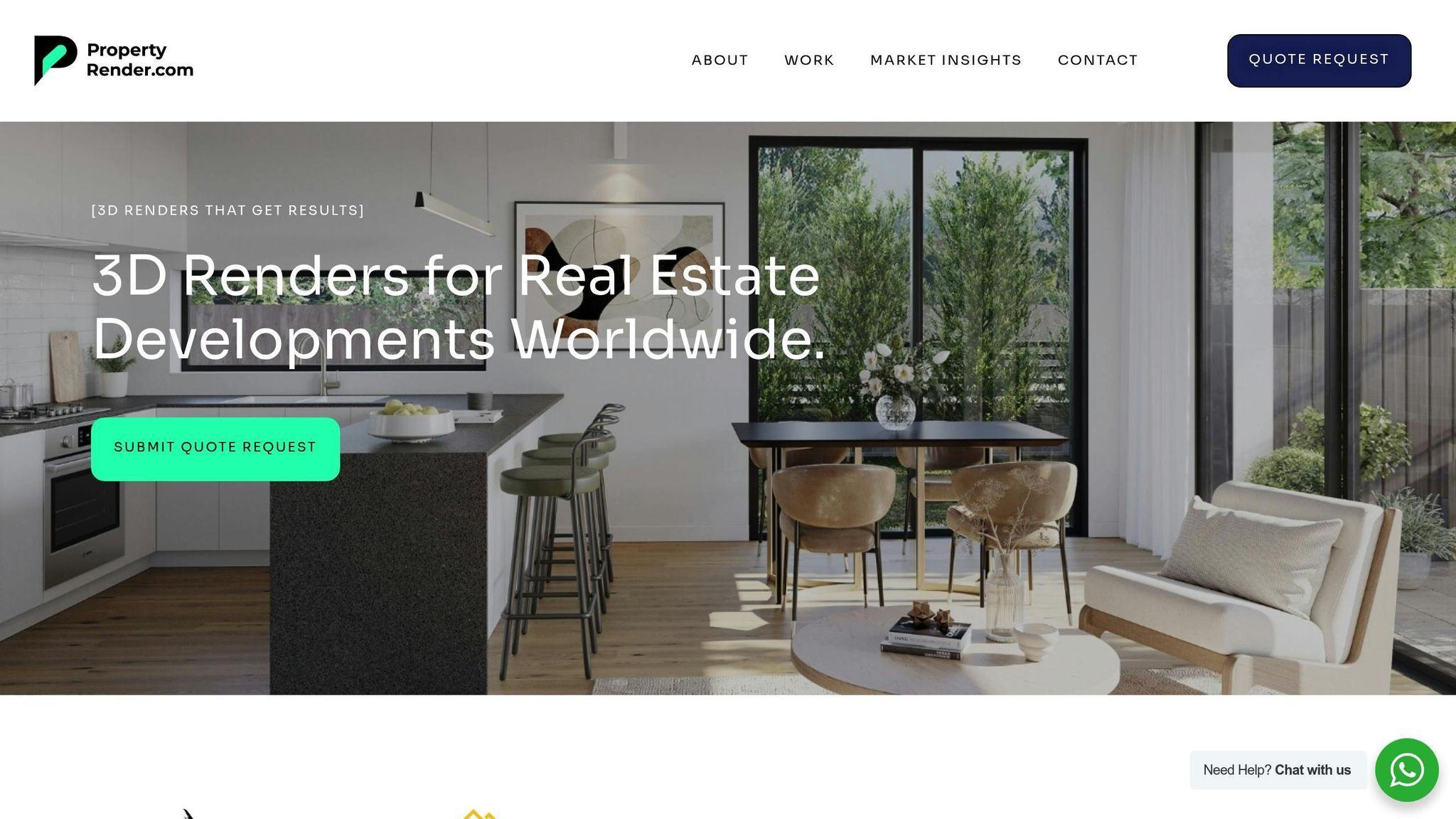
Property Render’s 3D services combine cutting-edge technology with streamlined project management to help sell properties faster, command higher prices, and reduce costs. Let’s dive into how these services and features translate into real returns.
Property Render’s 3D Visualization Services
Property Render provides a comprehensive range of 3D visualization tools tailored for real estate marketing. Their offerings include:
- Photorealistic renders for interiors and exteriors
- Aerial and streetscape views
- Virtual walkthroughs
- Detailed site and floor plan renders
- Photomontages that blend developments into real-world settings
Virtual walkthroughs and precise floor or site plans give buyers a clear sense of the space, minimizing the need for repeat showings. Their marketing packages bundle these services, creating all-in-one solutions for property campaigns. For commercial properties, specialized renders cater to unique requirements, ensuring every property type gets the attention it deserves.
Features That Drive ROI
These services come packed with features that engage buyers and boost sales:
- Photorealistic renderings: These visuals capture every detail with precision, often outshining traditional photography by allowing full control over lighting, staging, and presentation.
- Immersive 3D tours: With VR integration and tools like a "measure tape" feature, buyers can explore properties interactively, making decisions faster.
- Virtual staging: Buyers can see homes furnished in different styles, letting them envision the property’s potential without the cost of physical staging. This is especially helpful for vacant or newly built properties.
- Efficient project management: Real-time feedback and quick turnaround times (4–6 days for renderings, 6–8 days for tours) ensure projects stay on schedule and reach the market quickly, cutting down holding costs.
The results speak for themselves: properties marketed with Property Render’s services sell 20% faster and often fetch prices at least 8% higher compared to traditional methods. These tools turn visual storytelling into measurable market success.
Standard vs Premium Render Options
Property Render offers two tiers of services to match varying budgets and project goals. Here’s what each includes:
| Feature | Standard Renders | Premium Renders |
|---|---|---|
| Primary Use | Basic marketing, project approvals | High-impact campaigns, luxury sales |
| Visual Quality | Good quality with essential details | Photorealistic with exceptional detail |
| Included Services | Interior/exterior renders, floor plans, site plans | All standard services + aerial views, streetscapes, virtual walkthroughs |
| Best For | Budget-conscious or early-stage projects | Luxury markets, competitive pre-sales |
| ROI Impact | Moderate buyer engagement | Maximum engagement and premium pricing |
Standard renders are ideal for developers working with tighter budgets or those in less competitive markets. They offer professional visuals at a lower cost, making them suitable for basic marketing or early project phases.
Premium renders, on the other hand, are designed to deliver high-end visuals that stand out in competitive markets. The enhanced detail and immersive features, like virtual walkthroughs, create a strong emotional connection with buyers, helping properties sell faster and at higher prices.
Choosing between these options depends on the property type, target audience, and sales strategy. While luxury developments and competitive markets benefit most from premium services, standard renders are a practical choice for straightforward residential projects or early marketing efforts.
How to Get the Best ROI from 3D Visualization
To get the most out of 3D visualization, integrate it into your marketing efforts, tailor visuals to your audience, and track performance metrics to refine your strategy.
Adding 3D Visualization to Your Marketing Process
Work closely with architects and designers during the planning stages to create detailed visual representations that can drive pre-construction marketing efforts. For example, a luxury condo project saw a 25% faster sales rate by using 3D illustrations.
Incorporate 3D visualization at various points in your marketing timeline. Start with photorealistic renderings for early promotional materials, then use virtual tours to engage serious prospects. Real estate email marketing, for instance, has a 42% higher open rate compared to other industries. Virtual tours also allow international buyers to explore properties as though they were there in person, significantly expanding your audience.
"Don’t just show your products; bring them to life." – DemoUp Cliplister
Distribute these visuals across multiple platforms – websites, social media, email campaigns, and virtual showings – to maximize reach and engagement. This multi-channel approach helps align your visuals with what buyers are looking for.
Matching Visuals to Your Target Buyers
Customizing your 3D visualizations to suit your audience is key. Residential buyers often value comfort, lifestyle, and emotional appeal, while investors are more interested in functionality and financial returns. Identifying the buyer’s journey helps you focus on what matters most to each group.
For example, first-time homebuyers benefit from virtual staging that shows how furniture fits into a space, while luxury buyers expect photorealistic renderings of high-end finishes. Interactive 3D models that let users explore interior styles, color schemes, and decor options help buyers imagine themselves in the space.
"The renderings enabled us to envision our dream home prior to its construction, simplifying the decision significantly." – J. Scott Smith Visual Designs Customer
Interactive features like 360-degree views and clickable floor plans can also boost engagement. A townhome project, for instance, saw a 30% increase in consumer engagement after adopting interactive 3D visualizations. Emotional storytelling through realistic renderings helps buyers connect with properties on a deeper level. Once you’ve nailed down what works for your audience, tracking performance becomes the next step.
Using Data to Improve Your Results
To optimize your 3D visualization strategy, focus on key performance indicators (KPIs) that directly impact your business goals. Avoid vanity metrics and instead track meaningful data points.
Engagement metrics like time spent viewing 3D tours, interaction rates, and share/save rates are essential. On the lead generation side, monitor qualified inquiries, virtual tour completion rates, and contact form submissions. For sales, track metrics like time to sale, closing rates, and price negotiation margins. Properties featuring augmented reality in their marketing can see up to a 30% increase in interest and engagement.
Virtual tours also boost organic search visibility by 16%, and homes with 3D tours are 20% more likely to sell above asking price. Visual advertising can increase sales by as much as 23%.
| Engagement Metrics | Lead Generation | Sales Impact |
|---|---|---|
| Time spent viewing 3D tours | Number of qualified inquiries | Time to sale |
| Interaction rates with 3D content | Virtual tour completion rates | Closing rates |
| Share and save rates | Contact form submissions | Price negotiation margins |
Set SMART (Specific, Measurable, Achievable, Relevant, Time-bound) goals for your campaigns to evaluate success. Regular feedback from potential buyers can also help refine your visuals to better match their needs.
When optimized using performance data, 3D renderings can increase conversion rates by 40% compared to traditional methods. This data-driven approach ensures smarter spending and faster sales, making every marketing dollar count.
"You can’t improve what you don’t measure." – Peter Drucker
Cost analysis is another important factor. For example, a real estate agency saved $15,000 by using virtual staging instead of traditional methods. Homes with professional photography and 3D visuals can sell for up to $11,200 more than those without.
Conclusion: Getting the Most from 3D Visualization
The numbers don’t lie: 3D visualization delivers results. Properties using AR/VR sell 20% faster and see engagement jump by up to 70%. When 80% of buyers say they’d prefer agents offering 3D tours, it’s clear this isn’t just a trend – it’s becoming the standard.
Take virtually staged homes, for example. These properties sell 33%–73% faster, with an average ROI exceeding 200%. A standout case? A Seattle development that sold 28 days earlier after spending just $820 on visual marketing.
Property Render’s 3D services make achieving these kinds of results simple. Whether you need Standard Renders for approvals or Premium Renders for high-impact campaigns, the platform equips you with tools like interior and exterior renders, virtual walkthroughs, and aerial views. Together, these create a complete marketing package that engages buyers at every stage of their journey.
Want to see a big impact? Start with properties that have struggled to perform. Agencies using 3D visualization have reported an 80% increase in viewings. Or consider a luxury residential project in Miami that saw a 30% boost in pre-sales thanks to immersive 3D visuals.
The key to success lies in understanding your audience and tracking the right metrics. Monitor engagement, leads, and sales to fine-tune your strategy. Homes with professional 3D visuals can even sell for up to $11,200 more than those without. That’s not just an impressive stat – it’s a direct boost to your bottom line.
"The Unique 3D Tour was instrumental in accelerating our home sales, and the communication with the project manager ensured a smooth process from start to finish. Highly recommend!" – Emma S., Seasoned Property Developer
Visual-first marketing is now the norm in real estate. Nearly 78% of new-construction listings and 49% of high-end resale homes feature virtually staged photos. With Property Render, you’re not just keeping up – you’re leading the charge, equipped with the technology and expertise to meet evolving buyer expectations and market demands.
FAQs
How does 3D visualization help properties sell faster in the real estate market?
3D visualization speeds up the property sales process by providing potential buyers with a highly immersive way to explore listings. Research indicates that homes marketed with 3D tours and lifelike visuals sell up to 30% faster compared to those relying on traditional methods.
These tools let buyers virtually walk through a property, helping them picture its possibilities. This not only grabs their attention but also simplifies decision-making, resulting in faster sales and a smoother marketing experience.
How does the cost of virtual staging compare to traditional staging, and what impact does this have on marketing budgets?
Virtual staging offers a budget-friendly solution compared to traditional staging, with costs typically falling between $20 and $150 per image. On the other hand, traditional staging can set you back $2,500 or more for just three months. This stark difference in pricing gives real estate professionals the chance to stretch their marketing budgets further.
By lowering upfront costs while still delivering eye-catching visuals, virtual staging makes properties more appealing to buyers without breaking the bank. It’s a smart way to elevate property listings and improve returns on real estate marketing efforts.
What are the most important metrics to track when evaluating the ROI of 3D visualization in real estate?
To gauge the return on investment (ROI) of 3D visualization tools in real estate, keep an eye on key performance indicators (KPIs) like buyer engagement, lead-to-sale conversion rates, and property viewing statistics. These metrics reveal how effectively your 3D visuals are sparking interest and prompting potential buyers to take action.
You should also track time on market, sales speed, and price premiums achieved. These figures can show whether 3D visualization is helping properties sell faster and at higher prices. By diving into these data points, you’ll get a clear picture of how 3D tools are influencing your marketing and sales performance.


