


Virtual Reality (VR) is transforming how real estate firms train new agents. By replacing outdated methods like manuals and presentations with immersive 3D simulations, VR makes training more engaging, effective, and consistent across locations. Here’s why it works:
- Immersive Learning: Agents can explore virtual properties, practice client interactions, and refine sales techniques in lifelike settings.
- Higher Retention: VR boosts knowledge retention by up to 400% compared to traditional methods.
- Cost Efficiency: Eliminates travel and reduces logistical expenses by enabling remote training.
- Standardized Training: Ensures all agents receive the same high-quality instruction, regardless of location.
- Risk-Free Practice: Allows agents to handle challenging scenarios without real-world consequences.
With tools like the Meta Quest 3S or HTC Vive Focus Vision and platforms like Matterport, real estate firms can implement VR programs tailored to their needs. By combining VR modules with in-person mentoring and tracking performance metrics, companies can reduce turnover, improve agent readiness, and save time and money.
Webinar | Learn to Build VR Training FAST (without code or gear)
sbb-itb-e3e39b4
What Is VR Onboarding for Real Estate?
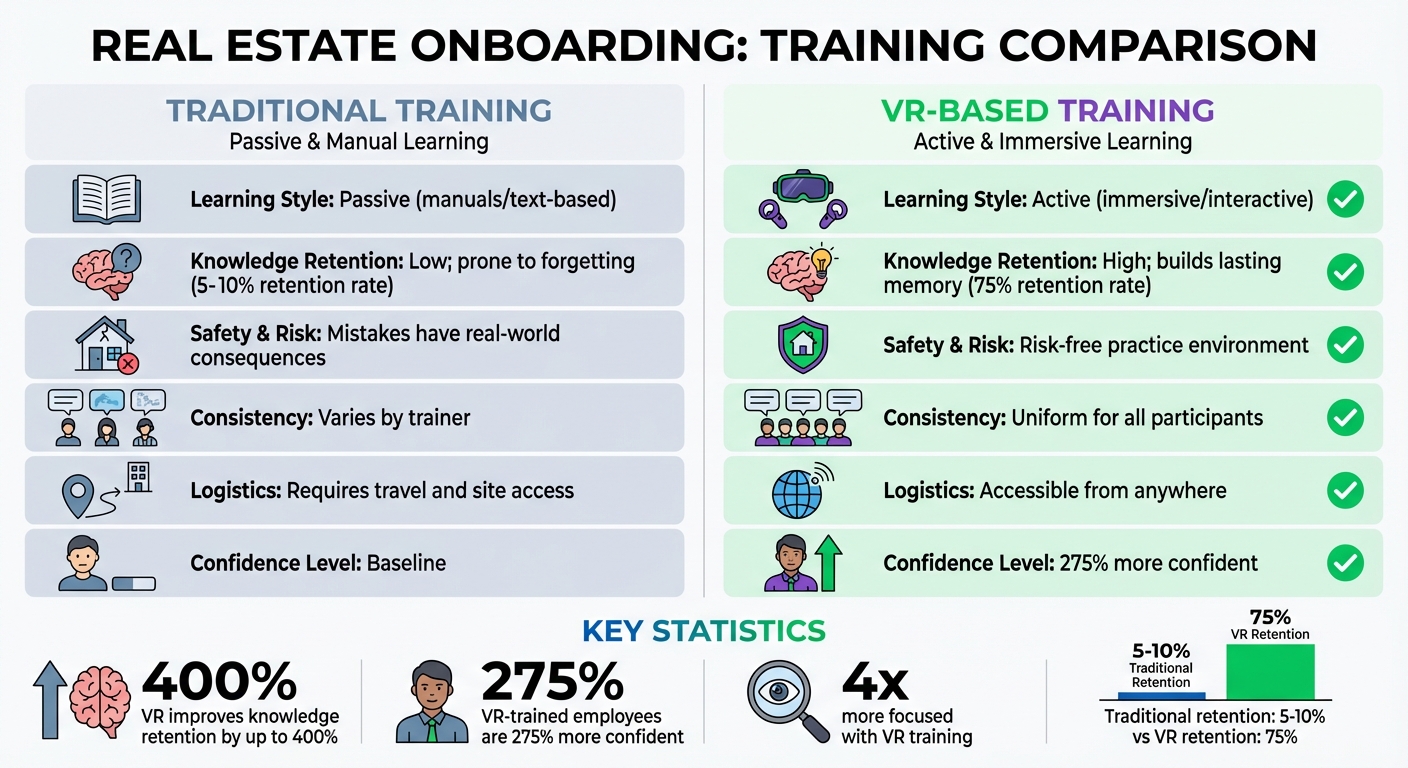
Traditional vs VR-Based Real Estate Training Comparison
VR onboarding leverages immersive 3D simulations to train real estate agents on property layouts, client interactions, and sales techniques – all without needing to visit physical sites. By wearing a VR headset, new agents can explore virtual properties, examine finishes, and practice sales pitches in lifelike environments.
Through VR, 2D floor plans and architectural documents are transformed into realistic 3D models that showcase building dimensions, orientation, and even furniture placement. This hands-on experience helps agents develop a sense of spatial awareness, making them better prepared for in-person client tours.
But VR goes beyond just property walkthroughs. It provides a risk-free environment where agents can simulate tricky client scenarios and experiment with staging strategies without the fear of losing a deal. Feedback is immediate, and every agent receives consistent, high-quality training no matter where they’re located.
How VR Changes Traditional Training Methods
This immersive approach shakes up traditional training by replacing passive learning with interactive experiences. Conventional onboarding often relies on manuals, slide decks, and shadowing, which can overwhelm new agents. VR, on the other hand, makes learning active and hands-on. Instead of imagining what a 2,500-square-foot home feels like, agents can virtually walk through it. Studies show VR-trained employees are up to 275% more confident in applying their skills, and knowledge retention can improve by as much as 400%.
VR also transforms training costs. Traditional methods often involve travel and coordinating access to properties, while VR allows agents to explore spaces in multiple cities – or even countries – without leaving their office.
| Feature | Traditional Training | VR-Based Training |
|---|---|---|
| Learning Style | Passive (manuals/text-based) | Active (immersive/interactive) |
| Knowledge Retention | Low; prone to forgetting | High; builds lasting memory |
| Safety & Risk | Mistakes have real-world consequences | Risk-free practice environment |
| Consistency | Varies by trainer | Uniform for all participants |
| Logistics | Requires travel and site access | Accessible from anywhere |
Common Applications in Real Estate Firms
Real estate firms are using VR onboarding for a variety of training scenarios. One of the most common is virtual property tours, where agents practice guiding clients through homes, pointing out key features, and answering questions about layouts and finishes. This is especially valuable for properties under construction, allowing agents to showcase floor plans and start selling units before any physical work begins.
Another key use is client presentation practice. Agents rehearse sales pitches, manage objections, and navigate tricky conversations using AI-driven avatars. They can also try out different staging options for the same room, such as demonstrating how a space could function as either a nursery or a home office.
Negotiation training is also a popular application. New agents simulate price discussions, inspection concerns, or multiple-offer scenarios, with the VR system analyzing their tone, word choice, and procedural accuracy in real time.
Some firms even use VR for "coming soon" listings that can’t be physically toured due to legal restrictions. In 2022, James Bowerman of Real Creative Group (Compass) used VR tours to show a Maryland property under such restrictions, successfully securing three offers from clients who only experienced the home virtually. As Bowerman explained:
"If you’re able to just simply strap on a VR headset and look at this property, you’ll be able to make a faster decision."
For firms managing short-term rentals, VR serves as a training tool for staff, helping them learn facility management and tenant walkthroughs remotely.
To create truly immersive and effective VR onboarding programs, many real estate firms partner with 3D architectural visualization specialists like Property Render. These collaborations ensure virtual environments are not only realistic but also engaging, setting the stage for a comprehensive VR training strategy explored further in the next sections.
Setting Clear Goals for Your VR Onboarding Program
Before diving into VR onboarding, it’s critical to set clear, measurable objectives. Think about what you want to achieve: quicker agent readiness, better knowledge retention, standardized training, or cutting costs on travel, materials, and instructor hours. The most successful VR onboarding programs start with specific, measurable goals that tie directly to your business outcomes. From there, take a close look at your current onboarding process to pinpoint where it’s falling short.
Finding Gaps in Your Current Onboarding Process
Start by identifying the weak spots in your existing training. Are new agents overwhelmed with too much information but still unprepared for real-world client interactions? Do they have trouble visualizing property layouts from 2D floor plans? Are knowledge retention rates disappointingly low, with key details forgotten after just a few weeks? Since VR has proven to enhance focus and retention, it’s worth asking if your current methods are missing these potential benefits.
Here’s a sobering statistic: over 37.9% of employees leave within their first year, and two-thirds of that turnover happens in the first six months. Early departures often stem from poor engagement during onboarding. Traditional methods like reading manuals or watching presentations result in retention rates of just 5% to 10%, while immersive VR training can push that number up to 75%. If you’re seeing frequent errors or having to repeatedly coach new hires, it’s a sign that passive training methods aren’t cutting it.
Take Toronto Hydro as an example. Back in 2025, they faced similar onboarding challenges when training technicians. Their old approach was slow and inconsistent. After switching to VR simulations for switchgear training, they sped up onboarding by 30% and saved 6 to 8 hours of trainer time per employee. Real estate firms can use the same approach: track how long it takes new agents to confidently handle their first solo property showing, measure the accuracy of their listing presentations, and survey them about unclear training topics.
Creating Measurable Performance Targets
Once you’ve identified the gaps, turn them into SMART goals – Specific, Measurable, Achievable, Relevant, and Time-bound. For example, if onboarding currently takes three weeks, aim to cut it down to one week within 90 days. Setting these kinds of targets ensures consistency across all training locations, which is a major advantage of VR-based programs.
| Metric to Measure | Measurement Timing | Why It Matters |
|---|---|---|
| Knowledge Retention | 30/60/90 days post-training | Evaluates long-term understanding and the quality of instructional design |
| Time to Proficiency | Post-training task performance | Essential for high-turnover roles or seasonal hiring surges |
| Agent Retention | 6-month turnover rate | Reduces re-hiring costs and builds a more stable team |
| Cost Avoidance | Annually | Measures financial savings, like reduced travel or material expenses |
For instance, one company achieved a 90% reduction in workplace injuries and a 50% improvement in knowledge retention by using VR training. Real estate firms can adopt similar benchmarks, like tracking how quickly agents master virtual property tours or improve their client interaction skills. Start by establishing a baseline – measure current training times, test scores, and productivity levels. This data will not only help prove ROI but also guide you in refining your program over time.
Tools and Setup for VR Training Programs
Once you’ve outlined your onboarding goals, the next step is to invest in the right equipment and content. Standalone VR headsets are a popular choice – they’re wireless, budget-friendly, and don’t require high-end gaming PCs. For instance, the Meta Quest 3S, starting at just $249, offers an affordable solution for large-scale onboarding programs.
If your business demands higher visual fidelity, such as showcasing luxury homes or intricate architectural designs, consider options like the HTC Vive Focus Vision. With 5K resolution and built-in eye tracking, it’s priced around $999 and delivers exceptional detail. Another strong contender is the Pico 4 Enterprise, which costs between $899 and $950. It’s designed for professional use, offering improved ergonomics and eliminating the need for agents to link social media accounts. All these headsets feature 6 Degrees of Freedom (6DoF), allowing trainees to move naturally within virtual spaces, making property tours feel more immersive. Once you’ve narrowed down your hardware options, it’s time to focus on the key factors for selecting the best VR equipment.
Selecting VR Headsets and Equipment
Choosing the right headset goes beyond price – it’s about balancing performance, comfort, and ease of deployment. For example, the Pico 4 Enterprise has a rear-positioned battery, which helps balance the weight and reduces neck strain, making it more comfortable for extended use.
If you’re managing devices across multiple locations, consider Mobile Device Management (MDM) tools like ArborXR or ManageXR. These platforms allow you to lock headsets into “Kiosk Mode,” ensuring new hires stay focused on training applications rather than being distracted by games or other apps. Reliable Wi-Fi is another critical factor – opt for Wi-Fi 6 or Wi-Fi 7 to enable smooth streaming of high-resolution content, especially when multiple agents are training simultaneously.
"The ideal enterprise VR headset will deliver a smooth, easy experience for users while providing admins control over what users see and do in VR." – The Organization, ArborXR
Developing VR Training Content
Creating effective training modules means aligning the virtual experience with your real-world property portfolio. While custom scenarios can be built using game engines like Unity or Unreal Engine, many real estate firms achieve better results with photorealistic 3D renders and virtual walkthroughs that mirror the properties they sell. Services like Property Render specialize in producing detailed interior and exterior renders, aerial views, and virtual walkthroughs. These assets allow agents to familiarize themselves with floor plans, property features, and client tours – even before a building is completed or visited in person.
For standard property tours, platforms like Matterport (starting at $69 per month for up to 20 tours) or CloudPano (around $33 per month for unlimited tours) simplify hosting and distributing VR content. These tools ensure consistency across training sessions, reinforcing a standardized approach. If your business involves off-the-plan sales or renovations, photorealistic renders enable agents to confidently present properties that are still under development. By integrating these assets into your VR onboarding program, you can create a seamless and effective training experience for your team.
Building Your VR Onboarding Program Step-by-Step
A well-organized rollout plan is key to delivering the consistency that VR training promises. Combine VR modules with real-world mentorship to create a structured program. Use a phased timeline that gradually shifts responsibilities from VR practice to actual client interactions.
The 30-60-90 Day Training Plan
To keep things clear and measurable, break your training into distinct phases with specific goals.
Days 1–30: Focus on product knowledge. During this phase, new hires use VR headsets to explore your firm’s property portfolio. They can virtually tour high-end listings, international properties, or off-the-plan developments – giving them access to spaces they wouldn’t otherwise visit. This method not only reduces travel costs but also eliminates scheduling headaches while helping agents familiarize themselves with floor plans, finishes, and neighborhood details. Keep VR sessions short – 30 to 45 minutes – with regular breaks to avoid fatigue.
Days 31–60: Transition to interactive simulations that develop soft skills. New agents practice client walkthroughs, learn how to address tough questions about property defects, and experiment with "experiential" sales techniques that focus on creating emotional connections rather than just presenting facts. This type of training has been shown to significantly cut down onboarding time and reduce the need for constant trainer involvement. By practicing with virtual clients, agents can make mistakes and learn from them in a risk-free environment before meeting real buyers.
Days 61–90: Shift the focus to independent performance targets. By this stage, agents should be hosting virtual open houses, using VR tours to qualify leads, and confidently presenting properties with minimal supervision. These tasks prepare them for solo client interactions, ensuring they’re ready to operate independently by the end of the 90-day period.
Once these VR-based phases are complete, supplement the program with in-person mentoring to round out the training.
Combining VR with In-Person Training
VR modules are perfect for covering repetitive, knowledge-heavy topics like property features, compliance policies, and standard procedures. This frees up senior agents to focus on high-level coaching. Pair each new hire with a mentor who can provide real-time support as they work through the VR modules.
To make this approach effective, mentors should first receive hands-on training with the VR headsets. This ensures they’re familiar with the technology and can troubleshoot any basic issues. Platforms with web-based instructor controls are especially useful, as they allow mentors to remotely launch VR sessions, monitor trainee progress in real-time, and even communicate with agents while they’re in the VR environment. Some firms take it a step further by using "casting" to project the trainee’s VR view onto a tablet or screen, enabling mentors to give immediate feedback during simulated client interactions.
Analytics from the VR modules – such as time spent on tasks and success rates – can help mentors pinpoint areas where the trainee needs improvement. This data-driven approach ensures that in-person mentoring focuses on addressing specific challenges rather than repeating what’s already been covered in VR. By blending the strengths of VR and personal guidance, your training program can deliver a well-rounded and effective onboarding experience.
Measuring Results and Improving Your Program
Once your VR onboarding program is up and running, tracking key metrics becomes essential to evaluate its impact. Use an XR management system that supports SCORM or xAPI standards to monitor training data effectively. These metrics form the backbone for ongoing improvements to your program.
Monitoring Agent Performance Metrics
Start with the basics: track metrics like completion rates, assessment scores, and time spent on each module. These numbers can tell you whether agents are finishing their training and how many attempts it takes them to master specific tasks. VR offers additional insights, such as eye tracking, voice analysis, and session playback, which can help pinpoint areas for targeted coaching.
"If you can’t measure something, how can you improve it? By accessing real-time training metrics with the right XR management system, VR training can unlock meaningful data points that guide strategic decision-making."
- Hanna Liszniansky, Marketing Manager, Roundtable Learning
Custom dashboards featuring heat maps and leaderboards can highlight problem areas in the training process. Additionally, reassessing agents at 30-, 60-, and 90-day intervals helps measure whether the training delivers long-term benefits. Beyond the numbers, gathering qualitative feedback is equally important for refining the program.
Using Feedback to Refine Training Content
Feedback collected after each VR session can reveal technical issues and gaps in the training content. Combine this feedback with performance data to identify and address areas needing improvement. Managers should also assess how well agents apply VR-learned skills during real-world client interactions. If there’s a disconnect between simulation performance and on-the-job results, it may signal the need to adjust the training material. Removing modules that don’t contribute to measurable success ensures the program remains effective.
"VR training shouldn’t be ‘set and forget.’ By leveraging analytics and user feedback, you can refine content, improve outcomes, and enhance scalability over time."
- Lorne Fade, Co-Founder, VR Vision
Every adjustment should tie back to your business goals. For instance, if customer service ratings remain unchanged or new agents struggle to close their first deals, take a closer look at your VR analytics to uncover potential bottlenecks. A great example comes from Avangrid Renewables, which achieved full ROI within two years and reduced procedural safety incidents by 60% through continuous refinement of their VR program based on performance data and user input. Regular, data-driven updates ensure your VR onboarding program stays aligned with your objectives and delivers meaningful results.
Conclusion
This guide has taken you step by step through the process of implementing VR onboarding, from spotting training gaps to tracking long-term results. Now, let’s focus on the key elements that can make your program a success.
VR onboarding is changing the way agents learn, connect, and perform. Studies reveal that learners trained with VR are four times more focused, and 44% of L&D professionals consider it better than traditional methods. Coupled with a well-structured 30-60-90 day plan, VR onboarding not only speeds up productivity but also addresses early turnover challenges.
For your program to truly make an impact, clear goals and high-quality visuals are essential. Whether you’re training agents on property walkthroughs, client negotiations, or virtual staging, photorealistic 3D renders and interactive tours are the backbone of effective training. These tools ensure the learning experience is immersive and memorable.
As highlighted, realistic 3D renders play a pivotal role – this is where Property Render can step in as a trusted partner. Specializing in 3D architectural visualization, their services include interior and exterior renders, virtual walkthroughs, and aerial views. Their photorealistic visuals allow new agents to familiarize themselves with properties before they’re even built, giving them the confidence to deliver polished presentations and tours.
Finally, VR onboarding isn’t a one-and-done effort. Regularly review performance metrics and gather feedback from agents to fine-tune your approach. The real estate industry is embracing VR tools, with 67% of agents investing in this technology themselves. And with 95% of professionals agreeing that using innovative tools helps them stay ahead of competitors, VR is no longer optional – it’s a necessity.
Start small, measure your outcomes, and expand on what works. The result? Better-prepared agents, improved retention, and stronger sales outcomes.
FAQs
How does virtual reality enhance training for real estate professionals?
Virtual reality (VR) is shaking up real estate training by offering immersive, hands-on experiences that stick with trainees far better than traditional methods. Instead of passively flipping through slides or reading documents, learners can step into fully-rendered, lifelike properties. They can walk through layouts, interact with design elements, and build a strong sense of space – making the learning process both dynamic and memorable.
What’s more, VR lets trainees tackle real-world scenarios like staging homes, negotiating deals, or conducting property tours – all in a completely risk-free environment. They can repeat these exercises as often as needed, sharpening their skills and getting instant feedback along the way. This combination of realistic visuals and interactive practice not only makes training more engaging but also ensures agents feel confident and prepared when it’s time to apply their knowledge in the field.
What equipment do I need to set up a VR onboarding program for my real estate firm?
To kick off a VR onboarding program for your real estate firm, you’ll need some essential gear to bring virtual spaces to life:
- VR headset: Choose a standalone or PC-tethered option, like Oculus, to create immersive experiences for users.
- Compatible computer or standalone device: Either a high-performance PC or a VR headset with built-in processing power is necessary to run VR software and render detailed 3D environments.
- Hand controllers or motion trackers: These tools let users move around and interact with virtual spaces seamlessly.
- Optional display hardware: Tablets or monitors can be handy for showcasing VR experiences to groups when using headsets isn’t feasible.
- 3D content creation tools: Software that transforms floor plans or CAD files into interactive VR scenes. Tools like those used by Property Render are a great example of this.
With this setup, you’ll be ready to offer your team an engaging and interactive VR onboarding experience.
How can real estate firms evaluate the success of VR onboarding programs?
To gauge how well VR onboarding is working, real estate firms can focus on a few key metrics: completion rates, pre- and post-training assessment scores, and time-to-productivity (like how quickly new agents close their first deal). By comparing these numbers with results from traditional onboarding methods, firms can identify gains in efficiency and performance.
It’s also important to evaluate cost savings. For instance, firms can look at reduced spending on training materials and shorter onboarding periods, weighing these benefits against the upfront costs of VR hardware and content development. Linking VR platforms with learning management systems (LMS) can further simplify data tracking, making it easier to monitor progress and uncover actionable insights. Beyond the numbers, collecting feedback from new agents about their confidence levels and overall experience helps ensure the program stays aligned with business objectives and continues to evolve.


