


Virtual tours are transforming how off-plan properties are marketed and sold. They address key challenges like buyer hesitation, lack of physical property access, and competition in crowded markets. Here’s why they’re so effective:
- Increase Buyer Confidence: Virtual tours let buyers explore properties in 3D, helping them visualize layouts, lighting, and space flow.
- Save Time and Money: Buyers can view properties remotely, removing the need for travel.
- Drive Sales Faster: Listings with virtual tours attract 87% more views and sell up to 31% faster.
- Boost Engagement: On average, buyers spend 8–12 minutes on virtual tours compared to 20–30 seconds with photos.
- Improve Marketing Strategies: Heat maps and user data from tours help developers refine campaigns and focus on features buyers care about.
Virtual tours are no longer optional – they’re now a critical tool in real estate, helping developers sell properties more effectively while giving buyers the confidence to invest.
What Is A Virtual Tour?
Problems with Selling Off-Plan Properties
Selling properties that don’t yet exist is no easy task. It’s not just about marketing – it’s about tackling the way people make life-changing decisions. Developers face a tough challenge: convincing buyers to commit to homes they can’t see or experience in person. These difficulties highlight why virtual tours are becoming such a game-changer in the industry.
Buyers Can’t Experience the Space
One of the biggest hurdles is the gap between what’s on paper and what buyers can visualize. Blueprints and static renderings can only go so far. They leave buyers guessing about critical details like how rooms connect, the amount of natural light, or even how the space feels overall. Without the ability to physically explore the property, many buyers are left feeling unsure about their decision.
This uncertainty often leads to hesitation. As Rod Woelfle, Director of Sales at East West Partners, puts it:
"There’s always a bit of unease when you’re dealing with two- or three-year timelines, but nothing quiets hesitation faster than proof."
The stats back this up: 77% of homebuyers are drawn to AR and VR experiences. Clearly, traditional tools like floor plans and brochures aren’t cutting it. Virtual tours fill this gap by turning abstract concepts into immersive, tangible experiences.
Distance and Time Barriers
Geography adds another layer of complexity. Buyers who are far away – whether in another state or another country – often face steep travel costs and scheduling conflicts. For many, the idea of traveling just to view a property is a dealbreaker.
The growing shift to digital-first interactions has only made these challenges more obvious. Research shows that 67% of buyers want virtual tours, and homes with these features tend to sell faster.
A great example of overcoming this obstacle comes from the Jeddah Central Development Company. Their Digital Twin Project covered a massive 5.7 million square meters (about 61.3 million square feet), giving global investors a chance to explore their vision virtually at Cityscape Global in Riyadh. As one expert explains:
"Virtual reality is not just a trend – it’s the future of long-distance property buying. Gone are the days of tedious cross-country trips or relying solely on static photos and video walk-throughs. With VR, buyers can immerse themselves in remote properties, exploring every detail as though they were physically present."
Standing Out in Competitive Markets
Beyond the logistical challenges, there’s the issue of standing out in an increasingly crowded market. The off-plan property sector is competitive, and developers can’t rely solely on location or pricing to attract buyers. Differentiating their projects has become essential.
Market saturation often forces prices and profit margins down. When multiple developers are offering similar properties in the same area, traditional marketing materials like brochures or renderings start to blur together. This is especially problematic given that 87% of product searches now begin online.
Credibility becomes a key factor in this environment. As Roula Rouva, founder and CEO of Roula Rouva | Forbes Global Properties, explains:
"Buyers also invest in the developer’s credibility as much as the villa. Show them a spotless delivery record and you’ve done most of the work in gaining their trust."
Regulations also play a role. Abdullah Alajaji, founder and CEO of Driven Properties | Forbes Global Properties, highlights how Dubai’s regulatory improvements have strengthened trust:
"Dubai’s regulatory landscape has come a long way in protecting off-plan investors. Rules have become much stronger and more transparent, which has helped build trust and stability in the market."
While these regulations benefit the market as a whole, they also raise expectations. Developers using advanced visualization technologies have a clear edge. Properties showcased through AR and VR sell 20% faster than those relying on traditional methods.
How Virtual Tours Solve These Problems
Virtual tours tackle some of the biggest challenges in selling off-plan properties by turning abstract blueprints into vivid, interactive experiences. They bridge the gap between what buyers imagine and what developers envision, offering a level of clarity that traditional marketing methods just can’t match.
3D Walkthroughs Let Buyers Explore Properties
Virtual tours bring a property to life with interactive 3D walkthroughs. Using 360-degree imagery, they simulate both the interior and exterior of a property – even before construction begins. This allows buyers to "walk" through spaces, moving from room to room as if they were there in person. These tours go beyond static floor plans, offering detailed previews of layouts, window views, and spatial relationships. Some even integrate real-world footage or drone imagery for added realism. Interactive floor plans are often included, showing users their current location and viewing angle while highlighting key features, making the experience intuitive and engaging.
Access from Anywhere on Any Device
One of the biggest advantages of virtual tours is their accessibility. Buyers can explore properties anytime, anywhere, using a computer, smartphone, tablet, or VR headset. This removes the need for in-person visits, making it easier for both local and international buyers to view properties on their own schedule. The ability to access these tours 24/7 ensures buyers stay engaged and informed throughout their decision-making process.
Building Emotional Connection and Buyer Confidence
Virtual tours don’t just inform – they connect. By offering a realistic, multi-sensory experience, they help buyers picture themselves living in the space. For instance, they can see how sunlight moves through a room or how different areas flow together. This level of immersion reduces uncertainty about things like room sizes, layouts, and views. It’s no wonder that 95% of home buyers are more likely to inquire about a property that includes a virtual tour.
sbb-itb-e3e39b4
Using Virtual Tour Data to Improve Marketing
Virtual tours do more than just showcase properties – they generate valuable insights into how potential buyers interact with off-plan properties. This approach replaces guesswork with concrete data, allowing developers to highlight key features and fine-tune their strategies to drive sales. The information gathered from virtual tours serves as a solid foundation for creating targeted and measurable marketing campaigns.
Tracking What Buyers Look at Most
Every click, pause, and movement in a virtual tour tells a story about buyer preferences. Heat mapping technology visually illustrates which areas of a property capture the most attention, offering a clear picture of where viewers are spending their time. These heat maps, combined with AI analysis, provide developers with actionable data . For example, if heat maps show that viewers consistently linger in specific rooms, it signals that these spaces resonate strongly with the target audience.
Beyond heat maps, virtual tours can track user interactions to uncover common questions or concerns. Repeated interactions in certain areas of the tour might suggest where additional details or explanations are needed. This deeper understanding helps developers identify features that spark the strongest emotional connections with potential buyers.
Using Data to Focus Marketing Efforts
Armed with these insights, developers can shift from broad marketing approaches to more precise strategies. For instance, if analytics reveal that viewers are particularly drawn to certain features, marketing materials can be designed to emphasize those highlights. By segmenting data based on demographics, location, or device usage, developers can create highly targeted campaigns.
Integrating virtual tours with CRM systems takes this personalization even further. Sales teams can reference specific features that caught a buyer’s attention during the tour, tailoring follow-up messages to align with individual preferences. Additionally, A/B testing within virtual tour platforms allows developers to experiment with different layouts, navigation styles, and call-to-action placements. This helps identify which elements drive higher engagement, enabling continuous refinement of marketing efforts based on real user behavior.
Virtual Tours vs. Traditional Marketing Methods
The advantages of virtual tours become especially clear when compared to traditional marketing tools like static photography. Virtual tours provide a wealth of behavioral insights that static images simply can’t match, making them far more effective for engaging potential buyers.
| Metric | Virtual Tours | Traditional Photography | Key Advantage |
|---|---|---|---|
| Engagement Time | 8–12 minutes average | 20–30 seconds | 5–10× longer dwell time, signaling stronger buyer interest |
| Lead Quality | 68% serious buyers | 41% serious buyers | Higher conversion rates from more qualified prospects |
| Listing Views | 87% more views | Baseline performance | Significantly broader market reach |
| Inquiry Rates | 22% higher | Baseline | Increased number of qualified leads and shorter sales cycles |
| Buyer Confidence | 34% higher spatial understanding | Limited spatial context | Fewer post-visit disappointments and stronger purchase intent |
Virtual tours deliver engagement data that static photography simply cannot. For example, properties featuring Matterport 3D scans often see buyers revisit listings an average of 3.2 times before scheduling in-person visits. This repeated engagement indicates sustained interest and provides multiple opportunities for follow-up.
"Maybe it doesn’t help you to get a 5 percent sales price rise by using visual tools – but it might help sellers in many other ways."
- Isamar Troncoso, Assistant Professor of Business Administration, Harvard Business School
Virtual tours also open the door to cross-border marketing opportunities that traditional methods can’t provide. With 52% of international buyers relying solely on virtual tours, developers gain valuable insights into global buyer behavior. This data enables developers to optimize properties for international audiences and adapt marketing strategies to suit diverse preferences.
Property Render: 3D Visualization for Off-Plan Properties
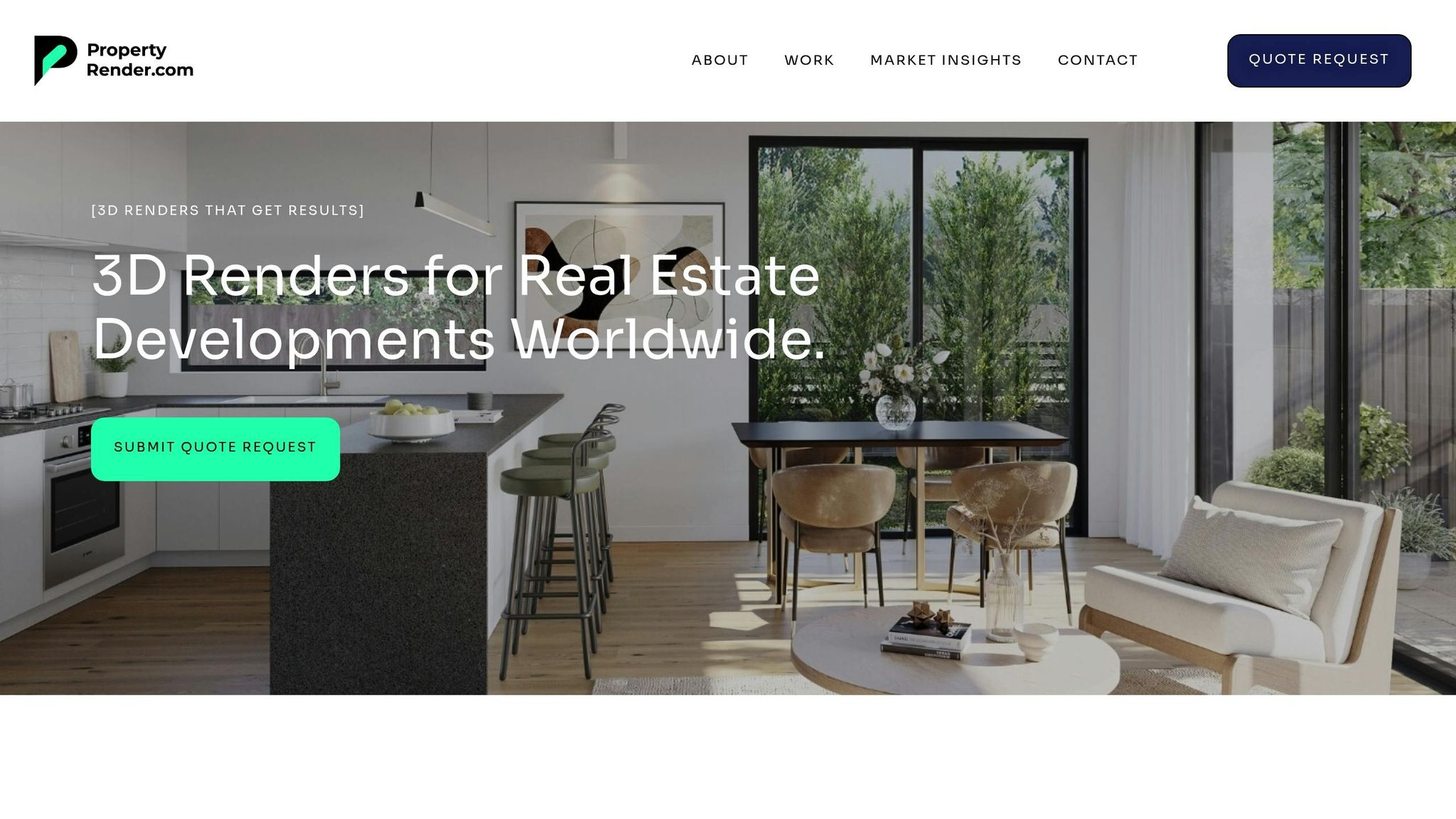
Property Render is changing the game for off-plan property marketing with its cutting-edge 3D visualization services. These tools tackle challenges like the lack of a physical property to showcase while helping developers stand out in competitive markets. For instance, listings with virtual tours get 87% more views, and properties sell up to 31% faster. Here’s a closer look at the services and marketing packages driving these results.
Complete 3D Visualization Services
Property Render provides a wide range of 3D architectural visualization options, including interior and exterior renders, aerial views, site plans, and virtual walkthroughs. These walkthroughs deliver a highly realistic experience, simulating what it feels like to explore a finished property. Features like pop-up windows add another layer of detail, offering information about furniture, brands, specifications, and nearby amenities such as schools and parks.
Their CORE Virtual Realty Tours take things further with multiple viewing modes and VR compatibility powered by Unreal Engine technology. Buyers can use virtual reality headsets to immerse themselves in properties, while real-life environment integration places 3D models within Google Maps views, showing how new buildings will fit into their surroundings.
Tailored Marketing Packages for Developers
Beyond visualization, Property Render offers custom marketing packages designed to turn blueprints into lifelike visuals. These packages even let buyers personalize aspects of a property before construction begins, showcasing endless design possibilities without requiring physical changes.
These visuals are optimized for use across brochures, websites, social media, and advertising campaigns. Whether it’s residential properties like private homes and apartments or commercial spaces such as offices and restaurants, the marketing materials cater to a variety of needs.
"3D Visualization Triggers Excitement that Builds Anticipation!" – CAD Evangelist, BluEntCAD
Seamless Integration for Real Estate Professionals
Property Render’s tools integrate effortlessly with websites, apps, and social media platforms where buyers search for properties. Using cloud rendering technology, updates can be made quickly based on market feedback, while real-time rendering allows instant changes to 3D models based on client input. This not only simplifies the sales process but also shortens the time it takes to bring properties to market.
These solutions are particularly useful for international marketing, giving remote buyers the ability to explore properties through immersive visualizations. This approach boosts engagement and speeds up decision-making. Throughout the rendering process, Property Render works closely with architects and interior designers to ensure the final visuals align with the planned development. Developers can also use these tools to test architectural ideas, explore different finishes, and refine layouts before construction begins.
Conclusion: How Virtual Tours Transform Off-Plan Property Sales
Virtual tours are reshaping the landscape of off-plan property sales, helping properties sell 31% faster and garner 87% more views. By 2025, it’s projected that 90% of homebuyers will expect immersive experiences. These tools don’t just speed up the sales process – they also enhance buyer confidence.
One of the standout benefits of virtual tours is how they allow buyers to form an emotional connection with the property’s design. This connection reduces hesitation, increases sale values by up to 9%, and cuts down wasted viewing time by 40%. Plus, the technology naturally filters out casual browsers, attracting more serious buyers who are ready to make decisions.
For developers, working with companies like Property Render can amplify these advantages. Their 3D visualization services and cloud-enabled updates provide accurate, real-time presentations that align with developers’ marketing strategies, ensuring properties are showcased at their best.
Virtual tours also eliminate geographical boundaries, essentially creating 24/7 open houses that expand market reach. With 67% of buyers actively searching for virtual tours, developers who adopt this technology position themselves ahead of the competition.
Far from being just a marketing enhancement, virtual tours represent a fundamental shift in how off-plan properties are marketed and sold. They drive higher engagement, shorten sales cycles, and boost conversion rates, making them an essential tool in the modern real estate industry.
FAQs
How do virtual tours build buyer confidence in off-plan properties?
Virtual tours play a key role in boosting buyer confidence when it comes to off-plan properties. They deliver immersive and lifelike experiences, allowing potential buyers to explore a property as though they were walking through it in person. This helps reduce doubts and enables buyers to clearly envision the layout, design, and overall vibe of the space – even before construction begins.
By offering a detailed and engaging preview, virtual tours help build trust and a sense of connection, making it easier for buyers to feel confident in their choices. This not only speeds up their decision-making process but also improves the chances of closing the sale.
What makes virtual tours a better marketing tool for selling off-plan properties?
Virtual tours offer an interactive and immersive way for potential buyers to explore a property’s layout, dimensions, and design – no matter where they are. This convenience reduces the need for multiple in-person visits and helps buyers picture what the finished property will look like.
With detailed 3D renderings and walkthroughs, virtual tours inspire trust and assurance in off-plan purchases, often leading to quicker sales and better price points. They also broaden your audience, drawing interest from buyers across different locations, while boosting the overall impact of your marketing efforts.
How can virtual tours help developers enhance their marketing strategies for off-plan properties?
Virtual tours offer developers a treasure trove of insights by tracking how viewers interact with a property. For example, they can see which features grab the most attention or how long users spend exploring certain areas. This kind of data helps developers zero in on what potential buyers find most appealing, allowing them to spotlight those features in their marketing efforts.
Beyond marketing, these analytics can also shape pricing strategies and highlight parts of the property that might need a little extra attention to boost buyer confidence. By tapping into this information, developers can craft highly targeted campaigns that resonate with buyers and, in turn, drive sales for off-plan properties.


