


Want your 3D visuals to attract the right buyers and boost sales? Here’s how:
- 3D tours drive results: Homes with virtual tours sell 31% faster and for 9% more. Listings with 3D visuals keep buyers engaged 5-10x longer.
- Know your audience: Families want safe, spacious layouts. Young professionals prefer sleek, modern designs. Eco-conscious buyers look for energy-efficient features.
- Tailor visuals to priorities: Highlight lifestyle perks like schools, parks, or luxury finishes. Use photorealistic or artistic renderings based on preferences.
- Use interactive tools: Virtual tours, clickable floor plans, and AR/VR experiences improve engagement and lead to up to 9% higher prices.
- Localize details: Use U.S. measurements (square feet), currency ($500,000), and familiar styles to connect with buyers.
Bottom line: Understand your audience, customize visuals to their needs, and use modern tech to stand out in the competitive real estate market.
Maximize Your Real Estate Listings with 3D Virtual Tours | Game-Changing Marketing Tips!
Know Your Target Audience Demographics and Preferences
To create 3D visuals that truly connect with potential buyers, you need to understand who they are and what drives their decisions. Demographics shape the real estate market in powerful ways, and sellers who tap into these trends can position their properties more effectively.
Identify Key Demographic Groups
The U.S. real estate landscape is shifting, with notable growth expected in the 35–49 and 70+ age groups by 2030. These changes directly influence how you approach 3D visualization strategies.
For instance, Baby Boomers (aged 59–77 in 2024) are looking to downsize into low-maintenance homes with features that support accessibility. Meanwhile, Millennials are entering their peak homebuying years, fueling demand for starter homes with modern amenities. Additionally, the rise of single-person households, unmarried couples, and multi-generational families calls for flexible living spaces.
To tailor your 3D renderings effectively, start by analyzing your transaction history from the past few years. Look at client data, such as age, income, property preferences, and referral sources. This will help you identify which demographic groups are most likely to invest in your projects. Key areas to examine include age, income, family size, education, and lifestyle preferences.
These insights will help you focus your visuals on features that matter most to each group.
Research Preferences and Lifestyle Priorities
Once you understand the demographics, dig deeper into what motivates their decisions. For example, younger buyers are increasingly drawn to sustainable living and energy-efficient features. Your 3D visuals should highlight elements like solar panels, energy-saving appliances, and eco-friendly designs.
"Understanding your audience is paramount in commercial real estate marketing. By delving into their demographics, psychographics, and behaviours, you gain insights that allow you to craft compelling messages."
– Manish M Babla, CEO & Founder of Primon Properties
Develop detailed buyer personas based on your research. Start with 2–3 core personas that reflect your most promising market segments. For each persona, consider their hobbies, interests, and priorities. This will guide you in showcasing lifestyle elements that resonate with them. You can also analyze successful local campaigns to spot underserved or oversaturated market segments.
Consider Regional and Local Factors
Demographics and lifestyle preferences are just part of the picture – local context adds another layer of complexity. According to a 2023 NAR report, 60% of buyers consider the quality of the neighborhood the most critical factor in their decision.
For coastal areas, emphasize ocean views and beach access, which often boost property values. In contrast, inland regions might focus on affordability and quieter lifestyles, making spacious layouts and serene surroundings more appealing.
Climate also plays a key role. Mild, year-round weather attracts retirees and those escaping harsh winters. In such areas, your 3D visuals should highlight outdoor spaces like patios and gardens that can be enjoyed year-round.
Economic trends are equally important. Booming job markets in industries like tech, healthcare, and finance drive housing demand and property values. Retirement hotspots like Florida and Arizona, on the other hand, offer opportunities in senior living and retirement communities.
The rise of remote work has shifted buyer priorities, with more people seeking homes in suburban and secondary markets that offer better work-life balance. Your 3D visuals should reflect this by showcasing home offices, outdoor spaces, and community amenities. Urban areas, meanwhile, continue to attract younger professionals, driving demand for rentals and urban conveniences.
Define Audience Expectations for 3D Visuals
Once you’ve gained insights into your audience, the next step is to define their specific expectations for 3D visuals. This ensures your renderings not only grab attention but also connect with viewers in a way that drives engagement and sales. Different buyer groups have varying needs, and addressing these directly is key to creating effective visual content.
Identify Key Features and Priorities
The success of your 3D renderings hinges on aligning their focus with what matters most to your target audience. For instance, residential buyers often prioritize comfort and aesthetics, while investors are more concerned with functionality and potential returns.
For residential buyers, it’s essential to emphasize lifestyle perks. Showcasing well-lit streets, ample parking, and nearby conveniences like schools, supermarkets, and parks makes a significant impact. These details help buyers imagine their daily routines within the space.
When it comes to interiors, focus on both functionality and design. Highlight elements like smart layouts, natural lighting, and stylish decor. Adding small, relatable touches – like a steaming cup of tea on a table or warm ambient lighting – can evoke emotions that resonate with buyers. Research even indicates that emotionally engaging ads can boost sales by 23% compared to neutral ones.
Customization is another major draw. Buyers want to visualize how they can make a space their own, so offering options like different facade finishes or window designs can be incredibly appealing. Meanwhile, other market segments may have unique priorities, such as interior flow, landscaping, or maximizing natural light. For luxury properties, emphasize premium finishes and amenities, while young families might respond better to family-friendly features.
Determine Visual Styles and Detail Levels
The style and level of detail in your 3D renderings should reflect your audience’s preferences and the type of property being showcased. For example, bright daytime renderings often appeal to families, while young professionals or retirees may be drawn to the drama of dusk or dawn scenes.
Photorealistic renderings aim to replicate the exact look of a future structure, while non-photorealistic renderings offer a more artistic take, focusing on mood or effect. The choice depends on your goals and the audience’s expectations.
For family-oriented designs, a warm, sunlit daytime rendering can highlight safety and comfort. On the other hand, urban luxury properties aimed at young professionals might benefit from sophisticated lighting in evening scenes to create a sense of elegance and exclusivity. In design competitions, bold artistic renderings – such as those depicting challenging weather conditions – might make a stronger impression.
Consistency in your visual style can also strengthen your brand identity. However, accuracy is non-negotiable. Renderings should precisely depict spatial dimensions, materials, and finishes to maintain credibility and appeal.
Include Technology Preferences
Modern buyers expect more than static images – they want immersive, interactive experiences. Virtual tours, for instance, are becoming a must-have. These tours allow buyers to explore properties in detail, offering features like room measurements, floor plans, and the ability to adjust the time of day in the visualization.
Interactive elements, such as clickable hotspots and points of interest, enhance engagement by giving buyers control over their experience. Smooth, distortion-free transitions are crucial for maintaining a professional impression. While 3D virtual tours provide a fully dimensional view, 360 walkthroughs rely on flat images but still offer a compelling way to explore spaces.
The benefits are undeniable. Properties with virtual tours can command up to 9% higher prices, and listings featuring video walkthroughs generate up to 49% more leads. Moreover, over 90% of buyers say they are more likely to purchase a home that offers a virtual tour.
Emerging technologies like AI, AR/VR, and blockchain are also reshaping 3D rendering. AI can enhance rendering quality, automate workflows, and enable smart customization. AR/VR integrations provide immersive property experiences, while virtual staging and blockchain-backed transactions add new layers of convenience and security.
To meet these expectations, include features like clickable maps, floor plans, and video walkthroughs. Ensure virtual tours are mobile-friendly and easy to access via your website. Adding annotations or descriptions to highlight key property features can guide viewers through the most important aspects, making their experience both informative and engaging.
Customize 3D Visuals for Real Estate Market Segments
Tailoring your 3D renders to match the priorities of different buyer groups can significantly boost your marketing impact. Each market segment responds to specific visual cues, so customizing your approach ensures you connect with your audience more effectively.
Design Visuals That Match Buyer Priorities
Every real estate market segment has unique preferences, and your visuals should reflect these priorities. For families, focus on creating a sense of safety, comfort, and functionality. Highlight features like open-layout kitchens, bright bedrooms, and outdoor spaces perfect for family gatherings. Adding details like playgrounds and safe walking paths helps reinforce the family-friendly vibe.
For luxury buyers, it’s all about elegance and exclusivity. Use your renders to showcase high-end finishes such as marble countertops, hardwood floors, and custom cabinetry. Draw attention to upscale amenities like wine cellars, infinity pools, or coffered ceilings. Thoughtful lighting can further enhance the feeling of sophistication.
Investors, on the other hand, are looking for visuals that emphasize rental potential and ROI. Highlight efficient layouts, durable materials, and tenant-friendly features like modern appliances, in-unit laundry, and flexible spaces that can serve multiple purposes.
Interactive features can also make a big difference. Allowing buyers to tweak elements like paint colors, flooring, or furniture arrangements helps them picture the property as their own. For example, a luxury residential project in Miami used immersive 3D visualizations tailored to its high-end audience, resulting in a 30% increase in pre-sales compared to earlier developments. Similarly, a Washington developer who integrated 3D home tours into their marketing saw properties sell 20% faster, with price increases reaching up to $300,000.
Once your visuals are tailored to your audience, the next step is ensuring they’re optimized for every marketing channel.
Optimize Visuals for Marketing Channels
Your 3D visuals need to perform well across all the platforms you use. For social media, ensure your images meet platform-specific requirements and load quickly on mobile devices. For websites, high-resolution visuals are key, but they should also load efficiently to maintain user engagement.
When creating print materials, use high-quality renders that capture intricate details, allowing potential buyers to appreciate the property’s quality during in-person presentations.
The impact of well-optimized visuals is undeniable. Visual content gets 94% more views than text-based material, and properties with virtual tours sell about 6% faster and for 3% more than comparable listings.
"The best marketing real estate projects using 3D renderings can significantly influence potential clients’ interest and decision-making."
– Gregory Gronbacher, Seasoned Real Estate Sales Agent
Consistency across channels is crucial. Use uniform color schemes, lighting, and composition to reinforce your brand identity. Additionally, localizing your visuals by incorporating familiar measurements and currency formats helps create a stronger connection with U.S. buyers.
Use U.S. Measurements and Currency Formats
To resonate with American buyers, always use imperial measurements (feet, inches, square feet) instead of metric units. For example, dimensions should be shown as "12′ x 15’", and property sizes should be expressed in square feet or acres.
Currency formatting should follow U.S. conventions, using the dollar sign and comma separators, like "$500,000" or "$1,250,000." On social media, shorthand formats like "$450K – $650K" work well, but full amounts are better suited for formal marketing materials.
Temperature references should also use Fahrenheit. Whether describing climate-controlled interiors or seasonal conditions, sticking to familiar units ensures clarity for American audiences.
Research shows that 99% of home buyers used the internet to search for properties in 2022. Encountering unfamiliar measurements or currency formats can create confusion, as buyers often rely on familiar visual and numerical cues.
Beyond technical details, consider cultural preferences. Use architectural styles, appliances, and outdoor spaces that align with American lifestyles and climate. High-quality visuals make a big difference: property listings with professional photos see 47% higher asking prices per square foot, while homes with drone or aerial shots sell 68% faster.
At Property Render, every 3D visualization is designed with these localization details in mind. From accurate imperial measurements in floor plans to interiors and exteriors that reflect American tastes, every element is crafted to resonate with U.S. buyers. This attention to detail helps ensure your marketing materials connect with your audience and drive results.
sbb-itb-e3e39b4
How Property Render Improves 3D Visualization Strategies
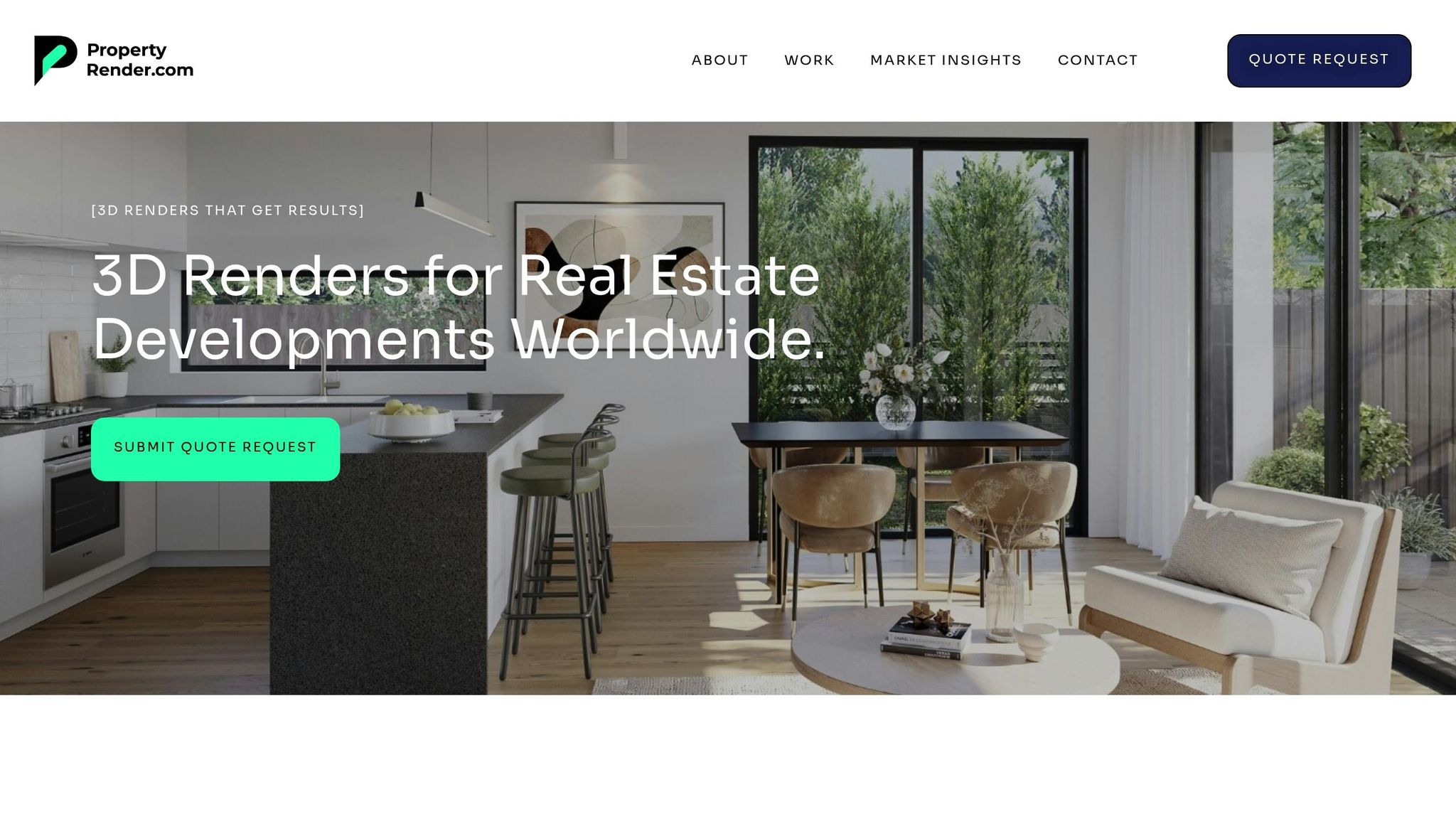
Property Render takes tailored visuals for U.S. buyers to the next level with their specialized 3D architectural visualization services. By focusing on the U.S. real estate market, they provide solutions that elevate your 3D visualization strategy, helping you connect with your audience more effectively.
Complete Visualization Solutions
Property Render delivers a full range of 3D visualization services designed specifically for real estate marketing. Their offerings include interior and exterior renders, aerial views, site plans, virtual walkthroughs, and marketing packages – all customized for the U.S. market.
Their expertise lies in turning early-stage concepts into stunning, lifelike visuals that support everything from initial presentations to full-scale marketing campaigns. Using cutting-edge technologies, Property Render provides services like 3D rendering, virtual reality (VR), augmented reality (AR), and high-quality photography. These tools create a solid foundation for impactful marketing across multiple channels.
Support for Marketing Campaigns
Property Render understands the importance of multi-channel marketing in real estate. Their marketing packages are built to meet the needs of campaigns across platforms like Instagram, website galleries, and even printed materials. Every visual asset is carefully optimized to suit its intended medium.
Their CORE Virtual Realty Tours and photomontage renders bring properties to life, creating immersive experiences for potential buyers. Additionally, streetscape and aerial renders highlight location benefits and community integration, giving buyers a clear sense of the property’s surroundings. By working closely with marketing teams, Property Render ensures that visuals align with campaign goals, target audiences, and brand identity, making every element of the strategy cohesive and effective.
Work with Property Render Experts
To keep projects on track and aligned with your vision, Property Render assigns a dedicated project manager to each client. This streamlined communication process ensures a smooth workflow and consistent results.
The team transforms 2D plans into immersive 3D experiences by collaborating closely with real estate professionals. Clients provide architectural plans, style references, and design details, which the team uses to create initial concepts that match your vision and market needs. Open communication between all parties minimizes misunderstandings and keeps everyone aligned from the start.
Here’s what one client had to say about their experience:
"The Unique 3D Tour was instrumental in accelerating our property sales and the communication with the project manager ensured a smooth process from start to finish. Highly recommend!" – Emma S., Real Estate Developer
Starting with a detailed project brief that outlines the property type, target audience, and desired outcomes, Property Render ensures every visual resonates with your market. This upfront planning, combined with their extensive experience, results in professional visuals that deliver measurable business results.
Evaluate and Improve Visual Strategies
To keep your 3D visuals relevant and aligned with your audience’s needs, regular evaluation and updates are a must. Measuring performance and refining visuals ensures they stay in tune with both market trends and what your audience values most.
Gather Feedback from Stakeholders
Feedback from stakeholders is a goldmine for improving your 3D visual strategy. Sales teams, real estate agents, and potential buyers all bring unique perspectives that can guide enhancements.
Set up clear feedback channels across all touchpoints. Sales teams can share which visuals generate the most interest during presentations. Agents can provide insights into how clients react to specific rendering styles or features. Track metrics like time spent viewing renders, click-through rates on virtual tours, and conversions from visual content to inquiries.
Group feedback into actionable categories like design, functionality, or messaging. For instance, if stakeholders frequently mention that parking spaces in exterior renders aren’t clear, prioritize addressing this in your next update. Similarly, if agents report that buyers often ask about interior lighting after viewing renders, improving lighting details becomes a focus.
Leverage analytics tools to understand how users interact with your 3D content. Metrics like engagement time, click-through rates, and conversions reveal which visuals resonate most and where adjustments are needed.
When making changes, prioritize based on their potential impact and alignment with your goals. For example, if stakeholders suggest adding lifestyle elements to interior renders, cross-check this idea with engagement data to confirm it will deliver results.
"The overarching theme in this process is to approach design with a multidisciplinary mindset… stay away from linear step-by-step processes and follow an iterative design approach while trying to shorten your design loops through timely feedback from relevant sources." – Elias Abou Samra, CEO @ RAFAL Real Estate
Use these insights to refine and evaluate how different visualization styles perform.
Compare Visualization Types and Performance
Building on stakeholder input, assess how various 3D visualization formats perform across channels. Each format serves a unique purpose. For instance, 3D models have been shown to increase engagement and conversions by up to 20%.
Track performance metrics for each type of visual and use A/B testing to make comparisons. For example, test minimalist architectural renders against lifestyle-oriented visuals featuring furniture and decor. Determine which versions drive more inquiries or keep viewers engaged longer.
Consider the marketing channel when analyzing performance. Paid ads, for example, can yield $2 for every dollar spent, making it essential to pair the right visual type with the right platform.
Examine the buyer journey to see how different visuals influence decisions. Some prospects might start with aerial site plans, move on to exterior renders, and finally request virtual walkthroughs. Understanding these patterns helps you design visual sequences that guide buyers more effectively.
After analyzing the data, adjust your strategy to keep pace with technological advancements and shifting audience preferences.
Adapt to Changing Preferences
While understanding your audience is the foundation, adapting your visual strategy to evolving trends is equally important. The global 3D rendering software market is projected to grow at a CAGR of 30.6% from 2023 to 2030, reaching USD 17.38 billion by 2030. This highlights the rapid changes in how audiences engage with visual content.
Stay updated on trends like VR, AI-driven personalization, and AR, which are transforming real estate marketing. Video content, in particular, continues to dominate online platforms.
Test emerging formats like 360-degree property tours or interactive floor plans with smaller audience segments before rolling them out widely. Pay attention to how different demographics – by age, income, or tech-savviness – respond to these innovations.
Optimize your 3D models to meet rising expectations for speed and quality. Techniques like reducing model complexity and using caching and CDNs can help.
Regularly review your strategy to stay ahead of market shifts. Quarterly assessments can help identify which visual approaches are gaining traction and which are losing impact. Keep an eye on industry developments to ensure your visuals remain relevant as audience expectations evolve. This proactive approach ensures your 3D content continues to engage and convert effectively.
Conclusion: Align 3D Visuals with Audience Needs
Creating 3D visuals that resonate with your audience isn’t just about crafting stunning graphics – it’s about understanding what influences their decisions and delivering experiences that align with their priorities. Research shows that high-quality 3D images can boost sales, and interactive 3D models have been shown to increase engagement and conversion rates by up to 20%.
Success starts with knowing your audience inside and out. For instance, first-time homebuyers may prioritize imagining their future lifestyle, while retirees looking to downsize might focus on comfort and accessibility. Your 3D visuals need to reflect these priorities, going beyond architectural detail to include interior designs, color schemes, and lifestyle elements that appeal to specific demographics. And it’s not just about the visuals – the technology you use to present them also plays a crucial role.
Buyers’ tech preferences are clear: 77% prefer VR tours, and 62% favor agents who provide them. Staying ahead by adopting these emerging formats is key to maintaining a competitive edge.
This is where Property Render’s services come in. From photorealistic interior and exterior renders to immersive virtual walkthroughs and aerial views, their offerings are designed to meet the demands of modern buyers. Their expertise in creating marketing packages tailored for off-the-plan sales ensures that your visuals do more than just impress – they create emotional connections that drive faster decisions.
As the real estate market evolves, so do audience expectations. By combining in-depth audience insights with advanced 3D visualization, you can turn properties into irresistible buying opportunities. With the right strategy, your marketing materials won’t just showcase properties – they’ll inspire buyers to make them their own.
FAQs
How does understanding buyer demographics help create effective 3D visuals in real estate?
Understanding who your buyers are is critical when creating 3D visuals that truly resonate. By diving into factors like age, income, and lifestyle preferences, you can craft visuals that emphasize the property features most appealing to specific groups. For example, younger buyers might gravitate toward sleek, modern layouts with smart home integrations, while older buyers may focus on comfort, accessibility, and classic designs.
When your visuals align with the unique priorities of each demographic, they become more engaging and effective. This tailored approach not only grabs attention but also shows potential buyers that you understand what they value in a home, increasing the chances of sparking genuine interest and driving sales.
What technologies can make 3D real estate visuals more engaging for buyers?
Technologies like immersive 3D tours, virtual reality (VR), and real-time 3D rendering are changing how people experience real estate. These tools let potential buyers explore properties in an interactive, almost life-like way, giving them the feeling of being there without ever leaving their homes.
Photorealistic rendering takes this experience up a notch by delivering visuals so detailed and true-to-life that they align perfectly with what buyers expect. Meanwhile, platforms offering virtual walkthroughs and interactive 3D features are reshaping property marketing, making listings more engaging and accessible to a broader audience.
How do regional and cultural factors shape 3D renderings for real estate marketing in the US?
Regional influences and local preferences significantly shape 3D renderings for real estate marketing in the US. Elements like architectural styles, climate, and even lifestyle preferences play a big role in how properties are visually presented. For example, a California property rendering might focus on open floor plans, abundant natural light, and inviting outdoor spaces. Meanwhile, a property in New England could feature warm, traditional interiors and classic design elements to reflect the region’s character.
By weaving these regional details into 3D visuals, the renderings resonate more with potential buyers. They feel more in tune with local tastes, making the properties not just visually appealing but also more relatable. This attention to detail can elevate marketing efforts, ensuring they connect with the intended audience in a meaningful way.


