


Developers use CGI (Computer-Generated Imagery) to sell off-plan properties faster by transforming architectural plans into lifelike 3D visuals. These visuals help potential buyers visualize properties before construction is complete, speeding up decision-making and increasing pre-sales. Here’s how CGI makes a difference:
- 3D Renders: Show realistic interiors, exteriors, and surroundings, creating emotional connections with buyers.
- Virtual Tours: Allow buyers to explore properties remotely, increasing engagement by up to 300%.
- Seasonal and Location Views: Highlight properties in different lighting and settings, making them more appealing.
- Customization: Buyers can see design changes (e.g., color schemes) instantly, boosting confidence.
- Faster Sales: Properties marketed with CGI sell up to 31% faster and for 3–9% higher prices.
- Cost Efficiency: CGI investments typically range from 0.3% to 1% of a project’s value but deliver significant returns.
For example, a Seattle developer used CGI to sell a property in just three weeks, achieving an 8% higher price. Similarly, a Miami luxury project pre-sold 80% of its units, worth $1.2 billion, using cinematic 3D walkthroughs. CGI is now a critical tool for modern real estate marketing, helping developers secure early sales and reduce risks.
Interactive CGI for Property Marketing & Sales
How Developers Use CGI to Sell Properties Faster
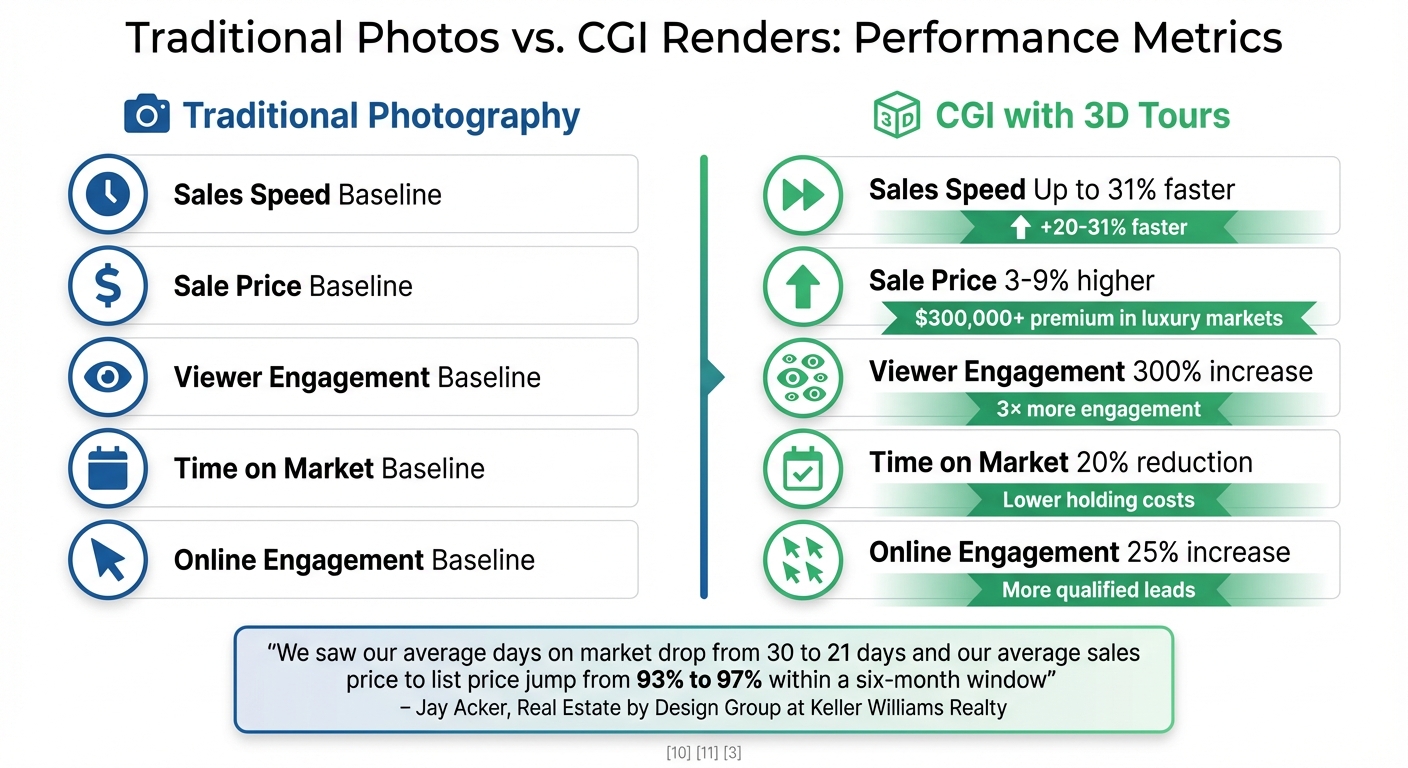
Traditional Photography vs CGI Renders: Performance Comparison for Off-Plan Property Sales
3D Virtual Tours for Remote Property Viewing
3D virtual tours allow potential buyers to explore properties anytime, anywhere, using their devices. This technology effectively acts as a virtual open house, giving buyers the freedom to view properties on their own schedule. Unlike static floor plans, virtual tours provide a much clearer sense of how spaces flow and connect.
The impact is undeniable – listings with 3D virtual tours close up to 31% faster and can fetch up to 9% higher prices. Beyond offering an immersive experience, CGI also adapts property visuals to highlight seasonal and locational features, enhancing their appeal.
Showing Properties in Different Seasons and Locations
CGI enables developers to present properties in the best possible light – whether that’s showcasing golden hour sunlight, lush green landscapes, or the ambiance of different times of day. Using HDRI (High Dynamic Range Imaging), artists can replicate natural lighting to create atmospheres that resonate with buyers. Tools like Unreal Engine even allow buyers to adjust sunlight in real-time, seeing how a room’s brightness changes from morning to evening.
This approach can go a step further with photo matching, which blends 3D models with real drone footage of the construction site. For example, from 2017 to 2024, Sterling-Huddleson Architecture marketed a luxury oceanfront estate in Carmel, California, using this method. They spent around 100 hours creating 5K resolution views that combined the 3D property model with actual drone footage of the Pacific coast. The result? The property sold before construction was completed.
Developers also use CGI to recreate surrounding neighborhoods, drawing on Google Maps data to highlight nearby schools, parks, and other amenities. In March 2023, Pero Hess Custom Homes in Chicago utilized exterior renders, interior views, and 3D floor plans to market a two-story home before breaking ground. When a buyer requested a specific color scheme – white siding, gray trim, and black windows – the artist delivered updated renders the very next day, speeding up the sale process.
Using Design Elements to Connect with Buyers
CGI goes beyond just showing dimensions; it creates emotional connections. By incorporating realistic lighting, furniture placement, and textures, CGI transforms abstract spaces into environments where buyers can imagine themselves living. For instance, it can illustrate how sunlight streams into a living room or how a kitchen feels during breakfast time. These emotional cues often lead to quicker decisions.
Customization is another key advantage. Developers can easily update finishes and materials to align with buyer preferences. For example, a buyer can see the same property with different flooring styles or fixture options. This level of personalization helps buyers feel confident in their decisions, even before construction is complete.
Using CGI Across Multiple Marketing Platforms
High-quality CGI assets are versatile and can be used across various platforms, including websites, social media, real estate portals like Homes.com and Apartments.com, and even print materials. This consistency in presentation builds a strong brand image and fosters trust among buyers.
In April 2024, a boutique European developer invested $60,000 – just 0.4% of a $15 million project – into CGI and VR for a 25-unit residential development. By leveraging these assets across digital and print channels, they secured reservations for over 60% of the units within the first month, all without needing a physical display suite. Properties with 3D digital twins also see 300% higher viewer engagement, proving the effectiveness of CGI in modern real estate marketing.
Traditional Photos vs. CGI Renders
Traditional photography has its limitations – it requires a completed property, which can delay marketing efforts by months or even years. CGI, on the other hand, allows marketing to start during the design phase. This approach not only captures buyer interest early but also facilitates pre-sales while construction is still underway. The differences in performance are striking:
| Metric | Traditional Photos | CGI with 3D Tours | Improvement |
|---|---|---|---|
| Sales Speed | Baseline | Up to 31% faster | 20–31% faster |
| Sale Price | Baseline | 3–9% higher | $300,000+ premium in luxury markets |
| Viewer Engagement | Baseline | 300% increase | 3× more engagement |
| Time on Market | Baseline | 20% reduction | Lower holding costs |
| Online Engagement | Baseline | 25% increase | More qualified leads |
Jay Acker from Real Estate by Design Group at Keller Williams Realty shared his experience: "We saw our average days on market drop from 30 to 21 days and our average sales price to list price jump from 93 to 97% within a six-month window".
Properties marketed with 3D digital twins consistently spend 20% less time on the market, which translates into reduced carrying costs and faster cash flow for developers.
Examples of CGI Driving Faster Off-Plan Sales
Here are some real-world examples that demonstrate how CGI is speeding up off-plan sales and transforming the buying process.
Chicago Single-Family Home Pre-Sales
In March 2023, Arthur Pero of Pero Hess Custom Homes in Chicago utilized 4K photorealistic exterior and interior renders to market a two-story single-family home before construction even began. Shortly after the CGI images were shared on Compass, a buyer requested a design change – white siding paired with black windows. The developer responded quickly, delivering updated renders within just 24 hours.
This instant visualization and flexibility allowed the buyer to confidently commit to the purchase without waiting for a physical structure to be built. Chicago’s success story is just one example of how CGI is reshaping off-plan sales globally.
Miami Luxury Unit Pre-Sales
In 2024, The Residences at Mandarin Oriental in Miami showcased the power of cinematic 3D walkthroughs to market their luxury units before construction started. This approach led to pre-sales of 80% of the units – valued at an impressive $1.2 billion – in just six months. These immersive visuals enabled both local buyers and international investors to experience the high-end finishes and waterfront views of the property, all without setting foot on an unfinished site. The results? Faster sales and drastically reduced market times.
Properties with Shorter Time on Market
A Sacramento builder took a similar approach by partnering with a top CGI service provider to create a visual catalog featuring 100 tiny home models. The result? The entire development was fully pre-sold within three months of the marketing launch. Likewise, Trilogy Homes used emotionally engaging "Golden Hour" renderings to sell $12 million worth of inventory for a Tribeca Penthouse project before construction even began.
These examples highlight how high-quality CGI not only accelerates sales but also enhances buyer confidence and engagement in off-plan projects.
sbb-itb-e3e39b4
How Property Render Helps Developers Market Off-Plan Properties
Property Render provides a comprehensive suite of CGI services tailored for marketing off-plan properties. These offerings include 3D exterior renderings to highlight building facades and landscaping, 3D interior visualizations that bring room layouts and finishes to life, aerial CGI for bird’s-eye views, streetscape renders for multi-building projects, and photomontage services that merge CGI models with real-life photography to show how developments integrate into their surroundings.
Standard CGI views are typically delivered within 7–14 days, while larger, multi-unit projects may take 3–4 weeks to complete. Developers are encouraged to order CGI as soon as planning approval is obtained to maximize the pre-sale window and secure reservations before construction begins. These services provide a strong foundation for more advanced marketing tools.
Premium Renders for High-Impact Visuals
Property Render’s Premium Renders offer photorealistic images that are nearly indistinguishable from actual photographs. These visuals are crafted by dedicated teams of digital artists and interior designers who create custom mood boards tailored to specific buyer profiles. The process includes detailed briefings, ensuring developers remain involved at every stage to guarantee the final renders reflect accurate architectural details, materials, and finishes.
With options for interior, exterior, aerial, and streetscape perspectives, these premium-quality visuals are ideal for brochures, websites, and sales centers. This level of detail not only enhances marketing materials but also helps secure pre-sales and reservations before construction even begins. Beyond static images, interactive tools take buyer engagement to the next level.
Virtual Walkthroughs and Interactive Property Tours
Property Render also offers virtual walkthroughs, creating immersive, interactive experiences powered by technologies like Unreal Engine. These digital tours allow potential buyers to explore every corner of a property, visualize furniture placement, and imagine their daily lives in the space. This interactive approach transforms prospects into enthusiastic buyers.
Virtual walkthroughs are especially effective for reaching remote or international buyers who may not be able to visit the site in person. By eliminating the need for travel, these tools significantly expand the potential buyer pool. Owen Setter, Head of New Homes at Greenslade Taylor Hunt, emphasized the value of high-quality CGI in May 2024:
"If you have some good quality CGIs as an example, it’s going to allow people to visualise what they’re purchasing much more easily. When you back that up with the kind of quality and flexibility that they’re buying with this CGI, that conversation with clients is really straightforward."
These immersive tools help reduce buyer hesitation, boost confidence, and drive quicker sales.
Standard vs. Premium Plans
Property Render offers two service tiers to meet different project needs. Standard Renders focus on basic visuals suitable for planning approvals, providing interior and exterior renders, floor plans, and site plans. However, these visuals are less detailed and realistic compared to premium options.
On the other hand, Premium Renders are designed for marketing purposes, offering photorealistic visuals, virtual walkthroughs, and aerial and streetscape views. While premium services come at a higher cost, they are tailored to attract buyers and drive pre-sales. Typically, developers allocate between 0.3% and 1% of a project’s Gross Development Value (GDV) to CGI services. For example, a $60,000 CGI investment for a $15 million development represents just 0.4% of the total GDV.
| Feature | Standard Renders | Premium Renders |
|---|---|---|
| Visual Quality | Basic, clearly identifiable as CGI | Photorealistic, nearly indistinguishable from photos |
| Best Use Case | Planning approvals, internal reviews | Marketing campaigns, pre-sales, investor presentations |
| Customization | Generic interiors and exteriors | Custom mood boards, tailored to buyer personas |
| Services Included | Floor plans, basic interior/exterior views | Virtual walkthroughs, aerial views, streetscapes, photomontage |
| Investment Level | Lower cost | Higher cost, typically 0.3%–1% of GDV |
Measurable Results from Using CGI in Off-Plan Sales
Higher Buyer Engagement and Interest
CGI has a proven track record of enhancing buyer engagement and boosting sales performance in off-plan property marketing. By transforming blueprints into vivid, lifelike representations, CGI allows potential buyers to envision how sunlight fills a room, how furniture fits into spaces, and how the layout flows. This ability to visualize fosters emotional connections and speeds up decision-making for properties that are still under construction.
One standout feature is the 3D virtual tour, which acts like an always-open house. Buyers can explore properties anytime, from anywhere, without the need for scheduled visits or traveling long distances. This level of accessibility not only broadens the pool of interested buyers but also keeps them engaged for longer periods on websites, leading to more inquiries and interactions. The result? Faster sales cycles and a surge in pre-sales activity.
Shorter Sales Cycles and More Pre-Sales
The efficiency of CGI is backed by hard data. Properties with 3D virtual tours sell up to 31% faster compared to those marketed using traditional methods. Listings enhanced with CGI see their average time on the market drop from 30 days to just 21, while the sales-to-list price ratio improves from 93% to 97%. These numbers clearly demonstrate how CGI accelerates sales timelines and enhances profitability.
Take, for example, a case study from May 2024 in Seattle’s Denny-Blaine neighborhood. A developer replaced outdated renders with high-quality 3D visuals, including photorealistic tours, and saw the property sell 20% faster – closing within three weeks. The immersive experience triggered a bidding war, pushing the final selling price up by $300,000 (an 8% increase) and cutting holding costs by $2,000.
Pre-sales also see dramatic improvements. In April 2024, a boutique European developer spent €60,000 (just 0.4% of the project’s gross development value) on a CGI package for a 25-unit residential development worth €15 million. Within the first month of the pre-sales campaign, over 60% of the units were either reserved or under contract. Private investors committed funds based solely on the digital assets provided, showcasing how CGI can drive early buyer confidence and deliver financial gains.
Better Marketing Return on Investment
The financial benefits of CGI in off-plan sales are undeniable. Faster sales and higher prices firmly establish CGI as a cornerstone of modern property marketing. Typically, CGI investments range from 0.3% to 1% of a development’s gross value, but the returns are substantial. These include higher selling prices (up to 9% more), lower holding costs (around 4% savings), and increased buyer competition, which often drives prices even higher.
For instance, high-quality CGI can boost sales-to-list price ratios from 93% to 97%, translating into tens of thousands in additional profits. A compelling example comes from Fort Lauderdale, Florida, where broker Stan Jones used bird’s-eye view CGI and photo-matching techniques to market a $5 million luxury property during its construction phase. The visuals, which showcased features like a private dock, pool, and ocean views, led to the property going "under contract" on Zillow before construction was even completed.
| Metric | Impact of CGI/3D Tours | Source |
|---|---|---|
| Sales Speed | Up to 31% faster | |
| Sale Price | 4% to 9% higher | |
| Pre-construction Sales | 60% reserved in 1 month | |
| Sales-to-List Price Ratio | 93% to 97% (4% increase) | |
| Marketing Investment | 0.3% to 1% of GDV |
With production times for high-quality CGI renders ranging from just 10 days to two weeks, developers can quickly bring properties to market during prime pre-sale periods. This speed, combined with the ability to secure buyer commitments early, makes CGI a highly effective and worthwhile investment for developers looking to maximize returns.
Conclusion
CGI has reshaped the way off-plan properties are marketed. By turning architectural blueprints into photorealistic visuals, developers can start marketing even before construction begins. This early start not only speeds up sales but also helps secure pre-sales and reduces the risk of unsold inventory.
The results speak for themselves. Properties marketed with CGI sell 20% faster and can command prices up to 8% higher. And here’s the kicker: developers typically spend just 0.3% to 1% of a project’s Gross Development Value on CGI, yet gain big advantages like shorter holding periods, heightened buyer interest, and increased investor confidence. As Suzy Nguyen from Arc & Sphere aptly says:
"Floor plans show dimensions. CGI shows desire."
Developers who succeed with CGI understand its power to create emotional connections that turn curiosity into commitment. Whether it’s a 3D virtual tour acting as a round-the-clock open house or photorealistic renders that instantly present multiple design possibilities, CGI removes uncertainty and helps buyers make quicker decisions. These practical benefits are at the heart of the customized solutions offered by Property Render.
With proven strategies, Property Render provides both Standard and Premium plans to suit various project goals. Standard renders are ideal for planning approvals, while Premium renders deliver the high-quality visuals and virtual walkthroughs that captivate buyers and drive quicker sales.
Stand out in the competitive real estate market. Boost your off-plan sales and maximize ROI with Property Render’s expertly crafted CGI solutions.
FAQs
How does CGI help buyers make decisions about off-plan properties?
CGI plays a key role in helping buyers feel confident when considering off-plan properties. It takes architectural plans and turns them into stunning, lifelike images that showcase every detail. From the layout and design to the materials and lighting, these renderings bring the future property to life, making it easier for buyers to imagine the finished space.
By turning abstract plans into something visually concrete, CGI helps bridge the gap between concept and reality. This not only builds trust but also creates an emotional connection, allowing buyers to see themselves living in the space. The result? Faster decision-making and a stronger sense of assurance in their investment.
What are the costs and benefits of using CGI for real estate marketing?
Using CGI for real estate marketing may require an upfront investment, but it often turns out to be a smart and budget-friendly choice. Compared to traditional methods like physical staging and professional photography, CGI can slash costs significantly. For instance, virtual staging with CGI can be up to 97% cheaper than physical staging. Plus, it eliminates the need for expensive mock-ups, on-site photo sessions, or physical materials.
Time is another area where CGI shines. Most renders are completed within just 2–3 days, whereas traditional methods can take weeks. Developers usually dedicate a small portion of the project’s gross development value (GDV) – typically between 0.3% and 1% – to CGI. This investment not only draws in buyers early but also boosts investor confidence and elevates how the property is perceived. While there are initial costs, the combination of time savings, marketing efficiency, and quicker sales makes CGI a compelling option for real estate developers.
What makes virtual tours and CGI different from traditional property marketing?
Virtual tours and CGI (Computer-Generated Imagery) have transformed property marketing by delivering immersive, lifelike visuals that showcase properties still under construction or even just on paper. Instead of relying on static blueprints, physical models, or basic photographs, CGI offers detailed renderings and virtual walkthroughs that let potential buyers experience a property as if it were already finished.
This approach does more than just show the layout – it helps buyers imagine themselves living or working in the space, creating a stronger emotional connection. By presenting a property’s full potential in an interactive and captivating way, virtual tours and CGI not only boost buyer confidence but also help streamline the sales process, giving developers a powerful edge over more traditional marketing techniques.


