


When selling off-plan properties, CGI (computer-generated imagery) helps buyers visualize what doesn’t yet exist. The two main types – exterior CGI and interior CGI – serve different purposes but work best when combined. Exterior CGI showcases the building’s design, surroundings, and curb appeal, while interior CGI focuses on layouts, finishes, and how the space feels to live in. Together, they help attract buyers, speed up decisions, and even increase sales prices.
Key Points:
- Exterior CGI: Highlights the building’s design, landscaping, and integration into the neighborhood. Works well for early marketing, investor presentations, and planning approvals.
- Interior CGI: Brings floor plans to life by showing room layouts, finishes, and lighting. Ideal for connecting with buyers and showcasing lifestyle potential.
- Combined Impact: Listings with both types of CGI see up to 95% more inquiries and sell faster.
Quick Comparison:
| Factor | Exterior CGI | Interior CGI |
|---|---|---|
| Purpose | Showcase architecture, curb appeal, and surroundings | Highlight layouts, finishes, and living spaces |
| Cost | From $710 per image | $415–$590 per image |
| Production Time | 7–14 days (standard projects) | 7–14 days (standard projects) |
| Best For | Planning approvals, hero shots, investor presentations | Off-plan sales, brochures, social media |
Combining both types of CGI ensures a complete visual story, helping buyers make confident decisions and developers close deals faster.
Exterior CGI: What It Shows and Why It Matters
Exterior CGI takes architectural blueprints and turns them into lifelike images that showcase a building’s design, including its shape, window placement, roof structure, and decorative details – all before a single brick is laid. These renders use realistic materials like brick, glass, wood, and metal, giving potential buyers a clear vision of the finished structure long before construction begins.
But it’s not just about the building itself. Exterior renders place the property within its environment, showing nearby buildings, streets, terrain, and even passing cars or pedestrians. This broader context helps buyers see how the property fits into the neighborhood and aligns with their lifestyle.
"A well-executed exterior render serves as a ‘virtual prototype’ of the building, ensuring smarter decisions and fewer expensive surprises during development." – Transparent House
Exterior CGI also captures different lighting conditions, showcasing how a building looks in natural daylight, at sunset, or illuminated at night. These lighting scenarios serve important roles: daytime views emphasize material textures and colors, while twilight renders highlight exterior lighting and create a high-end feel, perfect for investor presentations. Landscaping details, such as trees, shrubs, driveways, and outdoor amenities like rooftop terraces or pools, further enhance the visual appeal. Let’s dive into what makes exterior CGI so effective at showcasing both design and environmental context.
What Exterior CGI Does Best
Exterior CGI excels at highlighting architectural design and materials with incredible accuracy. It brings out the proportions, facade details, and structural elements of a building, making it easier for non-technical viewers to understand the design intent. In a way, it acts as a universal language, bridging the gap between architects, developers, and potential buyers.
It also excels at capturing the surrounding environment. By including details like planned landscaping, terrain, pavement, and outdoor features, these renders create a complete picture of a property’s curb appeal. For projects where the setting is a major selling point, photo matching techniques can integrate 3D models with real drone footage, adding realism while keeping costs down.
Adding life to the scene – like people, cars, or traffic – makes the visuals more relatable. For example, renders featuring people are 68% more likely to stick in buyers’ minds, and ads with these "peopled" images see a 22% higher click-through rate. It’s a small touch that makes a big difference.
When to Use Exterior CGI
Exterior CGI is particularly useful in the early stages of marketing, especially before construction begins. It’s ideal for showcasing single-family homes, apartment complexes, and mixed-use developments where visualizing curb appeal and neighborhood integration is crucial. Standard exterior renders usually take about 7 to 14 days to create, while larger projects, like multi-unit developments, may require 3 to 4 weeks.
This tool shines when you need to present different lighting scenarios to diverse audiences. Bright daytime views work well for brochures and property listings, while twilight renders are perfect for premium marketing materials and investor presentations. Aerial views can also effectively highlight site layouts, boundaries, and proximity to nearby amenities.
Exterior CGI is also a valuable asset for planning applications, helping local authorities visualize how a proposed building will impact its surroundings. For developments targeting specific groups – like families – adding relatable elements, such as children playing or people walking dogs, can signal that the design caters to their needs.
Interior CGI: Showing Layouts and Living Spaces
Interior CGI transforms 2D floor plans into lifelike 3D environments, allowing potential buyers to explore spaces as if they were physically there. Instead of trying to interpret blueprints or imagine how rooms connect, buyers can instantly see how a kitchen transitions into a dining area, how sunlight floods a bedroom, or how different spaces work together. It eliminates the guesswork and makes spatial relationships crystal clear.
These renders go beyond just layouts – they also highlight finishes and materials, like marble countertops, hardwood floors, or exposed brick walls. Subtle, "lived-in" touches, such as a book on a nightstand or a coffee cup on the counter, help create an emotional connection with the property.
The results speak for themselves. Listings with high-quality visuals get 118% more views and sell 32% faster than those with poor imagery. For high-end projects, advanced visualization tools can speed up sales by 20% and even boost prices by 3–7% compared to traditional marketing. And because people remember 80% of what they see versus just 20% of what they read, interior CGI leaves a lasting impression.
Next, we’ll look at how interior CGI not only illustrates spaces but also brings design concepts to life.
What Interior CGI Does Best
Interior CGI excels at showing how spaces work in real life. It reveals connections between rooms – like how a walk-in closet links to a master bedroom or how sliding doors open to a patio – all in a single view. It also demonstrates a room’s versatility, such as showcasing a space that can function as both a nursery and a modern home office, helping buyers imagine how the property can adapt to their needs.
Lighting is another standout feature. Advanced renders replicate how sunlight streams through windows at different times of day or how artificial lighting interacts with textures and finishes. As Lucas Imbimbo, Digital Marketing Specialist at 3D Design Bureau, explains:
"Produced to a photorealistic standard, these renders can even reproduce how light reacts to certain textures and how this would affect the overall lighting of a room".
Some high-end renders go even further, adding lifelike details like condensation on mirrors or glass surfaces, creating a sense of authenticity.
Close-up renders also shine a spotlight on craftsmanship. They can zoom in on the grain of a marble countertop, the texture of upholstery, or the finish of cabinet hardware, offering a level of detail that wide-angle views often miss. This is especially important for showcasing luxury properties.
When to Use Interior CGI
Interior CGI is particularly effective for high-end homes, condos, and office spaces where finishes and layouts play a critical role in decision-making. It’s most impactful during the later stages of marketing, when buyers are looking for detailed visuals of room configurations, materials, and how the space can fit their lifestyle.
Typically, creating standard interior renders takes about 7 to 14 days, making them a practical choice for projects that need detailed visuals before finalizing decisions. For developments with multiple unit types, interior CGI can highlight differences in floor plans, finishes, or views, helping justify price variations.
This visualization approach answers practical questions that traditional floor plans leave unanswered. By presenting these details upfront, interior CGI reduces uncertainty and speeds up decision-making. Properties marketed with ultra-realistic 3D renderings can sell up to 40% faster than those using traditional methods, while VR-enabled listings generate 95% more inquiries and help buyers decide up to 30% faster.
Exterior vs Interior CGI: Side-by-Side Comparison
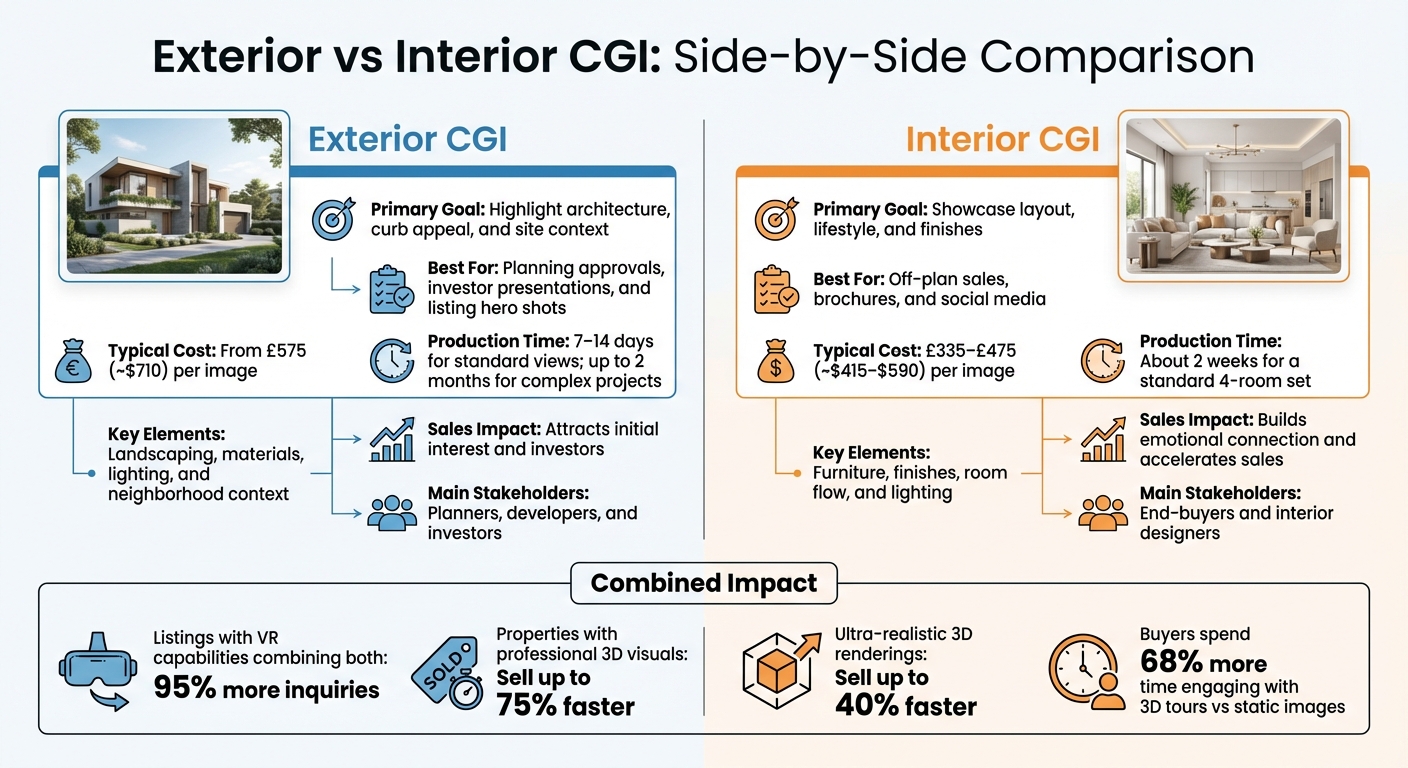
Exterior vs Interior CGI Comparison for Off-Plan Property Sales
When it comes to off-plan property sales, exterior and interior CGI play distinct yet complementary roles in maximizing marketing efforts. Exterior renders are designed to grab attention and generate initial interest, while interior CGI focuses on creating emotional connections by showcasing detailed interior designs. Let’s break down the differences in cost, production time, and their impact on sales.
Starting with costs, exterior CGI generally begins at £575 per image (around $710), while interior CGI falls between £335 and £475 per image (approximately $415 to $590). The pricing reflects the complexity of the work involved. Exterior renders often require detailed modeling of landscaping, surrounding buildings, and streetscapes. On the other hand, interior CGI emphasizes elements like furniture arrangements, material textures, and lighting to create a polished, inviting look.
Production timelines also vary. Standard exterior or interior views usually take 7–14 days to complete, but more intricate projects can stretch up to two months. The first image typically incurs higher costs due to the initial setup of the 3D model, but subsequent images become more affordable as they build on that foundation.
The impact on sales is another area where these two types of CGI differ. Exterior renders often serve as the "hero shot" on property listings, driving clicks and inquiries by highlighting curb appeal and architectural style. Meanwhile, interior CGI excels at converting interest into action by fostering emotional engagement. Properties that incorporate professional 3D visuals have been shown to sell up to 75% faster than those relying solely on traditional photography. Used together, exterior and interior CGI create a powerful combination that enhances engagement and speeds up the sales process.
Comparison Table: Exterior vs Interior CGI
| Factor | Exterior CGI | Interior CGI |
|---|---|---|
| Primary Goal | Highlight architecture, curb appeal, and site context | Showcase layout, lifestyle, and finishes |
| Best For | Planning approvals, investor presentations, and listing hero shots | Off-plan sales, brochures, and social media |
| Typical Cost | From £575 (~$710) per image | £335–£475 (~$415–$590) per image |
| Production Time | 7–14 days for standard views; up to 2 months for complex projects | About 2 weeks for a standard 4-room set |
| Key Elements | Landscaping, materials, lighting, and neighborhood context | Furniture, finishes, room flow, and lighting |
| Sales Impact | Attracts initial interest and investors | Builds emotional connection and accelerates sales |
| Main Stakeholders | Planners, developers, and investors | End-buyers and interior designers |
sbb-itb-e3e39b4
Using Exterior and Interior CGI Together
For off-plan buyers, blueprints alone often fall short of conveying the vision of a completed home. This is where combining exterior and interior CGI bridges the gap, offering a full visual story that helps buyers connect emotionally with the property. Exterior renders showcase the home’s curb appeal and its place within the neighborhood, while interior CGI allows buyers to imagine their daily lives – whether it’s arranging furniture, planning decor, or simply picturing how the space feels. Together, these elements significantly influence buyer decisions.
Think of it as a two-part journey: exterior CGI sets the stage, creating a sense of place and style, while interior CGI brings the story to life, illustrating how light, layout, and finishes come together. For instance, when buyers see how sunlight filters into a room based on the building’s orientation, they often feel more confident and decisive about their purchase.
The numbers back this up. Listings with VR capabilities that combine both exterior and interior views see 95% more inquiries. In one case study, a condo developer achieved a 35% increase in qualified leads and a 15% boost in sales within just six months.
How Combined CGI Improves Sales Results
To make the most of combined CGI, it’s essential to use it strategically at every stage of the sales process.
Start with exterior CGI as the "hero shot" – ideal for listing pages and social media posts to grab attention. Then, guide prospects into immersive interior virtual tours that highlight the layout, finishes, and lifestyle potential. This approach works: buyers spend 68% more time engaging with 3D tours compared to static images, proving the power of this combination.
For the best results, consistency is crucial. Ensure that materials, textures, and lighting are aligned across both exterior and interior renders, creating a seamless experience. You can elevate this further by showing the property at different times of day – daylight renders can emphasize material details, while twilight shots highlight exterior lighting and create a sense of ambiance. Interactive site plans also shine here, letting buyers click on specific plots to view both exterior and interior CGI for that unit. These tactics not only enhance the visual appeal but also strengthen the overall marketing narrative, helping buyers see the property as a cohesive and compelling choice.
Property Render‘s Exterior and Interior CGI Services

Property Render has honed its exterior and interior CGI services to help developers sell properties before construction even begins. By using architectural CAD drawings as the foundation, their team ensures every render is precise and true to the original design. Whether it’s showcasing a building’s curb appeal or illustrating how sunlight streams into a living space, these visuals turn blueprints into buyer-ready images.
But they don’t stop at static images. Property Render also provides 3D walkthroughs, aerial views, streetscape renders, site plans, and even interactive experiences. These versatile assets can be used across social media platforms, property listings, and investor presentations, giving developers multiple ways to engage their audience.
What sets Property Render apart is their attention to detail. Their renders include lifelike elements like a casually draped blanket, fogged mirrors, or lush landscaping. These touches make a space feel warm and inviting, helping potential buyers imagine themselves living there. As Valerie Adams from ArchiCGI puts it:
"Good CGI for property developers brings a space to life before there’s even a shovel in the ground. You can feel it, imagine yourself in it, and, if you’re selling, it starts to look like real money on the table".
Standard and Premium Render Options
To meet the diverse needs of developers, Property Render offers two service tiers: Standard and Premium.
Standard renders are perfect for initial presentations or planning approvals. They feature clean designs with basic textures and daytime lighting, and they’re typically delivered within 7–14 days. These renders are functional and cost-effective, ideal for projects in the early stages.
Premium renders, on the other hand, are designed for maximum impact. They offer photorealistic visuals that are nearly indistinguishable from actual photographs. This tier includes advanced features like twilight lighting, seasonal decor (think holiday-themed exteriors), and interactive options such as 3D virtual tours, VR-ready models, and clickable plot locators that reveal interior views. Premium renders take 3–4 weeks to complete and are aimed at high-stakes marketing campaigns.
The pricing reflects the level of detail. Standard renders, while functional, cost a few hundred dollars per image. Premium renders, with their hyper-realistic quality and added features, range from $435 to $620 for interiors and start at $750 for exteriors. These high-quality visuals are a strategic investment, with emotion-driven renders boosting sales by 23% and video content generating 21.2% more engagement on Instagram. For developers, this translates to faster and more profitable off-plan sales.
Choosing the Right CGI for Your Off-Plan Sales
When deciding between exterior and interior CGI, timing and purpose are key. Exterior renders are perfect for securing planning approvals and attracting investors by illustrating how your property fits into its surroundings. They help establish curb appeal and showcase architectural quality. On the other hand, interior CGI builds an emotional connection, helping potential buyers picture their daily lives within the space.
Your development stage should shape your CGI approach. Early on, during pre-planning and planning submissions, exterior views are essential to demonstrate building massing and how the project integrates with the site. As you transition into the off-plan sales phase, the focus should shift to interior renders that highlight layouts, finishes, and the lifestyle your property offers. For larger, multi-unit developments, you’ll likely need both types of CGI. Aerial views can provide valuable site context, while interior renders help differentiate between unit types and features. This phased approach also aligns with your marketing efforts.
Marketing channels play a significant role, too. Exterior renders are highly effective for billboards and outdoor ads, where grabbing attention quickly is crucial. Interior renders, however, excel in more detailed formats like brochures, social media, and email campaigns. They’re especially useful when buyers need to choose finishes, as they provide a clear visualization of options.
The impact of combined CGI strategies is undeniable. For instance, floor plans can increase click-through rates by up to 52%, while emotion-driven renders have been shown to boost sales by 23%. A great example comes from Charles Nitschke at Tomlinson Realty, who used 3D external renders for an unbuilt home in Spokane, WA, in 2021. The listing garnered 5,172 views and 265 saves in just 27 days – far outperforming similar properties using only 2D elevations.
Property Render offers both Standard and Premium CGI packages, enabling you to tailor your visuals to your project’s needs and budget. By aligning your CGI choices with your development phase and marketing strategy, you can maximize your sales potential.
FAQs
How can combining exterior and interior CGI improve off-plan property sales?
Combining exterior and interior CGI gives potential buyers a complete picture of a property long before construction starts. Exterior CGI focuses on the home’s curb appeal, landscaping, and how it fits into the neighborhood. On the other hand, interior CGI brings the floor plans, finishes, and overall functionality of the space to life. Together, they tell a cohesive visual story, helping buyers picture the property as a unified whole.
This method not only removes the guesswork about how the interior and exterior connect but also boosts buyer confidence and speeds up decision-making. Developers can use exterior visuals in brochures or site plans and complement them with interior 3D walkthroughs or floor plans to provide a realistic and immersive experience. The payoff? Quicker sales, higher offers, and more enthusiastic buyer interest.
How do I decide between standard and premium CGI services for my project?
When deciding between standard and premium CGI services, start by weighing your budget and timeline. Standard services are generally more affordable and quicker, often delivering basic interior visuals within 2–3 weeks. On the other hand, premium services come at a higher cost but provide top-tier visuals with intricate details, which may take 4 weeks or longer to complete.
Next, consider the level of detail and customization required for your project. Standard CGI is a solid choice for straightforward needs, such as static visuals for brochures or simple web listings. Premium services, however, offer enhanced realism, intricate finishes, and features like 360-degree views or animated walkthroughs – perfect for immersive presentations or high-end marketing campaigns.
Lastly, assess your project’s scope and need for flexibility. Standard packages typically include fewer views and limited revisions, making them ideal for simpler designs. Premium packages, by contrast, offer more render angles, custom staging, and additional revisions, making them a better fit for projects that require showcasing multiple options or adapting to changing marketing strategies.
How does CGI enhance property marketing for off-plan sales?
CGI, or computer-generated imagery, turns simple plans into striking, lifelike visuals, giving potential buyers a clear picture of a property long before construction starts. These detailed images remove the guesswork, helping buyers form an emotional connection to the project, which often leads to quicker decisions. Exterior CGI brings out features like curb appeal, landscaping, and how the property fits into the surrounding neighborhood. On the other hand, interior CGI dives into layouts, finishes, and the overall feel of the space.
But CGI isn’t just about aesthetics – it’s a powerful business tool. Developers frequently achieve higher pre-sale conversion rates and can often set premium prices when they use top-notch renders. These CGI assets are incredibly flexible, finding their way into brochures, websites, social media, and more. Plus, making updates to designs or finishes is both quick and cost-efficient. In today’s competitive real estate market, CGI has become a must-have for effective off-plan property marketing.


