


3D walkthroughs are now a must-have in real estate marketing. They allow buyers to explore properties digitally, offering an immersive experience that drives sales faster and at higher prices. By 2026, these tools have evolved significantly with AI, virtual reality, and mobile-first optimization leading the way. Here’s why they matter:
- Higher Sales Impact: Properties with 3D walkthroughs sell 31% faster and for 9% higher prices.
- Wider Reach: Virtual tours attract 87% more views and engage international and remote buyers.
- Advanced Features: AI now enables real-time customization, like switching floor plans or furniture arrangements.
- Cost Savings: Virtual staging and digital tools reduce marketing costs while increasing efficiency.
- Eco-Friendly: Fewer in-person visits mean reduced travel emissions, aligning with modern buyer expectations.
Whether you’re marketing unbuilt developments or existing properties, 3D walkthroughs provide an engaging, interactive way to connect with serious buyers and streamline the sales process. Keep reading to learn how these tools are shaping real estate in 2026.
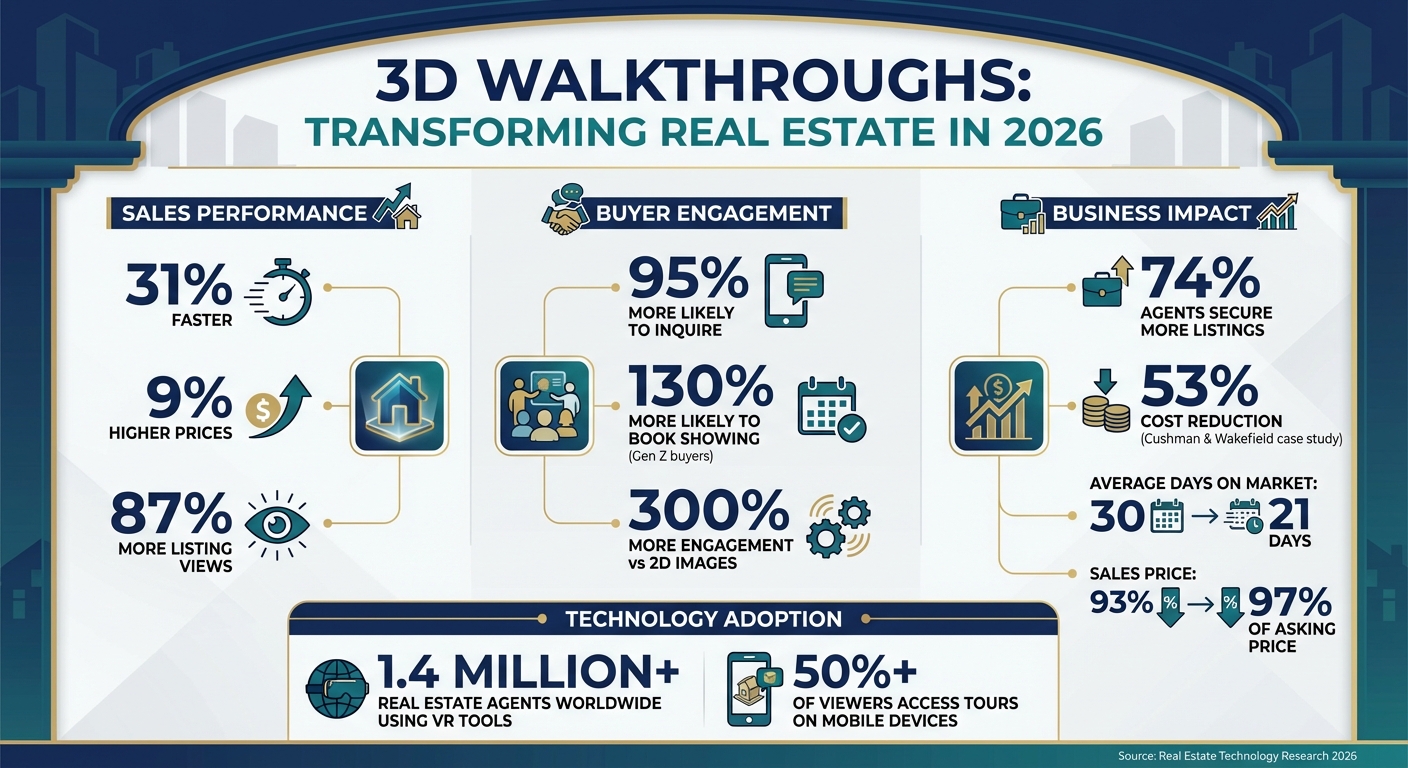
3D Walkthroughs ROI Statistics for Real Estate Marketing 2026
Benefits of 3D Walkthroughs for Real Estate Developers
Better Buyer Engagement
3D walkthroughs go beyond static photos by creating an immersive experience that resonates with potential buyers. This technology captures not just the dimensions of a property – height, width, and depth – but also its ambiance and spatial flow, giving viewers a true-to-life feel of the space. This realistic experience helps buyers visualize the property more effectively, leading to decisive actions. For instance, buyers are 95% more likely to inquire about a property after viewing a 3D walkthrough, while Gen Z buyers are 130% more likely to book an in-person showing.
The ability to connect emotionally and practically with a property through these walkthroughs directly boosts marketing outcomes.
Stronger Marketing Results
The enhanced engagement offered by 3D walkthroughs translates into tangible marketing benefits for developers. Properties with these interactive experiences tend to sell 31% faster and fetch up to 9% higher prices on average. These tours also help pre-qualify buyers by filtering out casual inquiries, ensuring that in-person visits are primarily from serious prospects. On top of that, 3D digital twins generate 300% more engagement compared to traditional 2D images, and 74% of agents report that these tools help them secure more listings.
For developers working with off-plan properties, 3D architectural walkthroughs offer a game-changing advantage: the ability to secure pre-sales before construction is complete. This means revenue streams can open earlier in the project timeline. Plus, these virtual tours serve as a 24/7 open house, accessible to international buyers and relocating professionals.
But the benefits don’t stop at marketing – 3D walkthroughs also streamline operations and cut costs.
Time and Cost Savings
3D walkthroughs simplify the sales process while significantly reducing expenses. In 2024, Cushman & Wakefield, a global real estate firm, reported a 53% reduction in costs after adopting digital capture services for property visualization. According to Oliver Skagerlind, Global Head of Client and Business Solutions at the firm:
"We know from experience that our clients are enthusiastic about how Matterport digital twins make listing and viewing properties much easier and more effective".
These virtual tours can also dramatically shorten the time properties spend on the market. For example, Real Estate by Design, a Texas-based firm, saw their average days on market decrease from 30 to 21 days within just a few months of implementing 3D tours in 2024. Not only that, but their average sales price jumped from 93% to 97% of the asking price during the same period.
Additionally, virtual staging eliminates the need for physical furniture rentals and interior decorators. A single 3D scan can produce multiple marketing assets – such as high-resolution photos, floor plans, and teaser videos – reducing the need for separate professional services. This all-in-one approach saves both time and money while maximizing marketing efficiency.
2026 Technology Trends in 3D Walkthroughs
AI-Powered Rendering
AI is revolutionizing how 3D walkthroughs are created, automating key processes like lighting, textures, and material adjustments to deliver photorealistic results without the need for manual post-production. Advanced algorithms now transform 2D and 360° images into detailed 3D digital twins by analyzing spatial depth with precision.
One standout feature is "Defurnish" technology, which allows users to remove furniture with a single click. This tool helps potential buyers see properties as blank canvases or explore various virtual staging options instantly. AI also generates property descriptions, room labels, and floor plans directly from 3D scans, saving significant time and effort. Buyers can even customize features in real time, such as changing wall colors or rearranging furniture, making the experience more interactive and tailored.
The adoption of cloud-based AI rendering has further streamlined the process. By offloading heavy processing to remote servers, even smartphones can handle high-quality visualizations without lag. This is crucial since over half of virtual tour viewers rely on mobile devices. Beyond visuals, the concept of "AI-assisted storytelling" has emerged, where AI crafts narratives and environmental context to evoke emotional connections, moving beyond static images of empty rooms.
These advancements in AI are setting the stage for even more immersive experiences, with virtual reality taking center stage.
Virtual Reality (VR) Integration
VR technology has taken 3D walkthroughs to the next level, allowing buyers to explore true-to-scale digital twins. Unlike flat 360-degree panoramas, these models capture height, width, and depth, providing an accurate representation of the space.
VR is especially useful for pre-selling developments that haven’t been built yet. Buyers and investors can virtually step into these spaces, gaining a sense of the layout and design before construction even begins. Platforms now offer "virtual open house" modes, where agents can guide multiple parties through a VR property simultaneously, creating a shared, interactive experience without the need for physical travel. By 2025, over 1.4 million real estate agents worldwide had adopted VR tools, and this number continues to grow as the technology becomes more affordable and accessible.
These advancements in VR are complemented by a growing focus on sustainability, which is reshaping how properties are marketed and experienced.
Eco-Friendly Visualization Practices
Sustainability is now a key focus in property marketing, and 3D walkthroughs are playing a major role in reducing environmental impact. By replacing multiple in-person site visits, virtual tours help cut down on travel-related carbon emissions – a significant benefit for international or out-of-state buyers. With 87% of home buyers expecting a virtual tour before considering an in-person visit, these digital tools act as an effective pre-screening method, minimizing unnecessary travel.
Developers are leveraging high-resolution 3D renderings to highlight sustainable materials like recycled wood, green roofs, and solar-ready facades with impressive detail. Walkthroughs now often include features like native landscaping, drought-resistant plants, and community gardens, promoting a lifestyle centered around sustainability rather than just showcasing the property. Interactive elements can draw attention to eco-friendly features, such as energy-efficient HVAC systems, smart home energy monitors, or sustainable insulation.
Beyond individual properties, this technology is aiding urban planning efforts by visualizing traffic patterns, green spaces, and proximity to amenities like parks and public transit. Some platforms even integrate energy-efficiency data into their digital twins, appealing to buyers who prioritize sustainability and data-driven decision-making. This alignment of visualization tools with environmentally responsible building practices reflects a broader shift toward mindful development and marketing.
How To Create A 3D Virtual House Tour
Property Render‘s Virtual Walkthrough Services

Property Render provides two distinct service tiers tailored to meet the needs of U.S. developers looking to visualize properties before construction begins. These services are designed to help showcase unbuilt properties and even presell units before any groundwork starts. They seamlessly integrate with major U.S. real estate platforms like Zillow, Apartments.com, and Homes.com, as well as social media platforms such as Instagram and Facebook. Additionally, the service includes neighborhood contextualization, highlighting nearby streets, trees, infrastructure, and community features. Quick design modifications – completed in under 24 hours based on client input – and virtual tours that pre-qualify leads help reduce unnecessary in-person showings. Below is a breakdown of the two service tiers tailored to fit various project needs and marketing strategies.
Standard Renders Plan
The Standard Renders Plan is ideal for developers in the early stages of marketing or seeking basic approvals. This plan includes essential visualization tools such as interior and exterior renders, floor plans, and site plan renders. These assets provide a clear understanding of spatial layouts and design concepts, making them perfect for residential developments under 2,500 square feet or for projects needing a more budget-conscious approach without extensive photorealistic details.
Premium Renders Plan
The Premium Renders Plan is designed for developers aiming to make a strong impression through high-impact marketing campaigns or competitive property launches. This tier offers advanced features like virtual walkthroughs, aerial views, streetscape renders, and photomontage renders. These tools create an immersive experience that boosts engagement by 300% and speeds up closings by an average of 21 days. The photorealistic quality of these renders helps build buyer confidence and trust, especially for pre-sales and international investors. Buyers can explore properties at their own pace, which often leads to scheduling physical visits with greater intent.
How to Create 3D Walkthroughs: Step-by-Step Guide
Crafting a 3D walkthrough requires careful attention to detail and a structured approach. Each phase of the process plays a crucial role in determining whether your final product captivates potential buyers or misses the mark. Skipping steps can lead to expensive revisions and missed opportunities, so let’s break it down.
Planning and Concept Development
Start by gathering all the essential references, such as floor plans, architectural drawings, and inspirational images. These will serve as the foundation for your digital model. Define your project’s goals early – are you aiming for a high-end cinematic walkthrough for a luxury property, or is a simple 360° tour sufficient for a standard listing? Deciding on features, materials, and furniture styles upfront will save you from making costly changes later.
Next, map out the visitor’s journey through the property. Begin at the entrance and guide them naturally from one room to the next, creating a smooth, intuitive flow. Also, think about how you’ll share the walkthrough. Will it be featured on MLS listings, social media platforms, or gated lead-generation pages? Establish clear performance metrics, such as how long viewers engage with the tour or the number of leads generated.
Once the planning is complete, you’ll need the right tools to bring your vision to life.
Selecting Tools and Software
Your choice of tools depends on your priorities. If speed is key, consider real-time rendering software like Enscape, which costs $47.90 per month and offers interactive previews. For photorealistic results, V-Ray at $45.00 per month is a solid choice. For larger projects that require animated storytelling or crowd simulations, Envision ($41.25 per month) offers advanced capabilities.
For capturing the property, the tools you use will vary by project scope. For small residential units, smartphone-based solutions can work well. However, for larger developments or projects requiring seamless transitions between indoor and outdoor spaces, a LiDAR-equipped camera like the Matterport Pro3 (around $4,000) is more effective. For instance, in 2024, Cushman & Wakefield partnered with Matterport to digitally scan over 1,000 properties in a year, cutting costs by 53% and improving customer service efficiency.
Whether you opt for DIY methods or hire professionals, make sure to capture high-quality scans. Professional services often deliver polished results within 24–48 hours, which can save time for tight deadlines.
After assembling your 3D model, focus on refining it to ensure a seamless and engaging experience.
Review and Optimization
Test the walkthrough to ensure smooth navigation between points. Abrupt or awkward transitions may suggest the use of stitched 2D panoramas instead of a true 3D model. Share drafts with stakeholders to gather feedback and refine the experience. Adding interactive elements like hotspots, labels, floor plans, and measurement tools can help potential buyers visualize themselves in the space.
Since over 50% of virtual tour viewers use smartphones, optimizing for mobile devices is critical. Make sure the walkthrough loads in under three seconds and that the mobile interface is responsive. Fine-tune lighting and textures for a polished, photorealistic look, and blur any sensitive details before publishing. Keep the tour concise – 3 to 5 minutes is ideal to maintain viewer interest without causing fatigue. Properties with well-optimized 3D walkthroughs have been shown to sell 31% faster and for up to 9% more on average.
sbb-itb-e3e39b4
Quality Standards Checklist for 3D Walkthroughs
Only publish walkthroughs that meet these standards. Poorly executed walkthroughs can hurt credibility and waste valuable resources. These guidelines ensure a professional finish and a great viewer experience. Make sure to align these standards with the latest trends, like AI-powered rendering and VR integration, as we move toward 2026.
Visual and Technical Accuracy
Your walkthroughs need to showcase height, width, and depth accurately, creating a to-scale model that mirrors real-world dimensions. Consider embedding measurement tools to help buyers check if their furniture fits.
Lighting is a dealbreaker. Both natural and artificial lighting must be rendered realistically – poor lighting is one of the main reasons buyers lose trust in a rendering. Use high-resolution textures with Physically Based Rendering (PBR), including normal, bump, and specular maps, to make surfaces look as real as possible. Stick to accurate colors and materials to maintain authenticity.
Navigation should feel effortless. Smooth transitions between viewpoints are critical – any glitches or signs of 2D stitching will stand out. Include structural details like doors, windows, and fixtures. If possible, add "dollhouse" views to give users a complete sense of the layout.
Finally, ensure these visual standards hold up across different devices.
Cross-Device Accessibility
With more than half of viewers accessing walkthroughs on mobile devices, optimizing for smartphones and tablets is non-negotiable. Test performance on both iOS and Android before launching. Aim for a load time of under three seconds to avoid losing viewers.
For video walkthroughs, aim for a minimum resolution of 1080p at 30fps, but prioritize 4K at 60fps for premium materials. Interactive elements should function consistently on all devices, but keep them simple to avoid overwhelming users. Also, confirm compatibility with major browsers like Chrome, Safari, Firefox, and Edge, as well as desktops and tablets.
Once technical and visual standards are met, think about how to deliver the walkthrough for maximum reach.
Browser-Based vs. App-Based Delivery
The way you deliver your walkthrough can greatly influence its reach and user experience:
| Feature | Browser-Based Delivery | App-Based Delivery |
|---|---|---|
| User Friction | Low friction: instant access via URL | High friction: requires download |
| Accessibility | Universal; works on any web browser | Limited to specific OS or VR hardware |
| Integration | Easy to embed in MLS, websites, and social media | Requires deep links for embedding |
| Performance | Relies on browser and internet speed | Often smoother; uses local device hardware |
| VR Support | Basic, limited VR functionality | Optimized for VR headsets (e.g., Gear VR) |
| Best Use Case | Social media, email marketing, MLS listings | In-person VR demos, dedicated presentations |
For most property developments, browser-based delivery is the better option. It’s simple – users can click a link and start exploring immediately, no downloads required. However, app-based delivery makes sense for high-end properties, especially for in-person presentations using VR headsets or when targeting buyers already on a specific platform.
Using 3D Walkthroughs in Real Estate Marketing Campaigns
Here’s how to make the most of 3D walkthroughs in your real estate marketing efforts. Once you’ve created a 3D digital twin, it becomes a versatile tool that can be repurposed into HDR photos, floor plans, teaser videos, and even Mattershort GIFs. This multichannel approach ensures your property is showcased across platforms like MLS listings, agent websites, Google Business Profiles, and real estate portals such as Realtor.com and Homes.com. It’s a smart way to maximize visibility while building on the benefits of 3D walkthroughs discussed earlier.
These walkthroughs also serve as excellent tools for pre-qualifying buyers. By requiring potential buyers to view the virtual tour before scheduling an in-person showing, you can filter out casual browsers and reduce no-shows, saving time and effort.
Social Media and Digital Campaigns
Short vertical video clips are perfect for platforms like Instagram Reels, TikTok, and Facebook Stories. Extract 15–60 second fly-through clips from the walkthrough to drive traffic to the full tour. For email campaigns, include a GIF preview or a video thumbnail with a clear call-to-action, such as "Take the full walkthrough", to encourage more clicks.
Interactive tags, like Mattertags, are great for highlighting standout features – think smart home tech, custom cabinetry, or energy-efficient upgrades – without overwhelming the visuals. You can even use retargeting ads based on which rooms viewers spent the most time exploring to design personalized follow-up campaigns for serious buyers. And don’t overlook QR codes on yard signs or print flyers – these connect offline interest to your online walkthrough, a tactic that’s gaining traction in 2026.
Beyond social media and digital engagement, live presentations take 3D walkthroughs to the next level by offering real-time interaction.
Live and Virtual Presentations
During live virtual showings, you can interact with potential buyers by answering questions, opening closets, turning on lights, or showcasing specific features on demand. Start with curb appeal, guide them through the interior, and finish with an exterior view. To make the experience smoother, share listing details 24 hours in advance so participants can come prepared, and follow up with a recording and next steps within two hours after the session.
This approach has already shown results. In 2024–2025, Jay Hudson Homes at Keller Williams used 3D tours to breathe new life into expired listings that had previously seen little interest. By relisting these properties with immersive walkthroughs, they saw immediate engagement and faster sales. They also used these tours in listing presentations to highlight their marketing edge. Similarly, Real Estate by Design in Texas saw their average days on the market drop from 30 to 21, with their average sales price rising to 97% of the asking price, up from 93%.
Live presentations turn passive viewing into active engagement, creating memorable experiences that help buyers feel confident in their decisions and move toward closing faster.
Measuring ROI and Performance of 3D Walkthroughs
When it comes to 3D walkthroughs, the benefits go beyond just boosting engagement and conversion rates – they offer measurable returns that make their marketing impact undeniable. Evaluating ROI for 3D walkthroughs isn’t just about tallying expenses. It involves analyzing listing views, lead generation, brand visibility, and even reduced property holding costs to get the full picture. Properties featuring 3D walkthroughs tend to sell faster and at higher prices.
Tracking Engagement Metrics
To understand how your 3D walkthroughs are performing, start by examining user interaction data. Many platforms provide dashboards that track total views, time spent in the tour, and where users tend to lose interest and drop off. For example, interactive hotspot clicks (like Mattertags) can reveal which property features capture the most attention. Interestingly, 3D digital twins can drive up to 300% more engagement compared to traditional 2D images. If users frequently exit at a specific room, it might be worth revisiting the lighting or navigation for that area to improve the experience.
Analyzing Conversion Rates
The true value of 3D walkthroughs lies in their ability to influence buyer decisions. Listings with 3D tours are 95% more likely to generate inquiries. By making 3D tours a prerequisite for scheduling in-person showings, you can ensure that only serious, pre-qualified buyers visit the property, cutting down the time it spends on the market. Another effective tactic is gated access – requiring an email to view the full tour – allowing you to capture leads and track how many of them proceed to physical showings or make offers. Comparing the "inquiry-to-showing" ratio of properties with 3D tours versus those without can also help you build a solid case for their effectiveness. These metrics provide a clear path to understanding the cost-benefit balance.
Cost-Benefit Analysis
To gauge the financial impact, compare the cost of creating 3D tours against the results they deliver. On average, producing an interactive 3D tour costs between $315 and $869 per property, whereas high-quality interior renders range from $600 to $1,500. But consider the potential upside: properties with 3D tours can sell 20–31% faster and command an 8–9% price premium. For example, Cushman & Wakefield reported saving 53% on costs after adopting professional 3D capture services for marketing and documenting over 1,000 properties in a single year. To further refine your analysis, calculate the cost per lead by dividing the investment in the walkthrough by the number of high-quality inquiries it generates. If you’re managing multiple listings each month, investing in your own equipment can pay off in as little as six to eight months.
Conclusion
By 2026, 3D walkthroughs have transitioned from being a luxury in real estate marketing to an absolute necessity for property developers aiming to stay competitive. Properties featuring virtual tours consistently outperform those with static presentations – they sell faster, fetch higher prices, and attract significantly more listing views. For developers working on off-plan projects, these tools provide photorealistic digital previews, helping to pre-sell unbuilt units by instilling genuine confidence in potential buyers. These proven metrics highlight how this technology is reshaping the property market.
The move toward true 3D digital twins – far beyond simple stitched 360-degree photos – has revolutionized the buying experience. These immersive walkthroughs offer accurate depth, scale, and spatial flow, resulting in 300% more viewer engagement compared to flat imagery. This capability not only enhances buyer interest but also helps identify serious prospects, reducing time spent on unqualified showings.
Key technological trends driving this shift – AI-powered rendering, VR integration, and mobile-first optimization – are redefining property marketing. They streamline the process for serious buyers, broaden access to international investors, and improve efficiency by minimizing wasted efforts. As Oliver Skagerlind from Cushman & Wakefield explained:
"We know from experience that our clients are enthusiastic about how Matterport digital twins make listing and viewing properties much easier and more effective."
This reflects a growing industry consensus: immersive visualization tools deliver clear, measurable benefits. These advancements not only boost engagement but also provide a competitive edge in the marketplace.
Whether you’re showcasing luxury condos or suburban homes, investing in high-quality 3D walkthroughs pays off. With 95% of buyers more likely to contact agents about listings with 3D tours and 74% of agents reporting that virtual tours help them secure more listings, the advantages are undeniable. The shift from traditional renderings to digital twins underscores the core message: advanced 3D walkthrough technology is now critical for effective property marketing. The real challenge lies in adopting these tools quickly to meet modern buyer expectations and accelerate sales cycles.
FAQs
How do 3D walkthroughs make real estate listings more engaging for buyers?
3D walkthroughs are changing the game for real estate listings by offering buyers an engaging, interactive way to explore properties remotely. Unlike traditional photos, these virtual tours give a true sense of the home’s layout, size, and flow, making it easier for potential buyers to imagine themselves living in the space.
In a crowded market, these walkthroughs help listings stand out by presenting properties in a more detailed and dynamic manner. Buyers can get a clearer picture of a home’s features, streamlining their decision-making process and cutting down on the need for in-person visits. This not only saves time for buyers but also for sellers and agents. By making properties easier to explore and remember, 3D walkthroughs create a stronger connection between buyers and their potential future homes.
How does AI improve 3D walkthroughs for real estate properties?
AI is transforming 3D walkthroughs by making them more lifelike, efficient, and engaging. It powers the creation of photorealistic visuals and streamlines the process of building detailed virtual property models, cutting down on manual effort and speeding up production. By analyzing data from reality capture tools, AI ensures precise and immersive property representations.
On top of that, AI introduces interactive elements like tailored virtual tours, smooth navigation, and real-time customization. These features let potential buyers explore properties with greater confidence. Together, these advancements enhance the visual appeal of walkthroughs while making property marketing more dynamic and effective heading into 2026.
How do 3D walkthroughs support eco-friendly real estate marketing?
3D walkthroughs offer a greener approach to real estate marketing by significantly reducing the need for physical property visits. Instead of driving from one location to another, potential buyers can explore homes virtually from their own living rooms. This shift not only saves time but also helps lower travel-related carbon emissions.
On top of that, digital tours cut down on the use of printed materials like brochures and lessen the resources typically needed for traditional open houses. By embracing 3D walkthroughs, real estate professionals can make their marketing efforts more environmentally friendly while providing buyers with a seamless and convenient way to view properties.


