


When it comes to selling homes, 3D floorplans are a game-changer. They help buyers visualize the property layout in ways photos and 2D plans can’t. Listings with 3D visuals generate 403% more leads, while homes with virtual tours receive 95% more phone inquiries and sell 31% faster. Buyers love these tools because they provide clarity, save time, and build trust by showing every detail of a property.
Here’s why 3D floorplans work so well:
- Clarity: They let buyers explore layouts, see how rooms connect, and imagine their furniture in the space.
- Engagement: 3D tours boost inquiries and reduce unnecessary showings by pre-qualifying serious buyers.
- Competitive Edge: Only 16% of agents use virtual tours, making this a great way to stand out.
Want better leads and faster sales? Invest in accurate, photorealistic 3D floorplans and share them across listings, social media, and email campaigns.
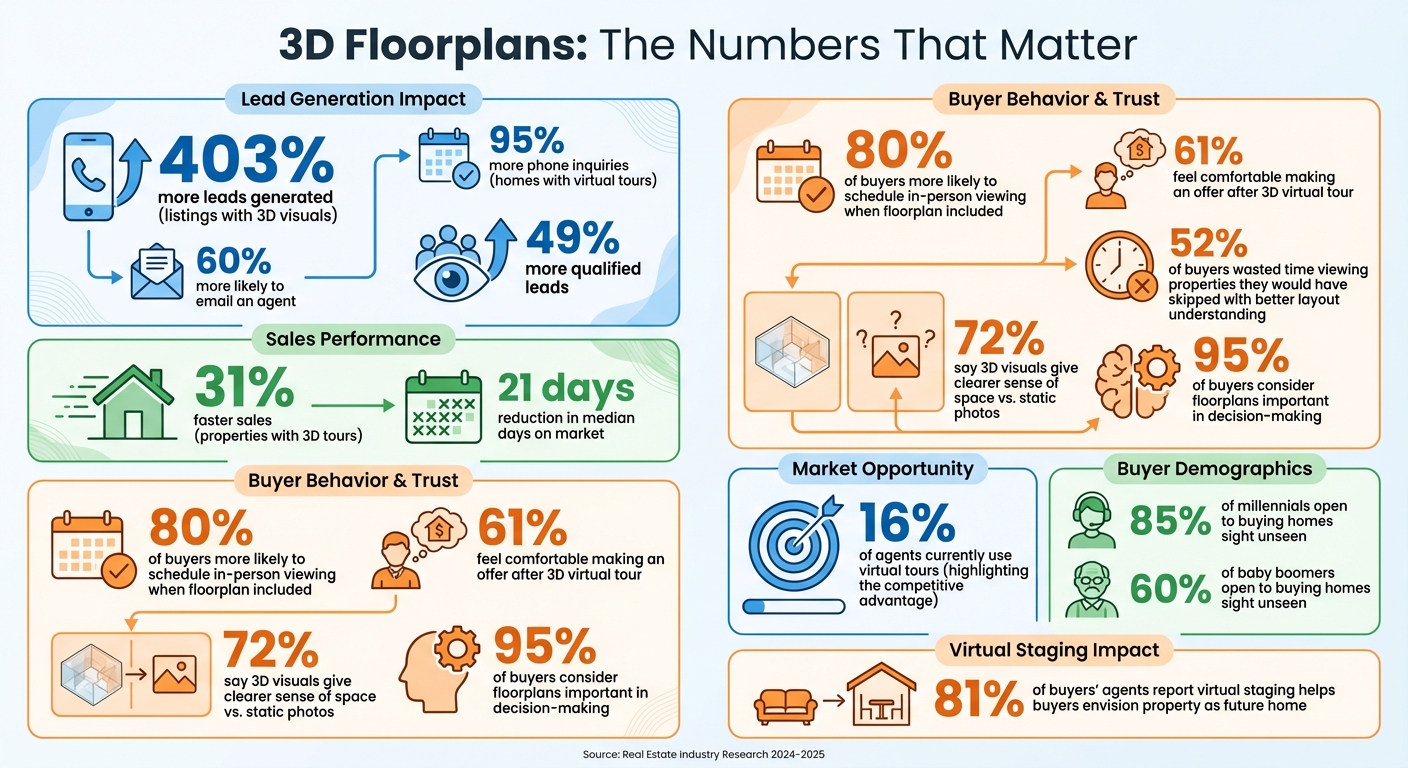
3D Floorplan Statistics: Lead Generation and Sales Impact in Real Estate
How 3D Floorplans Generate More Leads
Better Visual Clarity for Buyers
While traditional 2D floorplans provide measurements, they often fall short in showing how spaces truly connect. In contrast, 3D floorplans add depth, perspective, and height, offering buyers a way to see properties from different angles and understand how rooms flow together. This is especially important when you consider that 52% of home buyers admit they’ve wasted time viewing properties they would have skipped if they had understood the layout better. Additionally, 72% of buyers say 3D visuals give them a clearer sense of space compared to static photos.
With 3D floorplans, buyers can picture their lives in the home more easily. These layouts act like a "blank canvas", allowing potential buyers to imagine their furniture in the space and envision their daily routines. Features like photorealistic textures, lighting, and furnishings help define the scale and fit of rooms, creating a sense of realism that 2D sketches simply can’t match. This level of detail not only informs buyers but also helps your listing stand out in a crowded market by fostering a stronger emotional connection.
Stand Out in Competitive Markets
In a competitive real estate market, 3D visuals grab attention immediately. Listings featuring 3D tours receive 95% more phone inquiries and 65% more email inquiries than those without. The unique dollhouse view offered by 3D tours lets buyers explore how rooms and levels connect in ways that traditional photos just can’t show.
Here’s the kicker: only 16% of real estate agents currently use virtual tours, despite high demand from buyers. This gap creates a golden opportunity to set your listings apart. For instance, between March 2024 and March 2025, Jay Hudson Homes at Keller Williams used 3D tours to breathe new life into expired listings that had previously attracted little interest. By adding immersive 3D walkthroughs and professional floorplans, they saw immediate results – more engagement, quicker sales, and fewer unnecessary in-person showings. Properties with 3D virtual tours generate 49% more qualified leads and sell 31% faster than those without. Beyond just standing out, these tools build transparency, which boosts buyer confidence.
Build Trust with Accurate Property Details
When buyers can access precise, complete layouts, it builds trust. Being able to see the full property – including what’s behind walls or why certain spaces aren’t highlighted – helps buyers feel confident that nothing is being hidden. In fact, 80% of buyers are more likely to schedule an in-person viewing when a listing includes a floorplan, and 61% feel comfortable making an offer after experiencing a 3D virtual tour.
This level of transparency also helps weed out casual browsers. With detailed 3D floorplans, buyers understand the layout before scheduling a showing. As one Realtor.com professional put it:
When we schedule a showing, you’ll know that the people coming into your home are ‘pre‑qualified’ and excited. You’re not just another house on their list.
Interactive features, like real-time measurements, let buyers check room dimensions and ceiling heights without needing a tape measure. This added confidence leads to higher-quality leads and faster conversions, all thanks to the clarity and detail provided by 3D visuals.
Floor Plans | How To Create INCREDIBLE 2d And 3d FLOORPLANS | Real Estate Marketing
How to Design 3D Floorplans That Convert
3D floorplans are more than just a visual tool – they’re a way to build trust and encourage potential buyers to take action. When thoughtfully designed, they can captivate buyers, helping them feel confident in their decisions while boosting lead generation. Here’s how to make your 3D floorplans work harder for you.
Use Accurate Measurements and Layouts
Precision is key when creating a 3D floorplan. Buyers rely on exact measurements to determine whether a property fits their needs, from ensuring their couch will fit in the living room to understanding the overall layout. Avoid guesswork – include total square footage, room dimensions, and permanent features like kitchen islands, sinks, and bathtubs. These details help buyers visualize the space and its functionality right away.
To ensure accuracy, consider tools like iGUIDE‘s PLANIX, which offers measurements with a margin of error as low as 0.5%. Accurate floorplans don’t just save time; they help convert casual browsers into serious leads by allowing buyers to assess the property’s suitability before scheduling a showing.
Add Photorealistic Textures and Furnishings
While a basic floorplan outlines the structure, adding photorealistic textures and furnishings transforms it into a powerful visualization tool. High-quality finishes – like realistic flooring, countertops, and wall textures – combined with virtual furniture help buyers imagine their daily lives in the space. This approach is especially impactful for vacant homes or new builds, where staging can otherwise be a challenge.
Virtual staging has proven benefits, with 81% of buyers’ agents reporting that it helps buyers see a property as their future home. Adjust lighting, add cozy backgrounds, and create an inviting atmosphere to make the floorplan feel like more than just a diagram – it becomes a digital representation of a lifestyle.
Showcase Key Property Features
Highlighting unique aspects of a property can make all the difference. A dollhouse view, for example, can showcase how open-concept spaces flow together or how multiple levels connect seamlessly. Don’t forget to include outdoor areas like patios, balconies, and backyards to give buyers a complete picture of the property.
Interactive tags are another great addition. Use them to draw attention to upgrades like energy-efficient appliances, smart home features, or custom built-ins. For properties that might need updating, focus on showcasing their potential – like solid layouts or spacious rooms – rather than outdated finishes. With 95% of buyers considering floorplans an important part of their decision-making process, emphasizing these standout features is crucial.
Include Interactive and Aerial Views
Static images are fine, but interactive elements can take engagement to the next level. A dollhouse view provides a 3D cross-section of the entire property, helping buyers see how rooms and levels connect in ways that traditional photos simply can’t. Add 360-degree navigation to allow viewers to "walk" through the home at their own pace, exploring every corner.
Interactive 3D floorplans can generate up to 300% more engagement than standard photos. Features like clickable zones, where buyers can toggle between staged and empty views, provide flexibility for them to see both the property’s styled potential and a blank canvas for their own ideas. These elements not only make the experience more engaging but also help buyers feel more connected to the property, leading to faster, more qualified leads.
sbb-itb-e3e39b4
Tools and Services for Creating 3D Floorplans
Once you’ve honed your skills in converting floorplans, the next step is picking the right tools or services to bring your designs to life.
Producing high-quality 3D floorplans often demands expertise and advanced software that many in-house teams may not have. Instead of pouring resources into expensive tools and training, partnering with a specialized service can save time and money while delivering top-notch results. Property Render offers two tailored plans to fit different marketing goals and property types.
Your choice between these plans often depends on the property’s value and the audience you’re trying to reach. For instance, photorealistic renders are typically reserved for properties valued above $500,000 or those with standout architectural features, while simpler solutions are ideal for high-volume listings.
The creation process generally involves five steps: briefing, 3D modeling, texturing and furnishing, client revisions, and final rendering. To get started, you’ll need to provide assets like 2D sketches, CAD files, blueprints, or Matterport scan links. The team then uses your input to build and refine the model to your satisfaction.
Property Render Standard Renders Plan

The Standard Renders Plan is designed for professionals who need clear, precise 3D floorplans for approvals and basic marketing. It offers essential visualizations, including interior and exterior renders, floor plans, and site plans, without the added cost of photorealistic detailing. This plan is a great fit for high-volume listings and rental properties where the focus is on showcasing layouts and dimensions effectively.
Property Render Premium Renders Plan
The Premium Renders Plan takes things up a notch with photorealistic 3D floorplans tailored for marketing and sales. This plan includes advanced features like virtual walkthroughs, aerial views, streetscape renders, and detailed interior staging. These elements help potential buyers form an emotional connection with a property even before stepping foot inside.
Premium renders are particularly suited for luxury homes, off-plan developments, and properties with unique architectural designs. For listings where first impressions matter most, this level of detail can turn a casual browser into a serious buyer.
How to Use 3D Floorplans in Your Marketing
Creating stunning 3D floorplans is just the first step; the real magic happens when you strategically share them across your marketing channels to turn casual browsers into serious leads.
Add 3D Floorplans to Online Listings and Social Media
Make sure your 3D floorplans are visible wherever potential buyers are searching. Embed them on your agency’s website, property-specific landing pages, and popular real estate platforms like Homes.com, Apartments.com, and Realtor.com. With 76% of homebuyers using mobile devices to browse listings, it’s crucial that your 3D content is optimized for smartphones and tablets. The "dollhouse view" feature of 3D floorplans offers buyers a clear, comprehensive look at the entire property layout.
Social media is another powerful tool for showcasing your 3D floorplans. Create short, engaging video walkthroughs or interactive clips tailored for platforms like Instagram, TikTok, and Facebook. To boost interaction, use features like Instagram Stories polls or Q&A sessions alongside your 3D content. You can also link the digital and physical worlds by adding QR codes to yard signs, flyers, and brochures, directing potential buyers to your interactive 3D floorplans.
Beyond these platforms, consider weaving 3D floorplans into your direct communication strategies to expand your reach even further.
Use 3D Floorplans in Email Campaigns and Virtual Tours
While online listings grab attention, email campaigns help you nurture leads and stay connected with potential buyers. Include links to 3D tours in "Just Listed" emails or monthly "Featured Listings" newsletters to encourage referrals and repeat visits. You can also use gated content, like the 3D dollhouse view or measurement tools, to collect contact information via a simple email sign-up. Automate follow-up campaigns to target leads who engage with specific property tours.
Virtual open houses are another effective way to leverage 3D floorplans. Host live events where you can answer questions in real time while buyers explore the 3D model on their own devices. Afterward, send a follow-up email within 24 hours, thanking attendees and providing a link to an on-demand 3D tour for further review. To save time and focus on serious buyers, you can even require prospects to view the interactive tour before scheduling an in-person showing.
Track Performance Metrics to Improve Results
Keep a close eye on your performance metrics to refine your strategy. Track engagement data like total views, dwell time, and feature clicks, alongside conversion metrics such as email and phone inquiries. Listings with 3D showcases make buyers 60% more likely to email an agent and 95% more likely to call. Additionally, monitor your "lead-to-showing ratio" to ensure the 3D tours are effectively pre-qualifying buyers.
Other metrics to consider include days on market. Properties with high-quality visuals and 3D tours tend to sell up to 31% faster, with virtual tours reducing the median days on market by as many as 21 days. Calculate your cost per lead by dividing your total campaign investment by the number of leads generated. Use A/B testing to compare the performance of listings with and without 3D floorplans, analyzing differences in click-through rates and inquiry volume. If you notice viewers consistently leaving the tour at a specific spot, it might be time to re-stage that area or improve the lighting in future scans. These insights will help you fine-tune your marketing efforts and maximize the impact of your 3D floorplans.
Conclusion
3D floorplans have become a game-changer for real estate professionals looking to attract serious buyers and close deals more efficiently. Listings featuring 3D content generate four times more quality leads, with buyers being 60% more likely to email and 95% more likely to call compared to traditional listings. These tools allow buyers to visualize the property layout before scheduling a showing, effectively pre-qualifying them and saving valuable time. Notably, homes with 3D tours sell 31% faster and achieve 300% higher viewer engagement.
In a market where 85% of millennials and 60% of baby boomers are open to buying homes sight unseen, immersive 3D presentations have become a critical tool for staying competitive.
"I’m going to use the best technology in the marketplace to present your home – and people want to hear that. They want to hear what you are doing differently."
– Matt Grander, Owner, Grander and Associates
For professionals ready to take advantage of these benefits, Property Render offers Standard and Premium Renders Plans, providing photorealistic 3D floorplan solutions tailored to any property type. Whether you’re marketing off-plan developments or existing homes, these visualizations not only help you stand out in a crowded market but also position your brand as modern and forward-thinking.
Take the leap with 3D floorplans to engage qualified buyers, shorten time on the market, and close deals faster.
FAQs
How do 3D floorplans make property listings more engaging for buyers?
3D floorplans bring property listings to life with realistic, immersive visuals that let buyers grasp the layout and flow of a space at a glance. Unlike static, traditional methods, these detailed models help buyers imagine how they might use the property, making it easier to see themselves living there.
This clarity does more than just grab attention – it boosts buyer confidence, sparking greater interest and speeding up decision-making. By presenting spaces in a visually engaging and easy-to-understand format, 3D floorplans elevate the entire property viewing experience.
What makes a 3D floorplan effective for generating more leads in real estate?
Creating a standout 3D floorplan involves more than just visual appeal – it needs to feel like a true representation of the property. A well-designed floorplan should be highly detailed and visually rich, giving potential buyers a clear picture of the space. Adding realistic touches like natural lighting, lifelike textures, and thoughtfully chosen backgrounds can make the property feel warm and inviting, sparking genuine interest.
Interactivity takes things to the next level. Features such as virtual walkthroughs, clickable areas for zoomed-in views, and the option to explore various rooms or floors transform the experience into something immersive. These tools help buyers emotionally connect with the property, making it easier for them to imagine living there – and that connection often leads to more inquiries.
Don’t overlook the basics, though. Including clear room labels, precise measurements, and a logical flow ensures buyers can easily grasp the layout and size of the property. These practical details make it simpler for them to assess whether the space aligns with their needs. When you combine visual appeal, interactivity, and essential details, a 3D floorplan becomes a compelling way to attract and engage potential buyers.
How do 3D floorplans give real estate listings a competitive edge?
3D floorplans give real estate listings a strong advantage by providing visually rich and detailed views of a property. These designs allow potential buyers to grasp the layout, size, and flow of a space more effectively, helping them imagine how it could fit their lifestyle.
By drawing in buyers and making their decision process easier, 3D floorplans can increase interest in a property, leading to more inquiries and better chances of closing a deal. They align perfectly with today’s demand for clear and interactive visuals, helping properties shine in a competitive market.


