


In 2026, 3D architectural rendering is a must-have for real estate and design industries. Costs vary significantly based on project type, complexity, and location. Here’s a quick breakdown:
- Interior Renders: $150–$3,000 per image
- Exterior Renders: $300–$10,000 per image
- Aerial Views: $450–$5,000+ per image
- Animations: $3,000–$20,000 per minute
Factors influencing costs include project complexity, artist experience, software used, and revision requests. Regional pricing also plays a role, with North America and the UAE charging premium rates ($600–$2,500 per render), while Asia offers budget-friendly options ($150–$700 per render).
To save on costs, plan ahead, limit revisions, and consider outsourcing to lower-cost regions like Eastern Europe or Asia. For high-quality results, choose the right provider and provide clear project details upfront.
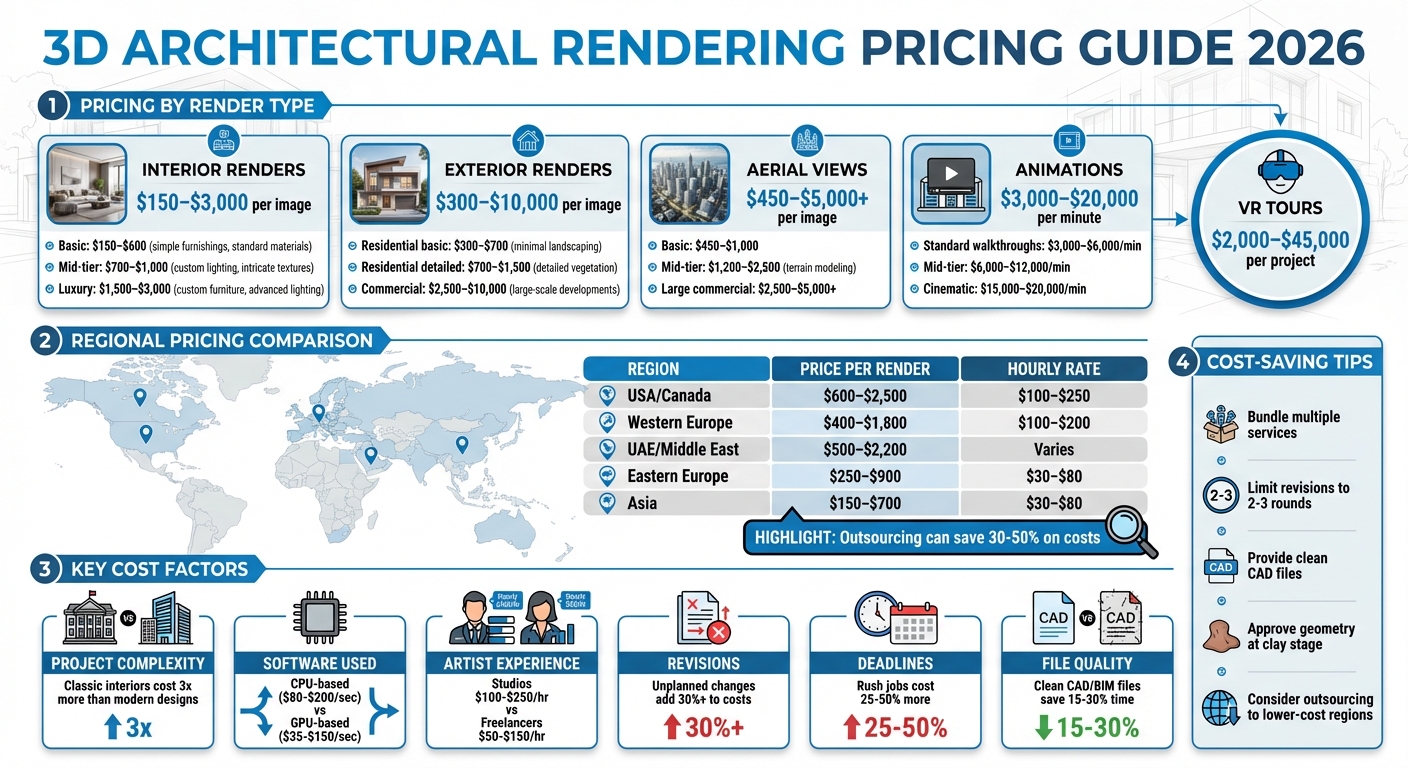
3D Architectural Rendering Costs by Type and Region in 2026
3D Rendering Services Prices Over the World | How much does 3D Rendering Cost | 3D Rendering Cost
sbb-itb-e3e39b4
What Affects 3D Rendering Costs
Understanding what drives the cost of a 3D render can help you budget effectively. The final price depends on several factors, including the complexity of the project, the tools used, and the experience of the artist. These elements explain the pricing ranges for interior, exterior, and animation renders mentioned earlier. Let’s break these down further, starting with project complexity.
Project Complexity and Detail Requirements
The scale and style of your project can have a bigger impact on costs than you might expect. For instance, a 5,000 sq. ft. classic interior design could cost up to three times more than a modern interior of the same size. Why? Classic styles often demand intricate details and longer development times. Similarly, the size of the project plays a role: while rendering a single-family home might cost $250–$700, larger projects like airports or skyscrapers can range from $1,500 to over $6,000. Custom elements, such as bespoke furniture models, can also add significant labor hours.
Exterior renders bring their own challenges. Features like dense landscaping, custom vegetation, or detailed city blocks can quickly increase costs. On the other hand, providing clean BIM or CAD files can save time – cutting modeling time by 15% to 30% – and reduce your overall bill.
Software and Tools
The tools and software used for rendering significantly influence both speed and cost. For example, CPU-based engines like V-Ray and Corona are known for their stunning photorealistic results, but they are slower and typically cost between $80 and $200 per second for animations. GPU-based tools like Lumion, D5, and Twinmotion, on the other hand, offer faster rendering at a lower price, usually around $35–$150 per second.
For projects involving virtual reality (VR) or augmented reality (AR), real-time game engines like Unreal Engine and Unity are essential. These require optimized textures and interactive features, which can push project costs anywhere from $2,000 to $45,000, depending on the complexity.
Output resolution is another factor to consider. While 4K is now the standard for high-quality marketing materials, 8K renders – used for large-scale displays like billboards – demand more resources and increase costs. Tight deadlines can also inflate expenses by 25% to 50%, as studios need to allocate extra rendering resources and staff.
Artist Experience and Revision Requests
The skill and experience of the artist play a critical role in determining costs. Professional studios often charge $100–$250 per hour, while freelancers typically range from $50 to $150 per hour. Although experienced artists may charge more, their efficiency and ability to avoid errors can save you both time and money in the long run. Alex Smith, Manager & Co-Owner of Render 3D Quick, explains:
"Experience matters – skilled artists work faster and produce fewer errors, which saves you money."
Most studios include 2–3 rounds of minor revisions, such as color adjustments or material changes, in their base pricing. However, larger changes – like altering a room layout or modifying architectural geometry – require significant re-rendering and are billed separately. Unplanned revisions can add 30% or more to your total cost. To keep costs in check, consolidate all feedback into a single document before submitting it to the studio. Additionally, approving geometry and camera angles during the "clay stage" can help avoid expensive changes later.
Pricing by Render Type
The type of render you choose directly impacts your budget. A straightforward interior view is far more affordable than a high-end cinematic aerial animation. Knowing these pricing tiers can help you allocate your resources wisely for marketing and sales purposes.
Interior Renders
Interior renders typically cost between $150 and $3,000 per image, depending on the level of detail and complexity.
- Basic interiors: These start around $150–$600 and work well for early design approvals, featuring simple furnishings and standard materials.
- Mid-tier interiors: Priced between $700 and $1,000, these include custom lighting, intricate textures, and branded decor.
- Luxury interiors: High-end spaces with custom furniture and advanced lighting design can range from $1,500 to $3,000.
MacKenzie Brown, CEO of Cad Crowd, highlights:
"The average price for high-quality rendering is between US$1,000 and US$2,000 for small and medium projects."
Most packages include two rounds of minor revisions, allowing for adjustments like color or material changes. Moving on, exterior renders come with their own unique pricing dynamics.
Exterior Renders
Exterior renders range from $300 to over $10,000 per image, with costs influenced by landscaping complexity and additional elements.
- Residential exteriors: Basic designs with minimal landscaping cost $300–$700. Adding detailed vegetation and street elements increases the price to $700–$1,500.
- Commercial exteriors: For large-scale developments, which may include vehicles, crowds, and intricate lighting, prices can exceed $2,500 and go up to $10,000.
Dense landscaping, custom plants, and detailed surroundings significantly increase both modeling time and costs. For luxury real estate marketing, high-end renders typically fall between $2,000 and $6,000 per image. If you’re on a tight deadline (under 48–72 hours), expect to pay an extra 25% to 50% on top of the base price.
Aerial Views and Site Plans
Aerial renders are priced between $450 and $5,000 or more, depending on the complexity of the terrain and the project’s scale.
- Basic aerial views: These start at $450–$1,000.
- Mid-tier projects: Requiring terrain modeling or drone-photo matching, these cost between $1,200 and $2,500.
- Large commercial developments: With extensive site context, prices can exceed $2,500 and approach $5,000.
Site plans and 3D floor plans are a more budget-friendly option, ranging from $300 to $1,500. Residential site plans typically cost $300–$650, while detailed commercial site plans with landscaping and parking layouts fall between $600 and $1,500.
Animations and Virtual Walkthroughs
Animations are priced differently from static images, with costs ranging from $3,000 to $20,000 per minute.
- Standard walkthroughs: Around $3,000–$6,000 per minute.
- Mid-tier productions: Between $6,000 and $12,000 per minute.
- Cinematic animations: High-detail productions can exceed $15,000–$20,000 per minute.
Some studios charge by the second, with rates varying from $50 to $250 depending on the complexity. Gülsevin Koçak from ArchiVinci explains:
"3D architectural animations start around $4,000 per minute and can exceed $12,000 per minute for cinematic, high-detail productions."
Virtual reality (VR) tours have an even broader price range, from $2,000 to $45,000 per project. Interactive VR tours, which use real-time engines and custom interfaces, tend to drive costs higher. Alex Smith, Manager & Co-Owner of Render 3D Quick, emphasizes:
"A single frame might take minutes. A 30-second video is hundreds of frames. It adds up fast."
Since a 30-second animation involves hundreds of frames, even small time differences per frame can significantly affect the overall cost.
To manage animation expenses, consider reusing existing 3D models, determine your resolution requirements early (standard HD is much cheaper than 4K), and finalize camera paths during storyboarding to avoid costly re-renders.
Regional Pricing Differences
Where a studio is located plays a big role in determining rendering costs. For instance, a high-end interior render might set you back about $2,000 in New York, while the same render could cost just $400 in Vietnam. These price gaps reflect differences in local labor costs, operational expenses, market demands, and project timelines.
Cost Comparison Across Regions
Hourly rates for 3D rendering vary widely depending on geography. Studios in North America, the UK, and Australia generally charge between $100 and $250 per hour, whereas professionals in Eastern Europe and Asia often charge between $30 and $80 per hour. Globally, more than 80% of visualization studios price their work between $500 and $1,500 per image.
| Region | Average Price Per Render | Hourly Rate | Regional Trends |
|---|---|---|---|
| USA / Canada | $600 – $2,500 | $100 – $250 | High-end quality, strong commercial demand, quick turnaround |
| Western Europe | $400 – $1,800 | $100 – $200 | Competitive markets with a rich architectural focus |
| UAE / Middle East | $500 – $2,200 | Varies | Luxury visuals in demand, fast delivery expectations |
| Eastern Europe | $250 – $900 | $30 – $80 | Skilled labor, emerging as a high-quality alternative |
| Asia (India, Vietnam) | $150 – $700 | $30 – $80 | Budget-friendly, great for bulk work, quality varies |
Danielle Lane from Freedes Studio highlights:
"Asia remains the most affordable region, while the US and UAE lead in high-end visualization pricing".
These price differences make outsourcing an attractive option for businesses looking to save on costs.
Outsourcing Options
Outsourcing rendering projects to lower-cost regions can reduce your budget by 30% to 50% without compromising quality [2,10]. Eastern Europe and Asia have become popular destinations for bulk rendering tasks, with many studios producing photorealistic results that rival those from Western studios. A rising trend in 2026 is the hybrid approach: clients rely on local studios for creative direction while outsourcing high-volume production to offshore teams.
Time zone differences are an important factor to consider when outsourcing. Ensure your chosen studio has overlapping work hours with your schedule [4,6]. As Rapid Renders puts it:
"A skilled, efficient team can deliver breathtaking photo-realistic results no matter where they’re based".
For early-stage concept renders, studios in Asia or Eastern Europe often provide excellent value [2,10]. Save premium Western studios for final marketing materials, where seamless communication and local expertise justify the higher costs.
Property Render Pricing Tiers
Property Render offers two pricing tiers designed to meet diverse project requirements and budgets. Whether you’re crafting initial marketing materials or preparing for investor presentations, these options allow you to align your expenses with your goals.
Standard Renders
Standard renders are priced between $550 and $1,500 per image, delivering detailed textures, professional lighting, and polished post-processing. These are well-suited for most marketing materials and client presentations. For simpler needs, basic concept renders are available at $150 to $450 per image, making them a great choice for preliminary reviews. Standard packages usually include two to three rounds of revisions, with turnaround times for still images ranging from three to seven business days. If your project demands advanced detail and photorealism, the Premium tier might be a better fit.
Premium Renders
Premium renders, starting at $2,000 per image, are designed for projects requiring top-tier photorealism. These visuals are perfect for high-impact marketing campaigns, gaining project approvals, or presenting luxury developments to investors. Danielle Lane highlights this distinction:
"Premium realism is the biggest factor separating affordable 3D rendering from high-end visualization studios."
This tier also includes complex aerial views (priced between $800 and $5,000, depending on scope) and cinematic virtual walkthroughs (typically costing $3,000 to $15,000+ for a 60-second video). These premium visuals feature advanced details, such as physically based materials and precise global illumination, and require one to three weeks to complete due to their complexity.
The premium tier is ideal when you need a few standout hero images to anchor your campaign rather than a high volume of standard renders. Property Render excels at creating compelling visual stories for undeveloped spaces, supporting property developers and project marketers in over 15 countries.
How to Reduce 3D Rendering Costs
Careful planning can significantly cut down 3D rendering expenses. By addressing common cost drivers like excessive revisions, rushed timelines, and unclear project outlines, you can manage your budget effectively while still achieving high-quality results.
Bundle Multiple Services
Combining multiple rendering services into one order often costs less than requesting them separately. Studios can save time by reusing 3D assets, lighting setups, and camera configurations across various views. For example, bundling exterior stills with an aerial view of the same building eliminates redundant modeling, while capturing multiple 360° panoramas in the same room allows the reuse of existing lighting and materials, which lowers the per-image cost.
Some providers offer package deals that include features like daytime and nighttime variants or short animated flythroughs for a single bundled price. For developers or agencies with recurring needs, signing a monthly retainer agreement can reduce the average cost per image and ensure smoother scheduling.
Limit Revision Requests
Most rendering packages include one or two rounds of revisions, but exceeding this limit often incurs extra charges – sometimes increasing costs by as much as 30%. To avoid this, provide clear and detailed inputs at the start. Share high-quality CAD files, 3–5 reference images that reflect the desired mood, and a finalized materials list.
During the "clay stage" (before textures are applied), approve the geometry and camera angles to avoid costly late-stage changes. Consolidate all internal feedback into a single, organized list instead of sending multiple requests piecemeal. This approach keeps the project within the initial revision scope and ensures steady progress. For instance, in 2025, an infill builder in East Vancouver streamlined the process for a duplex project by submitting CAD files and landscape plans upfront. They limited revisions to a single round (adjusting siding color and replacing a tree) and completed the project in six business days for $1,197. The units received their first offer within a week.
Select the Right Provider
Choosing the right provider can save both time and money. A slightly higher-priced studio that handles changes efficiently may prevent costly delays and rework. Look for a provider whose portfolio aligns with your architectural style. Responsiveness during initial inquiries – such as promptly answering questions – is another good indicator of reliability.
Ask for a detailed cost breakdown that separates charges for modeling, texturing, lighting, and post-production instead of accepting a single lump sum. Building a long-term relationship with a studio can lead to better rates, priority scheduling, and a consistent visual style across all your projects.
For example, Property Render offers both Standard and Premium pricing tiers, allowing you to choose an option that fits your budget while maintaining professional-grade quality.
Conclusion
Getting a handle on 3D architectural rendering costs in 2026 requires a closer look at the factors that influence pricing. Elements like the complexity of the project, regional labor costs, and the readiness of your files can mean spending anywhere from $199 to $5,000 for a single rendering. For high-end commercial projects, especially those involving animations or immersive experiences, costs can easily climb beyond $5,000.
Planning your budget effectively starts with proper preparation. For instance, clean CAD or BIM files can speed up production by 15% to 30%, saving both time and money. Additionally, consolidating feedback into a single revision round can help you avoid unnecessary expenses. As Abdullah Al Baki from 7cgi aptly puts it:
"The cost of architectural visualization may not be the price, but rather the finished product and your ‘hassle-free’ time".
FAQs
What are some effective ways to lower the cost of 3D architectural rendering services?
To keep the cost of 3D architectural rendering in check, focus on simplifying your project. This might mean reducing unnecessary details or avoiding overly complex lighting setups. Stick to the resolution and level of detail that’s genuinely essential for your needs – nothing more, nothing less. If you can afford to wait, allowing for a longer delivery timeline can also save you money, as studios often charge extra for rush jobs.
Another tip? Limit the number of revision rounds. The more changes you request, the higher the fees can climb. Choose a reliable studio that offers a good balance between quality and affordability. And most importantly, clearly communicate your requirements from the start to avoid misunderstandings or costly adjustments down the line.
What factors determine the cost of 3D architectural rendering?
The price of 3D architectural rendering varies based on a few important factors. These include the level of detail and complexity involved – think intricate textures, lifelike lighting, or advanced modeling – the type of render you’re looking for, such as interior, exterior, aerial views, or animations, and the timeline and revisions required. On top of that, the experience and tools of the rendering studio play a big role in determining the cost.
For instance, a straightforward interior render will generally cost less than a detailed aerial view or an animation. Being aware of these elements can help you allocate your budget wisely and get the visualizations that best suit your project.
Why do 3D rendering costs vary so much between regions?
3D rendering costs can vary significantly across the globe, influenced by factors like labor rates, expertise, and the cost of living. For instance, countries in Eastern Europe or Southeast Asia, where living expenses are generally lower, often provide more budget-friendly options. On the other hand, regions with higher living costs, such as the United States or the Nordics, typically charge more, especially for premium services.
Local market conditions also play a role. In areas where demand for 3D rendering is high and competition is stiff, prices may reflect the value of specialized skills and access to cutting-edge tools.


